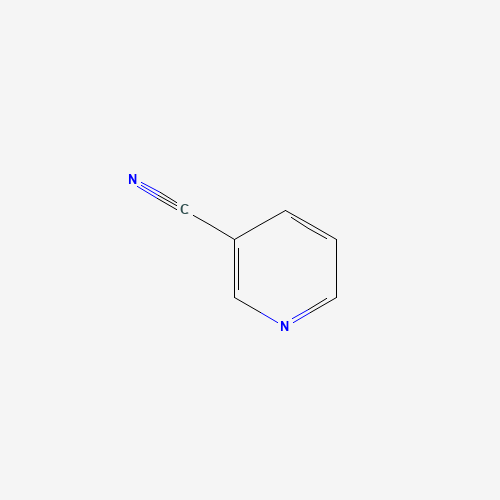
Adverse Effects:
Occupational hepatotoxin - Secondary hepatotoxins: the potential for toxic effect in the occupational setting is based on cases of poisoning by human ingestion or animal experimentation.
Hazards Summary:
A skin, eye, and mucous membrane irritant; Emergency treatment: Pyridine; Pyridine is an irritant that causes CNS depression after ingestion of 1/2 cup or inhalation of 6-12 ppm; It can cause liver and kidney injury; Causes respiratory depression and liver changes in lethal-dose studies of rats; [RTECS] An irritant; Harmful if swallowed; [Alfa Aesar MSDS] See m-Phthalodinitrile.
Disposal Methods:
SRP: At the time of review, criteria for land treatment or burial (sanitary landfill) disposal practices are subject to significant revision. Prior to implementing land disposal of waste residue (including waste sludge), consult with environmental regulatory agencies for guidance on acceptable disposal practices.
Ecotoxicity Values:
USDA APHIS Chemical Effects: collection=usda_chemeffect&query_type=synonym&query='^100-54-9$'
Environmental Fate:
ATMOSPHERIC FATE: According to a model of gas/particle partitioning of semivolatile organic compounds in the atmosphere(1), 3-pyridinecarbonitrile, which has a vapor pressure of 0.296 mm Hg at 25 °C(2), is expected to exist solely as a vapor in the ambient atmosphere(SRC). Vapor-phase 3-pyridinecarbonitrile is degraded in the atmosphere by reaction with photochemically-produced hydroxyl radicals(SRC); the half-life for this reaction in air is estimated to be 246 days(SRC), calculated from its rate constant of 6.53X10⁻¹⁴ cu cm/molecule-sec at 25 °C(SRC) determined using a structure estimation method(3).
Preventive Measures:
SRP: The scientific literature for the use of contact lenses in industry is conflicting. The benefit or detrimental effects of wearing contact lenses depend not only upon the substance, but also on factors including the form of the substance, characteristics and duration of the exposure, the uses of other eye protection equipment, and the hygiene of the lenses. However, there may be individual substances whose irritating or corrosive properties are such that the wearing of contact lenses would be harmful to the eye. In those specific cases, contact lenses should not be worn. In any event, the usual eye protection equipment should be worn even when contact lenses are in place.
Regulatory Information:
New Zealand EPA Inventory of Chemical Status: 3-Pyridinecarbonitrile: Does not have an individual approval but may be used under an appropriate group standard
Soil Adsorption/Mobility:
The Koc of 3-pyridinecarbonitrile is estimated as 37(SRC), using a measured log Kow of 0.36(1) and a regression-derived equation(2). According to a classification scheme(3), this estimated Koc value suggests that 3-pyridinecarbonitrile is expected to have very high mobility in soil(SRC).
Artificial Pollution Sources:
3-Pyridinecarbonitrile's production and use in organic synthesis(1) may result in its release to the environment through various waste streams(SRC).
Environmental Biodegradation:
ANAEROBIC: The maximum pseudo-first-order rate constant and half-life for 3-pyridinecarbonitrile in an anoxic sediment slurry from the estuary of the Tansui River (Guandu, Taipei) were 9.41 per day and 1.7 hrs, respectively(1). 3-Pyridinecarbonitrile was not transformed in the sterile control sediment slurry(1) which suggests that 3-pyridinecarbonitrile may degrade in the environment at least under anaerobic conditions(SRC).
Hazard Classes and Categories:
Specific target organ toxicity - Repeated exposure - Category 2 (blood system, testis)
Environmental Bioconcentration:
An estimated BCF of 3 was calculated for 3-pyridinecarbonitrile(SRC), using a log Kow of 0.36(1) and a regression-derived equation(2). According to a classification scheme(3), this BCF suggests the potential for bioconcentration in aquatic organisms is low(SRC).
Volatilization from Water/Soil:
The Henry's Law constant for 3-pyridinecarbonitrile is 2.74X10⁻⁷ atm-cu m/mole(1). This Henry's Law constant indicates that 3-pyridinecarbonitrile is not expected to volatilize from water and moist soil surfaces(2). 3-Pyridinecarbonitrile is not expected to volatilize from dry soil surfaces(SRC) based upon a vapor pressure of 0.296 mm Hg(3).
Environmental Abiotic Degradation:
The rate constant for the vapor-phase reaction of 3-pyridinecarbonitrile with photochemically-produced hydroxyl radicals has been estimated as 6.53X10⁻¹⁴ cu cm/molecule-sec at 25 °C(SRC) using a structure estimation method(1). This corresponds to an atmospheric half-life of about 246 days at an atmospheric concn of 5X10+5 hydroxyl radicals per cu cm(1). 3-Pyridinecarbonitrile is expected to undergo slow hydrolysis in the environment based upon the slow hydrolysis of other aromatic nitriles, eg, benzonitrile(2). 3-Pyridinecarbonitrile is also not expected to directly photolyze due to the lack of absorption in the environmental UV spectrum (>290 nm)(SRC).
Probable Routes of Human Exposure:
Occupational exposure to 3-pyridinecarbonitrile may occur through inhalation and dermal contact with this compound at workplaces where 3-pyridinecarbonitrile is produced or used. (SRC)
Environmental Fate/Exposure Summary:
3-Pyridinecarbonitrile's production and use in organic synthesis may result in its release to the environment through various waste streams. If released to air, a vapor pressure of 0.296 mm Hg at 25 °C indicates 3-pyridinecarbonitrile will exist solely as a vapor in the ambient atmosphere. Vapor-phase 3-pyridinecarbonitrile will be degraded in the atmosphere by reaction with photochemically-produced hydroxyl radicals; the half-life for this reaction in air is estimated to be 246 days. If released to soil, 3-pyridinecarbonitrile is expected to have very high mobility based upon an estimated Koc of 37. Volatilization from moist soil surfaces is not expected to be an important fate process based upon a Henry's Law constant of 2.74X10⁻⁷ atm-cu m/mole. If released into water, 3-pyridinecarbo...
Personal Protective Equipment (PPE):
Depending on the extent of possible contact, workers should be provided with personal protective equipment. A charcoal gas mask canister respirator has been found to be effective against a 2% pyridine concentration at 30 l/min for 1 hr. Rubber and plastic gloves should not be relied upon to prevent skin contact because pyridine and many of its derivatives penetrate these materials ... . /Pyridine, homologs, and derivatives/
Skin, Eye, and Respiratory Irritations:
Pyridine and its derivatives cause local irritation on contact with the skin, mucous membranes and cornea. /Pyridine and its derivatives/
EPA Provisional Peer-Reviewed Toxicity Values:
PPRTV Assessment: PDF Document