
β-Hydroxypropiovanillone, a natural compound, shows significant concentration-dependent inhibitory effects on α-glucosidase with an IC 50 of 257.8 μg/mL In Vitro β-hydroxypropiovanillone and its analogs can be obtained by chemoselective catalytic oxidation of lignin using 2,3-dichloro-5,6-dicyano-1,4-benzoquinone/tert-butyl nitrite/O 2 , followed by cleavage of arylglycerol-β-aryl ether with zinc. In SYK-6 cells, β-hydroxypropiovanillone (HPV) is oxidized to vanilloyl acetic acid (VAA) via vanilloyl acetaldehyde (VAL). The resulting VAA was further converted into vanillate through the activation of VAA by coenzyme A. MCE has not independently confirmed the accuracy of these methods. They are for reference only. Form:Solid IC50& Target:IC50: 257.8 μg/mL (α-glucosidase)
All
Chemical Reagents
Biomedicine
Organic raw materials
Inorganic chemical industry
intermediate
Agricultural chemicals
Auxiliaries and catalysts
Fragrances and Flavors
Dyes and Pigments
Daily chemical industry
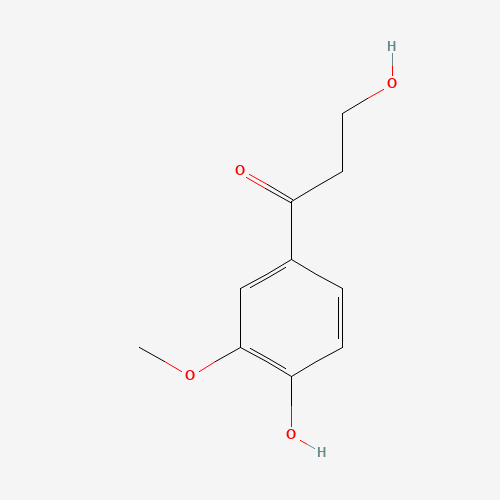
β-Hydroxypropiovanillone
CAS number:2196-18-1 molecular formula:C10H12O4
overview
compound introduction
Specs
| Chinese alias | β-羟基丙香草酮 | ||
| English alias | Q27283375 | beta-Hydroxypropiovanillone | 4-HYDROXYPROPIOGUAIACONE | CAA19618 | AKOS022645250 | 1-Propanone, 3-hydroxy-1-(4-hydroxy-3-methoxyphenyl)- | M22UI268J1 | -Hydroxypropiovanillone; -Hydroxypropioguaiacone | HY-N2929 | 3-hydroxy-1-(4-hydroxy-3-met | ||
| CAS number | 2196-18-1 | molecular formula | C10H12O4 |
| molecular weight | 196.20 g/mol | Exact mass | ≥97% |
| PSA | 66.800 Ų | logp | -0.200 |
numbering system
No numbering system information yet
physicochemical properties
No physical and chemical property information yet
Safety information
No safety information yet
Production methods and uses
No production method and use information yet
Related
upstream information
No upstream information yet
downstream information
No downstream information yet
MSDS
Found 0 shareMSDS