

Dihydrocapsiate, as a compound of capsinoid family, is an orally active TRPV1 agonist. Dihydrocapsiate can be used for the research of metabolism disease In Vitro Dihydrocapsiate (10, 25 and 50 μM; 48 hours; human preadipocytes) does not affect cell viability. Dihydrocapsiate (10 and 20 μM; 8 days; mature adipocytes) markedly decreases the expression levels of other adipogenic markers (such as SREBP1, FABP4, PLIN1, ADIPOQ and LEPTIN) and inflammatory markers (MCP1 and TNFα), whereas it enhances the expression levels of PGC1α (master regulator of mitochondrial biogenesis) and TBX1 (marker of “brite” cell). Dihydrocapsiate (25~200 μM; RAW 264.7 cells) prevents NO release and intracellular ROS generation. MCE has not independently confirmed the accuracy of these methods. They are for reference only. Cell Viability AssayCell Line: Human preadipocytes Concentration: 10, 25 and 50 μM Incubation Time: 48 hours Result: Did not affect cell viability. RT-PCRCell Line: Mature adipocytes Concentration: 10 and 20 μM Incubation Time: 8 days Result: Markedly decreased the expression levels of other adipogenic markers (such as SREBP1, FABP4, PLIN1, ADIPOQ and LEPTIN) and inflammatory markers (MCP1 and TNFα), whereas it enhanced the expression levels of PGC1α (master regulator of mitochondrial biogenesis) and TBX1 (marker of “brite” cell). In Vivo Dihydrocapsiate (2 and 10 mg/kg; p.o.) improves morphometric parameters and insulin levels, prevents high fat diet (HFD)-induced adipocyte size and enhances energy expenditure-related genes in WAT, alleviates HFD-induced hepatic steatosis, prevents HFD-induced fat deposition and enhances mitochondrial biogenesis genes in BAT and improves intestinal morphology and modulates SCFA availability. MCE has not independently confirmed the accuracy of these methods. They are for reference only. Animal Model: HFD-fed mice Dosage: 2 and 10 mg/kg Administration: P.o. Result: Improved morphometric parameters and insulin levels, prevented HFD-induced adipocyte size and enhanced energy expenditure-related genes in WAT, alleviated HFD-induced hepatic steatosis, prevented HFD-induced fat deposition and enhanced mitochondrial biogenesis genes in BAT and improved intestinal morphology and modulates SCFA availability. Form:Oil IC50& Target:TRPV1
All
Chemical Reagents
Biomedicine
Organic raw materials
Inorganic chemical industry
intermediate
Agricultural chemicals
Auxiliaries and catalysts
Fragrances and Flavors
Dyes and Pigments
Daily chemical industry
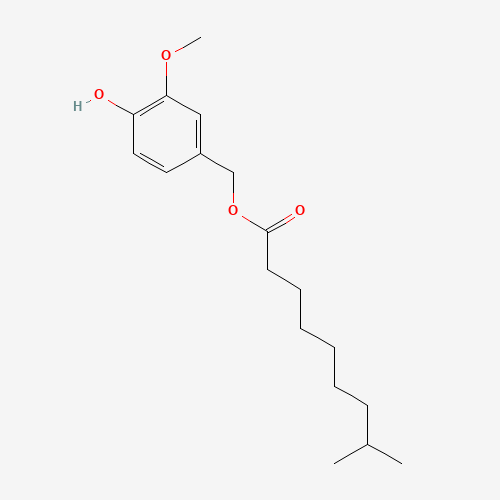
Dihydrocapsiate
CAS number:205687-03-2 molecular formula:C18H28O4
overview
compound introduction
Specs
| Chinese alias | 二氢辣椒素 | ||
| English alias | CHEBI:174951 | HY-124073 | (4-HYDROXY-3-METHOXYPHENYL)METHYL 8-METHYLNONANOATE | RBCYRZPENADQGZ-UHFFFAOYSA-N | Q27292214 | UNII-W2F7769AEU | SCHEMBL1585862 | MS-24475 | 4-Hydroxy-3-methoxybenzyl 8-methylnonanoate | Dihydrocapsiate, analytical standard | C | ||
| CAS number | 205687-03-2 | molecular formula | C18H28O4 |
| molecular weight | 308.41 g/mol | Exact mass | ≥99% |
| PSA | 55.800 Ų | logp | 5.000 |
numbering system
No numbering system information yet
physicochemical properties
No physical and chemical property information yet
Safety information
No safety information yet
Production methods and uses
No production method and use information yet
Related
upstream information
No upstream information yet
downstream information
No downstream information yet
MSDS
Found 1 shareMSDS
205687-03-2 | Dihydrocapsiate.pdf




