
compound introduction
All
Chemical Reagents
Biomedicine
Organic raw materials
Inorganic chemical industry
intermediate
Agricultural chemicals
Auxiliaries and catalysts
Fragrances and Flavors
Dyes and Pigments
Daily chemical industry
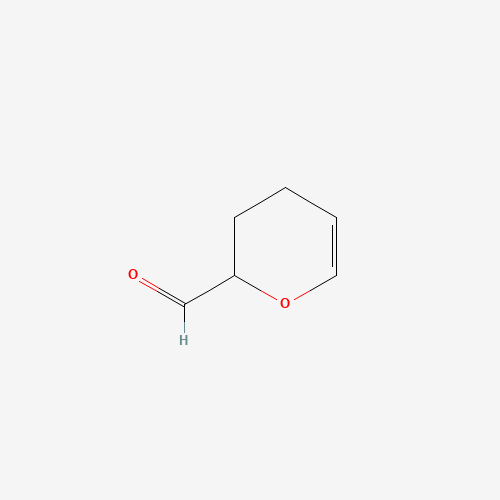
2-Formyl-3,4-dihydro-2H-pyran
Dangerous GoodsCAS number:100-73-2 molecular formula:C6H8O2
overview
Specs
| Chinese alias | - | ||
| English alias | 3,4-Dihydro-2H-pyran-2-carbaldehyde | ||
| CAS number | 100-73-2 | molecular formula | C6H8O2 |
| molecular weight | 112.13 | Exact mass | - |
| PSA | - | logp | - |
numbering system
| CAS | 100-73-2 |
| UNII | 49SA3RBS5H |
| Wikidata | Q18018102 |
| UN Number | 2607 |
| NSC Number | NSC Number: NSC95413 |
| PubChem CID | 60994 |
| Deprecated CAS | 77890-80-3 |
| Nikkaji Number | J21.552J |
| DSSTox Substance ID | DTXSID30274151 |
| European Community (EC) Number | 202-884-5 |
| PubChem Reference Collection SID | 500752835 |
| MEP ID | _25Q1B3AQY |
physicochemical properties
| XLogP3 | XLogP3-AA: 0.7 |
| Complexity | 107 |
| Exact Mass | 112.052429494 |
| Flash Point | 118 °F (NFPA, 2010) |
| Formal Charge | 0 |
| Chemical Classes | Reactive agents - 1st degree |
| Heavy Atom Count | 8 |
| Molecular Weight | 112.13 |
| Monoisotopic Mass | 112.052429494 |
| Isotope Atom Count | 0 |
| Physical Description | Colorless or yellow liquid with a pungent unpleasant odor; [CAMEO] Clear colorless liquid; [Sigma-Aldrich MSDS] |
| Rotatable Bond Count | 1 |
| Kovats Retention Index | Standard non-polar: 853 |
| Hydrogen Bond Donor Count | 0 |
| Covalently-Bonded Unit Count | 1 |
| Hydrogen Bond Acceptor Count | 2 |
| Topological Polar Surface Area | 26.3 Ų |
| Defined Atom Stereocenter Count | 0 |
| Defined Bond Stereocenter Count | 0 |
| Undefined Atom Stereocenter Count | 1 |
| Undefined Bond Stereocenter Count | 0 |
Safety information
DOT Label:
Flammable Liquid
First Aid:
ERG2024, Guide 129P (Acrolein dimer, stabilized): In Canada, an Emergency Response Assistance Plan (ERAP) may be required for this product. Please consult the shipping paper and/or the "ERAP" section.
Fire Hazards:
ERG2024, Guide 129P (Acrolein dimer, stabilized): · Many liquids will float on water.
Fire Fighting:
FIRE INVOLVING TANKS, RAIL TANK CARS OR HIGHWAY TANKS: Fight fire from maximum distance or use unmanned master stream devices or monitor nozzles. Cool containers with flooding quantities of water until well after fire is out. Withdraw immediately in case of rising sound from venting safety devices or discoloration of tank. ALWAYS stay away from tanks in direct contact with flames. For massive fire, use unmanned master stream devices or monitor nozzles; if this is impossible, withdraw from area and let fire burn. (ERG, 2024)
Toxicity Data:
LC50 (rat) = 3,225 ppm/4hr
Health Hazards:
ERG2024, Guide 129P (Acrolein dimer, stabilized): · Runoff from fire control or dilution water may cause environmental contamination.
Reactive Group:
Polymerizable Compounds
Adverse Effects:
Neurotoxin - Other CNS neurotoxin
Hazards Summary:
A mild skin irritant; Causes respiratory depression and lung changes in inhalation lethal-concentration studies of rats; Causes changes in bladder weight, changes in platelet count, and effects on other proteins in 9-day intermittent inhalation studies of rats; [RTECS] May cause eye and mucous membrane irritation; [CAMEO] May polymerize; An irritant that may cause serious eye injury; Harmful by ingestion, inhalation, and skin absorption; Inhalation of high concentrations may cause weakness, dizziness, and unconsciousness; [Sigma-Aldrich MSDS] Acrolein dimer, stabilized (UN2607) has warning of explosive polymerization; [ERG 2016]
DOT ID and Guide:
2607 129P
Reactivity Alerts:
Polymerizable
Reactivity Profile:
Aldehydes are frequently involved in self-condensation or polymerization reactions. These reactions are exothermic; they are often catalyzed by acid. Aldehydes are readily oxidized to give carboxylic acids. Flammable and/or toxic gases are generated by the combination of aldehydes with azo, diazo compounds, dithiocarbamates, nitrides, and strong reducing agents. Aldehydes can react with air to give first peroxo acids, and ultimately carboxylic acids. These autoxidation reactions are activated by light, catalyzed by salts of transition metals, and are autocatalytic (catalyzed by the products of the reaction). The addition of stabilizers (antioxidants) to shipments of aldehydes retards autoxidation.
Nonfire Spill Response:
LARGE SPILL: Dike far ahead of liquid spill for later disposal. Water spray may reduce vapor, but may not prevent ignition in closed spaces. (ERG, 2024)
Regulatory Information:
New Zealand EPA Inventory of Chemical Status: 2H-Pyran-2-carboxaldehyde, 3,4-dihydro-: HSNO Approval: HSR001240 Approved with controls
Air and Water Reactions:
Flammable. Soluble in water.
Isolation and Evacuation:
Evacuation: ERG2024, Guide 129P (Acrolein dimer, stabilized): · If tank, rail tank car or highway tank is involved in a fire, ISOLATE for 800 meters (1/2 mile) in all directions; also, consider initial evacuation for 800 meters (1/2 mile) in all directions.
DOT Hazard Classification:
Placard/Label(s)
Accidental Release Measures:
Spill or Leak: ERG2024, Guide 129P (Acrolein dimer, stabilized): · Water spray may reduce vapor, but may not prevent ignition in closed spaces.
Hazard Classes and Categories:
Flammable agents - 2nd degree, Reactive agents - 1st degree
Personal Protective Equipment (PPE):
Wear positive pressure self-contained breathing apparatus (SCBA). Structural firefighters' protective clothing provides thermal protection but only limited chemical protection. (ERG, 2024)
Emergency Response Planning Guidelines:
Emergency Response: ERG2024, Guide 129P (Acrolein dimer, stabilized): · For massive fire, use unmanned master stream devices or monitor nozzles; if this is impossible, withdraw from area and let fire burn.
Exposure Control and Personal Protection:
Protective Clothing: ERG2024, Guide 129P (Acrolein dimer, stabilized): · Structural firefighters' protective clothing provides thermal protection but only limited chemical protection.
Production methods and uses
purpose
Sources/Uses: Used to make other chemicals and plastics; [CAMEO]
Related
upstream information
No upstream information yet
downstream information
No downstream information yet
MSDS
Found 1 shareMSDS
100-73-2 | acrolin [stabilized] | acrorin dimer, stabilized