All
Chemical Reagents
Biomedicine
Organic raw materials
Inorganic chemical industry
intermediate
Agricultural chemicals
Auxiliaries and catalysts
Fragrances and Flavors
Dyes and Pigments
Daily chemical industry

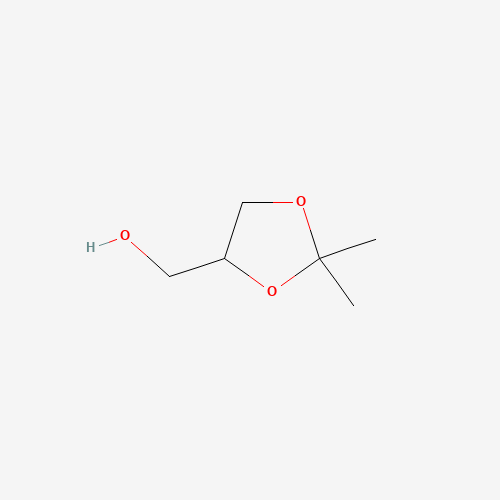
(2,2-dimethyl-1,3-dioxolan-4-yl)methanol

Dangerous Goods

CAS number:100-79-8    molecular formula:C6H12O3

overview

compound introduction

给出的RN指母体化合物;结构

Specs

Chinese alias丙酮甘油缩酮
English alias(2,2-Dimethyl-1,3-dioxolan-4-yl)methanol | 1,2-Isopropylidene-rac-glycerol | Isopropylidene glycerol | Solketal | 2,2-Dimethyl-1,3-dioxolane-4-methanol | 1,2-Isopropylideneglycerol | Glycerolacetone | DL-1,2-Isopropylideneglycerol | Glycerol,2-O-isopropyl
CAS number100-79-8molecular formulaC6H12O3
molecular weight132.16Exact mass≥98%
PSA38.7logp-0.2

numbering system

CAS100-79-8
UNII3XK098O8ZW
HMDB IDHMDB0258367
WikidataQ2968854
ChEMBL IDCHEMBL3342436
WikipediaSolketal
NSC NumberNSC Number: NSC59720
ICSC Number0790
PubChem CID7528
Deprecated CAS36543-79-0
Nikkaji NumberJ20.693H
DSSTox Substance IDDTXSID9021845
Metabolomics Workbench ID131398
European Community (EC) Number202-888-7
PubChem Reference Collection SID505436963
MEP ID_25Q1B42VD

physicochemical properties

XLogP3XLogP3-AA: -0.2
Density1.065 @25 °C
SolventsSolvents -> Other Solvents
Complexity100
Exact Mass132.078644241
FragrancesFragrance Ingredient (1,3-Dioxolane-4-methanol, 2,2-dimethyl) -> IFRA transparency List
SolubilitySolubility in water: miscible
Flash Point80 °C c.c.
Animal DrugsPharmaceuticals -> UK Veterinary Medicines Directorate List
Boiling Point75 °C @760 [mm Hg]
Formal Charge0
Melting Point-26.4 °C
Vapor DensityRelative vapor density (air = 1): 4.6
Vapor Pressure70 [mm Hg] @20 °C
Chemical ClassesIndustrial compound
Heavy Atom Count9
Molecular Weight132.16
Monoisotopic Mass132.078644241
Isotope Atom Count0
Physical DescriptionODOURLESS OILY COLOURLESS LIQUID.
Rotatable Bond Count1
Food Contact SubstancesFCS -> FDA Inventory of Effective Food Contact Substance (FCS) Notifications
Hydrogen Bond Donor Count1
Covalently-Bonded Unit Count1
Hydrogen Bond Acceptor Count3
Topological Polar Surface Area38.7 Ų
Defined Atom Stereocenter Count0
Defined Bond Stereocenter Count0
Undefined Atom Stereocenter Count1
Undefined Bond Stereocenter Count0

Safety information

Fire Hazards:
Combustible. Above 80 °C explosive vapour/air mixtures may be formed.
Safe Storage:
Separated from strong oxidants. Ventilation along the floor.
Fire Fighting:
Use water spray, alcohol-resistant foam, carbon dioxide.
Eye Prevention:
Wear safety spectacles.
Adverse Effects:
Neurotoxin - Acute solvent syndrome
Exposure Routes:
The substance can be absorbed into the body by inhalation of its aerosol.
Fire Prevention:
NO open flames. Above 80 °C use a closed system and ventilation.
Hazards Summary:
An eye irritant; Causes change in heart rate and blood pressure in intravenous lethal-dose studies of rats and rabbits; [RTECS] An eye irritant; [ICSC] May cause irritation; [Alfa Aesar MSDS] See 1,3-Dioxolane.
Inhalation Risk:
No indication can be given about the rate at which a harmful concentration of this substance in the air is reached on evaporation at 20 °C.
Skin Prevention:
Protective gloves.
Spillage Disposal:
Collect leaking and spilled liquid in sealable containers as far as possible. Wash away remainder with plenty of water.
EPA Safer Chemical:
EPA Safer Chemical: Green half-circle - The chemical is expected to be of low concern based on experimental and modeled data. Additional data would strengthen EPA's confidence in the chemical's safer status.
First Aid Measures:
Ingestion First Aid: Rinse mouth. Do NOT induce vomiting.
Signs and Symptoms:
Eye Exposure: Redness.
Exposure Prevention:
PREVENT GENERATION OF MISTS!
Ingestion Prevention:
Do not eat, drink, or smoke during work.
Inhalation Prevention:
Use ventilation.
Regulatory Information:
New Zealand EPA Inventory of Chemical Status: Isopropylidene glycerol: Does not have an individual approval but may be used under an appropriate group standard
ICSC Environmental Data:
Environmental effects from the substance have not been investigated adequately.
Hazard Classes and Categories:
Aquatic Chronic 2 (14.7%)
Effects of Short Term Exposure:
The substance is irritating to the eyes.
Protective Action Criteria (PAC):
PAC-3: 1400 [mg/m3]

Production methods and uses

purpose
Uses:
Sources/Uses: Used as solvent, plasticizer, and pharmaceutical aid (solubilizing and suspending agent)
Consumer Uses:
Solvent
Industry Uses:
Monomers
Household Products:
Household & Commercial/Institutional Products: • Inside the Home
Use Classification:
Fragrance Ingredients
General Manufacturing Information:
Industry Processing Sectors: Plastics Material and Resin Manufacturing

Related

upstream information

No upstream information yet

downstream information

No downstream information yet

MSDS

Found 1 shareMSDS
100-79-8 | DL-1,2-Isopropylideneglycerol.pdf