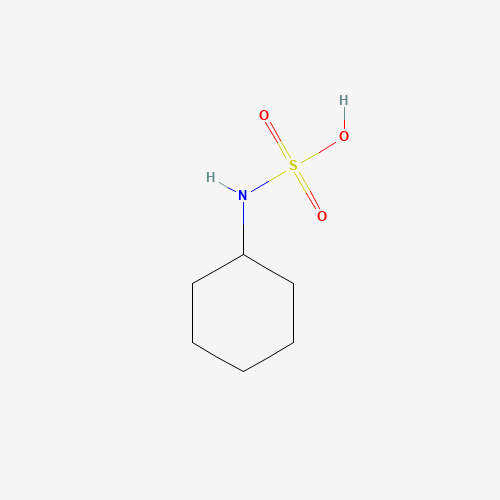
Adverse Effects:
Occupational hepatotoxin - Secondary hepatotoxins: the potential for toxic effect in the occupational setting is based on cases of poisoning by human ingestion or animal experimentation.
Hazards Summary:
In lethal dose studies, mice have seizures; Oral LD50 (mouse) = 680 mg/kg; Oral LD50 (rat) = 12,000 mg/kg; [ChemIDplus] No toxic effects found in rats fed high doses for entire life; An irritant; May cause skin sensitization; Effects in lethal-dose animal studies include convulsions and injury to liver and kidneys; [MSDSonline] See Potassium cyclamate. See Sodium cyclamate.
Disposal Methods:
SRP: Criteria for land treatment or burial (sanitary landfill) disposal practices are subject to significant revision. Prior to implementing land disposal of waste residue (including waste sludge), consult with environmental regulatory agencies for guidance on acceptable disposal practices.
FDA Requirements:
Cyclamate and its derivatives. Calcium, sodium, magnesium and potassium salts of cyclohexane sulfamic acid. Cyclamates are synthetic chemicals having a sweet taste 30 to 40 times that of sucrose, are not found in natural products at levels detectable by the official methodology, and have been used as artificial sweeteners. Food containing any added or detectable level of cyclamate is deemed to be adulterated in violation of the act based upon an order published in the Federal Register of October 21, 1969 (34 FR 17063).
Environmental Fate:
ATMOSPHERIC FATE: According to a model of gas/particle partitioning of semivolatile organic compounds in the atmosphere(1), cyclamate, which has an estimated vapor pressure of 5.3X10⁻⁷ mm Hg at 25 °C(SRC), determined from a fragment constant method(2), will exist in both the vapor and particulate phases in the ambient atmosphere. Vapor-phase cyclamate is degraded in the atmosphere by reaction with photochemically-produced hydroxyl radicals(SRC); the half-life for this reaction in air is estimated to be 3.7 hours(SRC), calculated from its rate constant of 3.4X10⁻¹¹ cu cm/molecule-sec at 25 °C(SRC) that was derived using a structure estimation method(3). Particulate-phase cyclamate may be removed from the air by wet or dry deposition(SRC). Cyclamate does not contain chromophores that abso...
Average Daily Intake:
Cyclamates are widely used as non-caloric sweeteners, the average daily dietary intake generally being less than 3 mg/kg body weight.
Regulatory Information:
New Zealand EPA Inventory of Chemical Status: Sulfamic acid, cyclohexyl-: Does not have an individual approval but may be used as a component in a product covered by a group standard. It is not approved for use as a chemical in its own right.
Soil Adsorption/Mobility:
Using a structure estimation method based on molecular connectivity indices(1), the Koc of cyclamate can be estimated to be 12(SRC). According to a classification scheme(2), this estimated Koc value suggests that cyclamate is expected to have very high mobility in soil. The estimated pKa of cyclamate is 1.71(3), indicating that this compound will exist almost entirely in the anion form in the environment and anions generally do not adsorb more strongly to soils containing organic carbon and clay than their neutral counterparts(4).
Artificial Pollution Sources:
Cyclamate's production and use as a non-nutritive sweetener(1) may result in its release to the environment through various waste streams(SRC).
Environmental Biodegradation:
AEROBIC: Cyclamate was eliminated in wastewater treatment plants with activated sludge processes sampled in Zurich Switzerland; a mean removal efficiency of 99% was observed. Incubation experiments with activated sludge resulted in a first order half-life of 20 minutes with 99% removal efficiency after 3 hours. No loss was observed using sterile controls(1).
Evidence for Carcinogenicity:
Evaluation: There is inadequate evidence in humans for the carcinogenicity of cyclamates. There is inadequate evidence in experimental animals for the carcinogenicity of cyclamates. Overall classification: Cyclamates are not classifiable as to their carcinogenicity to humans (Group 3). /Cyclamates/
Hazard Classes and Categories:
Eye Irrit. 2 (71.4%)
Environmental Bioconcentration:
An estimated pKa of 1.71(1) indicates cyclamate will exist almost entirely in the anion form at pH values of 5 to 9 and therefore bioconcentration of cyclamate in aquatic organisms is low(SRC).
Volatilization from Water/Soil:
The estimated pKa of 1.71(1) indicates cyclamate will exist almost entirely in the anion form at pH values of 5 to 9 and therefore volatilization from water surfaces is not expected to be an important fate process. Cyclamate is not expected to volatilize from dry soil surfaces(SRC) based upon an estimated vapor pressure of 5.3X10⁻⁷ mm Hg(SRC), determined from a fragment constant method(2).
Antidote and Emergency Treatment:
/SRP:/ Advanced treatment: Consider orotracheal or nasotracheal intubation for airway control in the patient who is unconscious, has severe pulmonary edema, or is in severe respiratory distress. Positive-pressure ventilation techniques with a bag valve mask device may be beneficial. Consider drug therapy for pulmonary edema ... . Consider administering a beta agonist such as albuterol for severe bronchospasm ... . Monitor cardiac rhythm and treat arrhythmias as necessary ... . Start IV administration of D5W /SRP: "To keep open", minimal flow rate/. Use 0.9% saline (NS) or lactated Ringer's if signs of hypovolemia are present. For hypotension with signs of hypovolemia, administer fluid cautiously. Watch for signs of fluid overload ... . Treat seizures with diazepam or lorazepam ... . Use...
Environmental Abiotic Degradation:
The rate constant for the vapor-phase reaction of cyclamate with photochemically-produced hydroxyl radicals has been estimated as 3.4X10⁻¹¹ cu cm/molecule-sec at 25 °C(SRC) using a structure estimation method(1). This corresponds to an atmospheric half-life of about 3.7 hours at an atmospheric concentration of 5X10+5 hydroxyl radicals per cu cm(1). No loss was observed using sterile controls in an activated sludge system(2). Cyclamate does not contain chromophores that absorb at wavelengths >290 nm(3), and therefore is not expected to be susceptible to direct photolysis by sunlight(SRC).
Probable Routes of Human Exposure:
Occupational exposure to cyclamate may occur through inhalation and dermal contact with this compound at workplaces where cyclamate is produced or used. Monitoring and use data indicate that the general population may be exposed to cyclamate via ingestion of contaminated drinking water and consumer products containing cyclamate. (SRC)
Environmental Water Concentrations:
SURFACE WATER: Eight lakes in Switzerland were sampled in February and March 2008, resulting in cyclamate concentrations ranging from below the detection limit in a remote mountain lake to 0.13 ug/L in the Greifensee, which is within a densely populated catchment area(1).
Environmental Fate/Exposure Summary:
Cyclamate's production and use as a non-nutritive sweetener may result in its release to the environment through various waste streams. If released to air, an estimated vapor pressure of 5.3X10⁻⁷ mm Hg at 25 °C indicates cyclamate will exist in both the vapor and particulate phases in the atmosphere. Vapor-phase cyclamate will be degraded in the atmosphere by reaction with photochemically-produced hydroxyl radicals; the half-life for this reaction in air is estimated to be 3.7 hours. Particulate-phase cyclamate will be removed from the atmosphere by wet or dry deposition. Cyclamate does not contain chromophores that absorb at wavelengths >290 nm, and therefore is not expected to be susceptible to direct photolysis by sunlight. If released to soil, cyclamate is expected to have very high...
Effects During Pregnancy and Lactation:
◉ Effects on Lactation and Breastmilk