

bpV(phen) trihydrate, a insulin-mimetic agent, is a potent protein tyrosine phosphatase (PTP) and PTEN inhibitor with IC 50 s of 38 nM, 343 nM and 920 nM for PTEN , PTP-β and PTP-1B , respectively. bpV(phen) trihydrate inhibits proliferation of the protozoan parasite Leishmania in vitro. bpV(phen) trihydrate strongly induces the secretion of a large number of chemokines and pro-inflammatory cytokines, and it activates a Th1-type pathway (IL-12, IFNγ). bpV(phen) trihydrate can also induce cell apoptosis , and has anti-angiogenic and anti-tumor activity In Vitro bpV(phen) (5 μM; 24.5 hours; H9c2 cells) treatment causes a further decrease of cell viability in H/R-injured H9c2 cells. bpV(phen) (5 μM; 24.5 hours; H9c2 cells) treatment increases the apoptosis of H/R-injured H9c2 cells. bpV(phen) (5 μM; 24.5 hours; H9c2 cells) treatment significantly promotes the accumulation of cytoplasmic Cytochrome C in H/R-injured H9c2 cells. After stimulation of bpV(phen), PTEN-induced putative kinase protein 1 (PINK1)/Parkin-mediated mitophagy is inhibited. bpV(phen) is an insulin-mimetic agent following insulin-receptor tyrosine kinase hyperphosphorylation and activation . MCE has not independently confirmed the accuracy of these methods. They are for reference only. Cell Viability AssayCell Line: Hypoxia/reoxygenation (H/R)-injured H9c2 cells Concentration: 5 μM Incubation Time: 24.5 hours (hypoxia for 24 h; reoxygenation for 30 minutes) Result: Caused a further decrease of cell viability. Apoptosis AnalysisCell Line: Hypoxia/reoxygenation (H/R)-injured H9c2 cells Concentration: 5 μM Incubation Time: 24.5 hours (hypoxia for 24 h; reoxygenation for 30 minutes) Result: Increased the apoptosis of H/R-injured H9c2 cells. Western Blot AnalysisCell Line: Hypoxia/reoxygenation (H/R)-injured H9c2 cells Concentration: 5 μM Incubation Time: 24.5 hours (hypoxia for 24 h; reoxygenation for 30 minutes) Result: Showed an increased release of Cytochrome C. In Vivo bpV(phen) (5 mg/kg; intraperitoneal injection; daily; for 38 days; male BALB/c nude (nu/nu) athymic mice) treatment causes a significant reduction in average tumor volume . MCE has not independently confirmed the accuracy of these methods. They are for reference only. Animal Model: Male BALB/c nude (nu/nu) athymic mice (6-7 weeks old) injected with PC-3 cellsDosage: 5 mg/kg Administration: Intraperitoneal injection; daily; for 38 days Result: Caused a significant reduction in average tumor volume. Form:Solid IC50& Target:IC50: 38 nM (PTEN), 343 nM (PTP-β) and 920 nM (PTP-1B),Parasite Leishmania,Apoptosis
All
Chemical Reagents
Biomedicine
Organic raw materials
Inorganic chemical industry
intermediate
Agricultural chemicals
Auxiliaries and catalysts
Fragrances and Flavors
Dyes and Pigments
Daily chemical industry
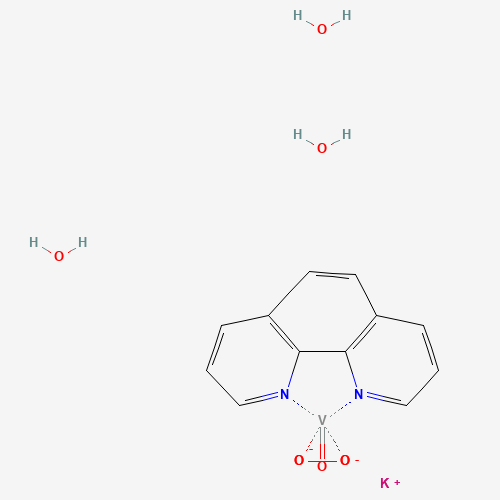
bpV(phen) trihydrate
CAS number:171202-16-7 molecular formula:C12H14KN2O8V
overview
compound introduction
Specs
| Chinese alias | bpV(phen)三水合物 | ||
| English alias | - | ||
| CAS number | 171202-16-7 | molecular formula | C12H14KN2O8V |
| molecular weight | 404.29 g/mol | Exact mass | ≥98% |
| PSA | - | logp | - |
numbering system
No numbering system information yet
physicochemical properties
No physical and chemical property information yet
Safety information
No safety information yet
Production methods and uses
No production method and use information yet
Related
upstream information
No upstream information yet
downstream information
No downstream information yet
MSDS
Found 0 shareMSDS




