
Licarin A ((+)-Licarin A), a neolignan, significantly and dose-dependently reduces TNF-α production (IC 50 =12.6 μM) in dinitrophenyl-human serum albumin (DNP-HSA)-stimulated RBL-2H3 cells. Anti-allergic effects. Licarin A reduces TNF-α and PGD2 production, and COX-2 expression. In Vitro Licarin A is found in plants such as Aristolochia taliscana , Machilus thunbergii and Myristica fragrans , which are used as spices and in folk medicines for nervous and digestive disorders. Licarin A also exhibits anti-inflammatory effects. Licarin A (5-20 μM) reduces TNF-α and prostaglandin D2 (PGD2) secretion via the inhibition of PKCα/βII and p38 MAPK pathways. Licarin A treatment tends to reduce phosphorylated PKCα/βII and p38 MAPK protein levels. MCE has not independently confirmed the accuracy of these methods. They are for reference only. Form:Solid
All
Chemical Reagents
Biomedicine
Organic raw materials
Inorganic chemical industry
intermediate
Agricultural chemicals
Auxiliaries and catalysts
Fragrances and Flavors
Dyes and Pigments
Daily chemical industry
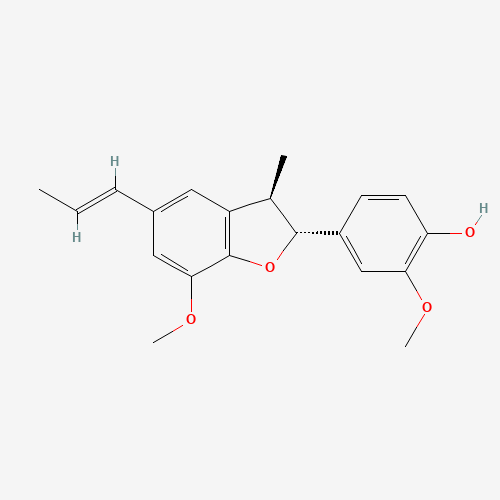
Licarin A
CAS number:51020-86-1 molecular formula:C20H22O4
overview
compound introduction
Specs
| Chinese alias | 利卡林 A | ||
| English alias | MS-24874 | (invertedexclamationmarkA)-LicarinA | (-)-Licarin A | (+)-licarin A | trans-2,3-dihydro-2-(4-hydroxy-3-methoxyphenyl)-7-methoxy-3-methyl-5-(E)-propenylbenzofurane | SCHEMBL2871105 | AC-34409 | Phenol, 4-((2R,3R)-2,3-dihydro-7-methoxy-3-methyl-5 | ||
| CAS number | 51020-86-1 | molecular formula | C20H22O4 |
| molecular weight | 326.39 g/mol | Exact mass | ≥98% |
| PSA | 47.900 Ų | logp | 4.400 |
numbering system
No numbering system information yet
physicochemical properties
No physical and chemical property information yet
Safety information
No safety information yet
Production methods and uses
No production method and use information yet
Related
upstream information
No upstream information yet
downstream information
No downstream information yet
MSDS
Found 0 shareMSDS