
YM-244769 is a potent, selective and orally active Na + /Ca 2+ exchanger ( NCX ) inhibitor. YM-244769 preferentially inhibits NCX3 and suppresses the unidirectional outward NCX current (Ca 2+ entry mode), with IC 50 s of 18 nM and 50 nM, respectively. YM-244769 efficiently protects against hypoxia/reoxygenation-induced SH-SY5Y neuronal cell damage. YM-244769 can also increase urine volume and urinary excretion of electrolytes in mice In Vitro YM-244769 (0.003-1 μM) inhibits dose dependently the initial rates of 45 Ca 2+ uptake into NCX1, NCX2, and NCX3 transfectants with IC 50 values of 68 ± 2.9, 96 ± 3.5, and 18 ± 1.0 nM, respectively. YM-244769 (0.3 or 1 μM) efficiently protects against the hypoxia/reoxygenation-induced lactate dehydrogenase (LDH) release in SH-SY5Y cells and in LLC-PK 1 cells (1 μM). YM-244769 possesses reverse mode-selectivity. YM-244769 (1 and 10 μM) inhibits NCX current (I NCX ) in a concentration- and [Na + ] i -dependent manner, the IC 50 against the unidirectional outward I NCX (Ca 2+ entry mode) is 0.05 μM. The IC 50 values against the bidirectional outward and inward I NCX are similar and approximately 100 nM with a Hill coefficient of about 1. YM-244769 is trypsin-insensitive. MCE has not independently confirmed the accuracy of these methods. They are for reference only. Cell Viability AssayCell Line: SH-SY5Y cells treated with NCX1 or NCX3 antisense Concentration: 0.3 and 1 μM Incubation Time: Result: Hypoxia/reoxygenation-induced LDH release was significantly attenuated: reduction in cell damage was greater in cells treated with NCX3 antisense (by 61%) than in cells treated with NCX1 antisense (by 35%). 0.3 or 1 μM efficiently suppressed the hypoxia/reoxygenation-induced cell damage in SH-SY5Y cells treated with NCX1 antisense more than in those treated with NCX3 antisense. In Vivo YM-244769 (0.1-1 mg/kg; p.o.; once) exhibits dose-dependently natriuretic action in mice and significantly increases urinary excretion of Ca 2+ as well as Ca 2+ /Cr ratio. MCE has not independently confirmed the accuracy of these methods. They are for reference only. Animal Model: Wild-type C57BL/6J mice and NCX-KO miceDosage: 0.1, 0.3 and 1 mg/kg Administration: Oral administration, once Result: Caused a dose-dependent increase (up to approximately 200%) in urine volume and urinary excretion of electrolytes (Na + , K + and Cl - ). Natriuretic actions were equivalently observed in NCX1-KO and WT, but disappeared in NCX2-KO and double KO. Form:Solid IC50& Target:IC 50 : 18 nM (NCX3), 68 nM (NCX1), 96 nM (NCX2)
All
Chemical Reagents
Biomedicine
Organic raw materials
Inorganic chemical industry
intermediate
Agricultural chemicals
Auxiliaries and catalysts
Fragrances and Flavors
Dyes and Pigments
Daily chemical industry
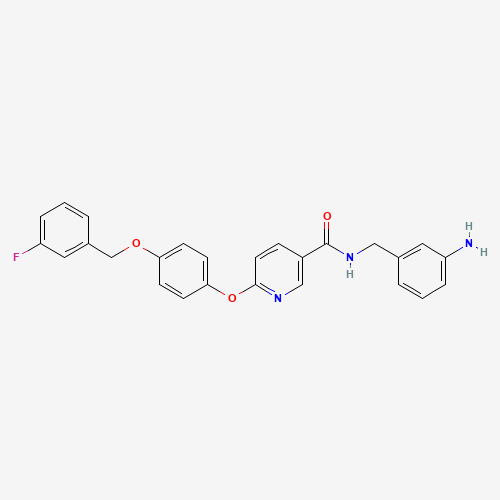
YM-244769
CAS number:838819-70-8 molecular formula:C26H22FN3O3
overview
compound introduction
Specs
| Chinese alias | - | ||
| English alias | - | ||
| CAS number | 838819-70-8 | molecular formula | C26H22FN3O3 |
| molecular weight | 443.47 g/mol | Exact mass | ≥98% |
| PSA | - | logp | - |
numbering system
No numbering system information yet
physicochemical properties
No physical and chemical property information yet
Safety information
No safety information yet
Production methods and uses
No production method and use information yet
Related
upstream information
No upstream information yet
downstream information
No downstream information yet
MSDS
Found 0 shareMSDS