
Jatrorrhizine hydroxide is an alkaloid isolated from Coptis chinensis with neuroprotective, antimicrobial, antiplasmodial and antioxidant activities Jatrorrhizine hydroxide is a potent and orally active inhibitor of AChE ( IC 50 =872 nM) over >115-fold selectivity for BuChE Jatrorrhizine hydroxide reduces uptake of serotonin (5-HT) and norepinephrine (NE) via inhibition of uptake-2 transporters In Vitro Jatrorrhizine has antiplasmodial and antiamoebic activity, it against Plasmodium falciparum and E. histolytica with IC 50 values of 3.15 and 82.7 µM, respectively. The hOCT2 (organic cation transporter 2), hOCT3, and PMAT (plasma membrane monoamine transporter) are capable of transporting monoamine neurotransmitters in the brain. Jatrorrhizine has the inhibitory potency of jatrorrhizine on 5-HT and NE uptake in hOCT2-, hOCT3-, and PMAT-transfected cells. Jatrorrhizine strongly inhibits PMAT-mediated MPP + uptake with an IC 50 value of 1.05 μM and reduces 5-HT and NE uptake mediated by hOCT2, hOCT3, and hPMAT with IC 50 values of 0.1-1 μM (for OCT2 and OCT3) and 1-10 μM (for PMAT). Clearance of neurotransmitters released into the synaptic cleft is defined by two distinct processes. Uptake-1, the common target of current applied antidepressants, is comprised of the serotonin transporter (SERT), the “SERT”, had a high affinity but low capacity to take up [3H]5-HT. Uptake-2 transporters are an important supplementary regulation system in monoamine clearancethought to be the “NET”, has low affinity but high capacity to take up [ 3 H]5-HT into brain slices. Jatrorrhizine significantly inhibited 5-HT and NE uptake in synaptosomes at 25 μM and 50 μM. MCE has not independently confirmed the accuracy of these methods. They are for reference only. In Vivo Jatrorrhizine (intraperitoneal injection; 5, 10, 20 mg/kg) can significantly reduce the duration of immobility when compared with vehicle control group in tail suspension test (TST). MCE has not independently confirmed the accuracy of these methods. They are for reference only. Animal Model: Male ICR albino miceDosage: 5, 10, 20 mg/kg Administration: Intraperitoneal injection; 5, 10, 20 mg/kg Result: Reduced immobility period in tail suspension test. Form:Solid IC50& Target:IC50: 872 nM (AChE)
All
Chemical Reagents
Biomedicine
Organic raw materials
Inorganic chemical industry
intermediate
Agricultural chemicals
Auxiliaries and catalysts
Fragrances and Flavors
Dyes and Pigments
Daily chemical industry
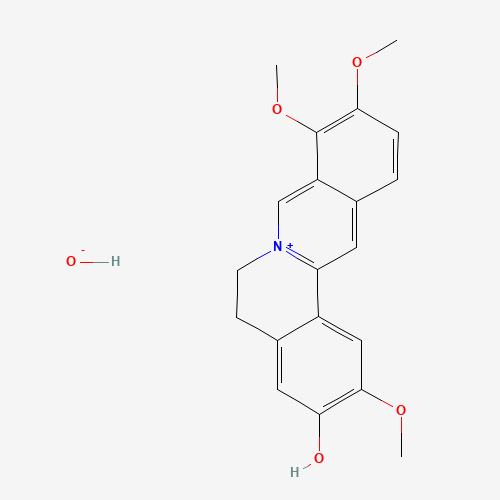
Jatrorrhizine hydroxide
CAS number:483-43-2 molecular formula:C20H21NO5
overview
compound introduction
Specs
| Chinese alias | 氢氧化药根碱 | ||
| English alias | 2,9,10-Trimethoxy-5,6-dihydroisoquinolino[2,1-b]isoquinolin-7-ium-3-ol;hydroxide | HY-N0749A | MS-25554 | Dibenzo[a,g]quinolizinium, 5,6-dihydro-3-hydroxy-2,9,10-trimethoxy-, hydroxide | Jatrorrhizine (hydroxide) | Jatrorrhizine hydroxide | ||
| CAS number | 483-43-2 | molecular formula | C20H21NO5 |
| molecular weight | 355.38 g/mol | Exact mass | ≥98% |
| PSA | - | logp | - |
numbering system
No numbering system information yet
physicochemical properties
No physical and chemical property information yet
Safety information
No safety information yet
Production methods and uses
No production method and use information yet
Related
upstream information
No upstream information yet
downstream information
No downstream information yet
MSDS
Found 0 shareMSDS