
产品介绍: Cilengitide (EMD 121974, NSC 707544)是一种有效的integrin抑制剂,作用于αvβ3受体和αvβ5受体,无细胞试验中IC50分别为4.1 nM和79 nM,比作用于gpIIbIIIa选择性高10倍左右。 Information Cilengitide trifluoroacetate Cilengitide (EMD 121974, NSC 707544) is a potent integrin inhibitor for αvβ3 receptor and αvβ5 receptor with IC50 of 4.1 nM and 79 nM in cell-free assays, respectively; ~10-fold selectivity against gpIIbIIIa. Phase 2. Targets αvβ3 receptor (Cell-free assay); αvβ5 receptor (Cell-free assay) 4.1 nM; 79 nM In vitro Cilengitide is a cyclized pentapeptide peptidomimetic designed to compete for the arginine-glycine-aspartic acid (RGD) peptide sequence that regulates integrin-ligand binding. Cilengitide selectively and potently blocks the ligation of theαvβ3 andαvβ5 integrins to provisional matrix proteins such as vitronectin, fibronectin, fibrinogen, von Willebrand factor, osteopontin, and others. Cilegitide inhibits angiogenesis in vitro. 10 μM Cilengitide completely inhibits attachment of BAE, BME and HUVE cells on vitronectin and fibronectin. Cilengitide inhibits in vitro angiogenesis of BAE cells on three-dimensional collagen and fibrin gels pretreated with FGF-2(or VEGF-A) with IC50 of 15 μM and 8 μM, 4 μM and 3 μM, respectively. Cilengitide blocks proliferation and induces apoptosis of endothelial cells as well as differentiation of human endothelial precursor cells (EPCs). 50 μg/mL Cilengitide completely inhibits the proliferation of human microvascular endothelial cell line HMEC-1 and leads to apoptosis in ~30% cells. 1.0 μM Cilengitide treating for 9 days inhibits the proliferation of EPCs by nearly 40%. 1 μM Cilengitide inhibits the differentiation of EPCs by more than 80% at 14 days. Cilengitide inhibits adhesion and induces apoptosis of tumor cells. 25 μg/mL Cilengitide causes detachment of DAOY cells (medulloblastoma) and U87MG cells (glioblastoma) from vitronectin and tenascin by more than 60%. 25 μg/mL Cilengitide induces a nearly 50% apoptosis rate of these cells. In vivo Cilengitide is activity against tumor growth and angiogenesis as single-agent. 100 μg Cilengitide induces a significant decrease in the number of CD 31+ vessels seen in tumors (2/high-Solid field) compared with control tumors (56/high-Solid field). 100 μg Cilengitide increases cellular apoptosis in the brain tumors of animals (2.2% apoptotic cells/high-Solid field) compared with those receiving the inactive peptide (1.7% cells/high-Solid field). Cilengitide treatment results in prolonged survival of the mice bearing melanoma xenografts M21 compared with control treatment group. (36.5 vs 17.3 days). Cilengitide can augment the therapeutic benefit associated with cytotoxic agents including chemotherapy and radiation therapy in tumor models. Cilengitide (250 mg/dose) alone does not alter tumor growth of breast cancer xenografts when compared with untreated mice, but combined modality RIT (CMRIT) using RIT and six doses of Cilengitide (250 mg/dose) increases efficacy of treatment, with the cure rate for mice that receives only RIT increasing from 15 to 53%. CMRIT significantly increases apoptosis of tumor and endothelial cells 5 days, and decreases tumor proliferation. Cell Research(from reference) Cell lines:Human microvascular endothelial cell line HMEC-1 Concentrations:1-50 μg/mL Incubation Time:3 days
All
Chemical Reagents
Biomedicine
Organic raw materials
Inorganic chemical industry
intermediate
Agricultural chemicals
Auxiliaries and catalysts
Fragrances and Flavors
Dyes and Pigments
Daily chemical industry
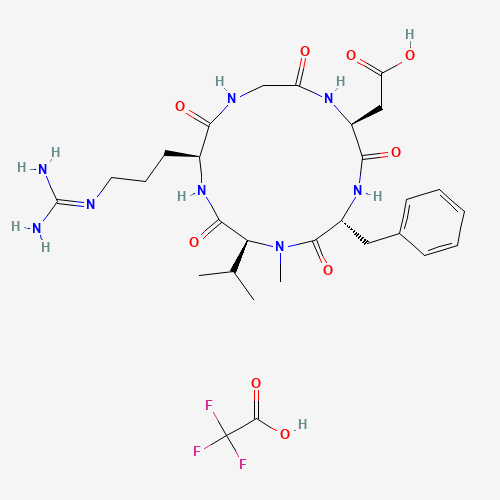
Cilengitide trifluoroacetate
CAS number:199807-35-7 molecular formula:C29H41F3N8O9
overview
compound introduction
Specs
| Chinese alias | - | ||
| English alias | EMD 121974 | NSC 707544Cyclo(L-arginylglycyl-L-α-aspartyl-D-phenylalanyl-N-methyl-L-valyl) 2,2,2-trifluoroacetic acid(1:1) | ||
| CAS number | 199807-35-7 | molecular formula | C29H41F3N8O9 |
| molecular weight | 702.68 g/mol | Exact mass | ≥98% |
| PSA | 276.000 Ų | logp | -0.565 |
numbering system
No numbering system information yet
physicochemical properties
No physical and chemical property information yet
Safety information
No safety information yet
Production methods and uses
No production method and use information yet
Related
upstream information
No upstream information yet
downstream information
No downstream information yet
MSDS
Found 0 shareMSDS