

IPN-60090 dihydrochloride is an orally active and highly selective inhibitor of glutaminase 1 ( GLS1 ; IC 50 =31 nM), with no activity observed against GLS-2. IPN-60090 dihydrochloride exhibits excellent physicochemical and pharmacokinetic properties in vivo . IPN-60090 dihydrochloride can be used for solid tumors research, such as lung and ovarian cancers In Vitro There are two known isoforms of glutaminase: GLS-1 (also called kidney-type or KGA), and GLS-2 (also called liver-type or LGA). GLS-1 is ubiquitous and GLS-2 expression appears limited primarily to the liver. In a dual-coupled enzyme assay, IPN60090 dihydrochloride inhibits purified recombinant human GLS-1 (GAC isoform) with an IC 50 of 31 nM, and has no activity against GLS-2, with an IC 50 of >50000 nM. IPN60090 dihydrochloride inhibits the proliferation of A549 cells with an IC 50 of 26 nM. MCE has not independently confirmed the accuracy of these methods. They are for reference only. In Vivo IPN60090 dihydrochloride (3 mg/kg for i.v.; 10 mg/kg for p.o.) has excellent pharmacokinetic properties, with CL=4.1 mL/min/kg, t 1/2 =1 hour, C max =19 μM, F%=89%. IPN-60090 dihydrochloride (oral administration; 100 mg/kg; twice daily; 30 days) shows similar efficacy and target engagement to CB-839 dosed orally at 250 mg/kg twice daily. And the 100 mg/kg BID dose of IPN-60090 is a tolerated dose for the following model study. IPN-60090 dihydrochloride (oral administration; 100 mg/kg; twice daily; 30 days; monotherapy or in combination with TAK228 ) causes tumor growth inhibition. IPN-60090 alone demonstrates robust in vivo target engagement in a dose-dependent manner. The glutamate/glutamine ratios and the free plasma concentrations of IPN-60090 at 4 hours post-dose on both day 4 and day 28 are all decreased. Furthermore, IPN-60090 dihydrochloride in combination with TAK228 strongly causes an 85% tumor growth inhibition, IPN-60090 alone causes a 28% tumor growth inhibition in vivo. MCE has not independently confirmed the accuracy of these methods. They are for reference only. Animal Model: Female CD-1 miceDosage: 3 mg/kg for i.v.; 10 mg/kg for p.o. (Pharmacokinetic Analysis) Administration: Intravenous injection and oral administration Result: CL (4.1 mL/min/kg), t 1/2 (1 hour) for i.v.; C max (19 μM), F% (89%) for p.o.. Animal Model: Ru337 non-small cell lung cancer patient-derived xenograft (PDX) subcutaneous mouse model as monotherapy or in combinationDosage: 100 mg/kg Administration: Oral administration; 100 mg/kg; twice daily; 30 days; monotherapy or in combination with TAK228 Result: Exhibited an improvement in the combination regimen group over either single agent. Form:Solid IC50& Target:IC50: 31 nM (GLS1)
All
Chemical Reagents
Biomedicine
Organic raw materials
Inorganic chemical industry
intermediate
Agricultural chemicals
Auxiliaries and catalysts
Fragrances and Flavors
Dyes and Pigments
Daily chemical industry
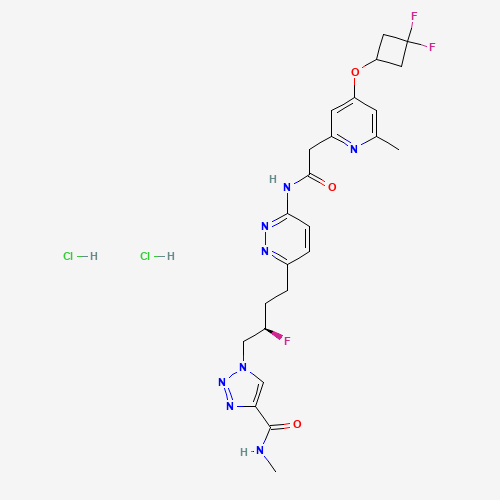
IPN60090 dihydrochloride
CAS number:2102101-72-2 molecular formula:C24H29Cl2F3N8O3
overview
compound introduction
Specs
| Chinese alias | IPN60090 二盐酸盐 | ||
| English alias | - | ||
| CAS number | 2102101-72-2 | molecular formula | C24H29Cl2F3N8O3 |
| molecular weight | 605.44 g/mol | Exact mass | ≥99% |
| PSA | - | logp | - |
numbering system
No numbering system information yet
physicochemical properties
No physical and chemical property information yet
Safety information
No safety information yet
Production methods and uses
No production method and use information yet
Related
upstream information
No upstream information yet
downstream information
No downstream information yet
MSDS
Found 0 shareMSDS




