

4-(6-Bromo-2-benzothiazolyl)benzenamine is a β-amyloid PET (positron emission tomography) tracer that can be used in the diagnosis of neurological diseases, such as Alzheimer's and Down's syndrome. In Vitro 4-(6-Bromo-2-benzothiazolyl)benzenamine (compound 6l) plus ultraviolet A (UVA) can induce caspase-3 activity, poly(ADP-ribose)polymerase cleavage, M30 positive CytoDeath staining, and subsequent apoptotic cell death. Treatment of A375 cells with 4-(6-Bromo-2-benzothiazolyl)benzenamine plus UVA results in a decrease in mitochondrial membrane potential (ΔΨ mt ), oxidative phosphorylation system (OXPHOS) subunits, and adenosine triphosphate (ATP) but an increase in mitochondrial DNA 4977-bp deletion via reactive oxygen species (ROS) generation. Transmission electron microscopy (TEM) observations also show major ultrastructural alterations of mitochondria. MCE has not independently confirmed the accuracy of these methods. They are for reference only. In Vivo 4-(6-Bromo-2-benzothiazolyl)benzenamine plus UVA is shown to reduce murine melanoma size in a mouse model. 4-(6-Bromo-2-benzothiazolyl)benzenamine-PDT may serve as a potential ancillary modality for the treatment of melanoma. MCE has not independently confirmed the accuracy of these methods. They are for reference only. Cell Assay For fluorescence Measurement of Uptake of 4-(6-Bromo-2-benzothiazolyl)benzenamine, cultured A375 cells are seeded on glass coverslips with a density of 2×10 4 cells/well in 24-well plate for 24 h until cell attachment. Then the cells are exposed to 4-(6-Bromo-2-benzothiazolyl)benzenamine at 5 μM for indicated times in the dark. The cells are washed twice with PBS and are then fixed with 4% paraformaldehyde at 4°C for 30 min. The qualitative expression of cell fluorescence is determined using a Leica inverted microscope. MCE has not independently confirmed the accuracy of these methods. They are for reference only. Animal administration Mice A total of 5×10 6 B16 cells are inoculated into female ICR mice (about 19-21 g, 7 weeks). The subcutaneous inoculation of tumor cells resulted in tumor generation at the injection site. When tumors reached about 4×4 mm 2 in diameter, mice are separated into groups. Each group had four mice in each experiment; 4 mg/kg of 4-(6-Bromo-2-benzothiazolyl)benzenamine is injected into the tumor site, and then tumor is exposed to different doses of UVA on the day after injection. Tumor volume is measured by calipers every 5 days after agent injection, and tumor volume is calculated aladdin has not independently confirmed the accuracy of these methods. They are for reference only. Form:Solid IC50& Target:β-amyloid
All
Chemical Reagents
Biomedicine
Organic raw materials
Inorganic chemical industry
intermediate
Agricultural chemicals
Auxiliaries and catalysts
Fragrances and Flavors
Dyes and Pigments
Daily chemical industry
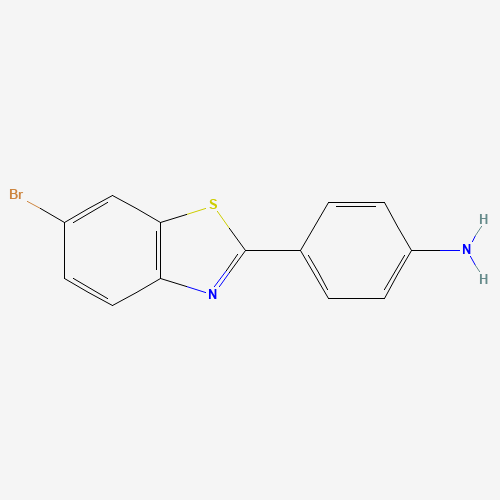
4-(6-Bromo-2-benzothiazolyl)benzenamine
CAS number:566169-97-9 molecular formula:C13H9BrN2S
overview
compound introduction
Specs
| Chinese alias | 4-(6-溴-2-苯并噻唑)苯胺 | ||
| English alias | 4-(6-Bromobenzo[d]thiazol-2-yl)aniline | [4-(6-bromo-1,3-benzothiazol-2-yl)phenyl]amine | HY-111514 | 4-(6-Bromo-2-benzothiazolyl)benzenamine | AKOS017549675 | DTXSID80438347 | PD102319 | SCHEMBL2461395 | BDBM50129783 | 4-(6-Bromo-benzothiazol-2-yl)-pheny | ||
| CAS number | 566169-97-9 | molecular formula | C13H9BrN2S |
| molecular weight | 305.19 g/mol | Exact mass | - |
| PSA | 67.200 Ų | logp | 4.300 |
numbering system
No numbering system information yet
physicochemical properties
No physical and chemical property information yet
Safety information
No safety information yet
Production methods and uses
No production method and use information yet
Related
upstream information
No upstream information yet
downstream information
No downstream information yet
MSDS
Found 0 shareMSDS




