
compound introduction
All
Chemical Reagents
Biomedicine
Organic raw materials
Inorganic chemical industry
intermediate
Agricultural chemicals
Auxiliaries and catalysts
Fragrances and Flavors
Dyes and Pigments
Daily chemical industry
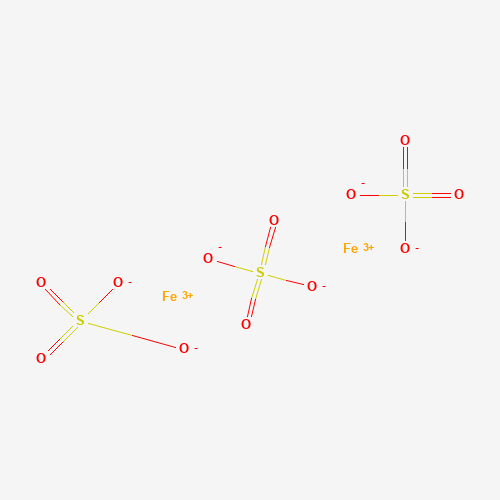
Ferric sulfate
CAS number:10028-22-5 molecular formula:Fe2O12S3
overview
Specs
| Chinese alias | - | ||
| English alias | Iron (III) sulfate; Sulfuric acid iron(3+) salt (3:2) | ||
| CAS number | 10028-22-5 | molecular formula | Fe2O12S3 |
| molecular weight | 399.88 | Exact mass | - |
| PSA | - | logp | - |
numbering system
| CAS | 10028-22-5 |
| UNII | 4YKQ1X5E5Y |
| RXCUI | 24913 |
| HMDB ID | HMDB0303489 |
| KEGG ID | D08922 |
| ChEBI ID | 53438 |
| Wikidata | Q409021 |
| ChEMBL ID | CHEMBL5095046 |
| Wikipedia | Iron(III) sulfate |
| DrugBank ID | DB11171 |
| DrugCentral | 4529 |
| PubChem CID | 24826 |
| Related CAS | 43059-01-4 (monohydrate) |
| Deprecated CAS | 1299332-62-9 |
| NCI Thesaurus Code | C76712 |
| DSSTox Substance ID | DTXSID5029712 |
| European Community (EC) Number | 688-452-0 |
| PubChem Reference Collection SID | 481107164 |
| MEP ID | _25Q1B3FME |
physicochemical properties
| Density | 3.1 @25 °C |
| Color/Form | Yellow crystals |
| Complexity | 62.2 |
| Exact Mass | 399.725060 |
| Solubility | Insol in sulfuric acid, ammonia |
| Corrosivity | Corrosive to copper, copper alloys, mild steel, and galvanized steel. |
| Boiling Point | The Anhydrous form decomposes (480ºC) |
| Decomposition | When heated to decomposition it emits toxic fumes /of iron and sulfur oxides./ |
| Formal Charge | 0 |
| Melting Point | 480 °C (decomp) |
| Food Additives | FLAVORING AGENT OR ADJUVANT -> FDA Substance added to food |
| Chemical Classes | Metals -> Metals, Inorganic Compounds |
| Heavy Atom Count | 17 |
| Molecular Weight | 399.9 |
| Refractive Index | Index of refraction: 1.814 |
| Monoisotopic Mass | 399.725060 |
| Isotope Atom Count | 0 |
| Physical Description | Greyish-white solid, slightly soluble in water; Very hygroscopic; Commercial product is yellow and contains about 20% water; Off-white or yellow odorless powder; [MSDSonline] |
| Rotatable Bond Count | 0 |
| Stability/Shelf Life | Hydrolyzed slowly in aqueous solution. |
| Hydrogen Bond Donor Count | 0 |
| Covalently-Bonded Unit Count | 5 |
| Hydrogen Bond Acceptor Count | 12 |
| Other Experimental Properties | Density 2.0-2.1; melting point, decomposes at 480 °C; very soluble in water /Nonahydrate/ |
| Topological Polar Surface Area | 266 Ų |
| Defined Atom Stereocenter Count | 0 |
| Defined Bond Stereocenter Count | 0 |
| Undefined Atom Stereocenter Count | 0 |
| Undefined Bond Stereocenter Count | 0 |
Safety information
First Aid:
SKIN: flush with water. (USCG, 1999)
Interactions:
...A brief exposure (1 hr) of 51Cr-radiolabeled breast cancer cells (BT-20) but not colon cancer cells (Caco-2) to hemin (10 uM) or FeSO4 (10 uM) significantly enhances cytotoxicity mediated by 0.5 mM hydrogen peroxide (H2O2). Associated with Caco-2 resistance, these cells were found to be enriched in the endogenous iron chelator, ferritin. If cellular ferritin is even further increased through 1 hr incubation (24 hr prior to H2O2 exposure) of both cell types with hemin, FeSO4, or exogenous spleen apoferritin itself (24 hr), marked resistance to H2O2-mediated cytotoxicity is manifest. Under several conditions, the sensitivity of tumor cells to oxidant-mediated lysis is inversely proportional to their ferritin content. Pretreatment of BT-20 and Caco-2 cells with hemin or FeSO4 rapidly in...
Fire Potential:
Not flammable
Health Hazards:
Inhalation of dust irritates nose and throat. Ingestion causes irritation of mouth and stomach. Dust irritates eyes and can irritate skin on prolonged contact. (USCG, 1999)
OSHA Standards:
Vacated 1989 OSHA PEL TWA 1 mg/cu m is still enforced in some states. /Iron salts, soluble, as Fe/
Reactive Group:
Salts, Acidic
Adverse Effects:
Occupational hepatotoxin - Secondary hepatotoxins: the potential for toxic effect in the occupational setting is based on cases of poisoning by human ingestion or animal experimentation.
Cleanup Methods:
Environmental considerations, water spill: Neutralize with agricultural lime, crushed limestone, or sodium bicarbonate. Adjust pH to neutral (pH= 7). Use mechanical dredges or lifts to remove immobilized masses of pollutants and precipitates.
EPA Ecotoxicity:
Pesticide Ecotoxicity Data from EPA: 22
Hazards Summary:
A skin, eye, and mucous membrane irritant; Overexposure may cause liver damage; A skin, eye, and throat irritant; An irritant; [MSDSonline] See Iron salts, soluble.
Disposal Methods:
SRP: The most favorable course of action is to use an alternative chemical product with less inherent propensity for occupational exposure or environmental contamination. Recycle any unused portion of the material for its approved use or return it to the manufacturer or supplier. Ultimate disposal of the chemical must consider: the material's impact on air quality; potential migration in soil or water; effects on animal, aquatic, and plant life; and conformance with environmental and public health regulations.
FDA Requirements:
Trace minerals added to animal feeds. These substances added to animal feeds as nutritional dietary supplements are generally recognized as safe when added at levels consistent with good feeding practice. All substances listed may be in anhydrous or hydrated form. Iron sulfate is included on this list. /Iron Sulfate/
Ecotoxicity Values:
LC50 Salmo trutta (Brown trout) 47 mg total Fe/L (0.24 mg soluble Fe/L)/96 hr /Conditions of bioassay not specified in source examined/ /Analar grade iron (III) sulphate/
FIFRA Requirements:
Residues of ferric sulfate are exempted from the requirement of a tolerance when used as a solid diluent or carrier in accordance with good agricultural practices as inert (or occasionally active) ingredients in pesticide formulations applied to growing crops or to raw agricultural commodities after harvest.
Reactivity Profile:
FERRIC SULFATE is acidic. Corrosive to copper, copper alloys, mild steel, and galvanized steel (USCG, 1999).
Storage Conditions:
Keep well closed and protected from light.
Preventive Measures:
All ... /iron/ preparations should be kept in child-proof bottles. /Iron preparations/
Allowable Tolerances:
Residues of ferric sulfate are exempted from the requirement of a tolerance when used as a solid diluent or carrier in accordance with good agricultural practices as inert (or occasionally active) ingredients in pesticide formulations applied to growing crops or to raw agricultural commodities after harvest.
Ecotoxicity Excerpts:
/AQUATIC SPECIES/ ...The acute and chronic effects upon Daphnia longispina, the dominant member of the zooplankton. Laboratory tests established that, although dissolved iron had no measurable effect, the presence of particulate iron caused mortalities in acute tests (48 hours) and reduced number of broods per female and numbers of young hatching in chronic tests (21 days). At 11.48 mg Fe/L, 50% mortalities occurred in the population, /while/ 4.49 mg Fe/L caused reductions in reproduction and increased mortality rates over 21 day tests. In inert china clay, similar results were observed, suggesting that it was the particulate nature of the ferric sulfate that caused the effects, rather than any toxic properties. A safe level of 1.69 mg Fe/L was calculated. The area of the filter of the...
NIOSH Recommendations:
Recommended Exposure Limit: 10 Hr Time-Weighted Avg: 1 mg/cu m. /Iron salts (soluble, as Fe)/
Air and Water Reactions:
Soluble in water. Hygroscopic in air. Forms acidic aqueous solutions.
Human Toxicity Excerpts:
/HUMAN EXPOSURE STUDIES/ Twenty normal and 18 asthmatic human volunteers were exposed to ferric sulfate aerosol at a nominal concentration of 75 ug/cu m (equivalent to 20 ug iron/cu m). The concentration and particle size distribution (2 micron mass median aerodynamic diameter; geometric standard deviation of 3) were selected to simulate worst case ambient conditions. Ferric sulfate was chosen for study because it is toxic, it is a respiratory system irritant, and increased use of coal and high sulfur fuel oils will lead to increased concentrations of iron and sulfate in ambient air. A double blind protocol was followed in which each subject was exposed on two days, separated by about a three week period. The subjects were exposed to clean air (sham) on one day and to ferric sulfate aer...
Fire Fighting Procedures:
If material involved in fire: Extinguish fire using agent suitable for type of surrounding fire. (Material itself does not burn or burns with difficulty.)
Other Safety Information:
Chemical Assessment: IMAP assessments - Sulfuric acid, iron(3+) salt (3:2): Environment tier I assessment
Non-Human Toxicity Excerpts:
/LABORATORY ANIMALS: Subchronic or Prechronic Exposure/ ...Standardized osseous defects were created bilaterally in the naturally edentulous zone in rabbit mandibles. The control site was sutured immediately after clot formation in the defect. The contralateral experimental site received ferric sulfate application until complete hemostasis was achieved. The defect was filled with ferric sulfate solution to maximize any effect on healing and then closed with sutures. The experimental and control specimens were examined histologically after 18 and 46 days and scored for healing. Statistical analysis by Wilcoxon signed rank test showed significant adverse effects on osseous healing when ferric sulfate solution was left in situ.
Populations at Special Risk:
...There is concern that the individual with metabolic defects that impair the ability to regulate iron absorption will be at risk from excessive exposure to iron, primarily as a result of acceleration of accumulation of iron in the body and an earlier onset of clinical symptoms of the disease. /Iron salts/
Hazard Classes and Categories:
Acute Tox. 4 (100%)
Standard Transportation Number:
49 638 27; Ferric sulfate
Antidote and Emergency Treatment:
Hemodialysis and hemoperfusion are not effective for removing iron but may be necessary to remove iron-deferoxamine complex in patients with renal failure. Exchange transfusion is occasionally used for massive pediatric ingestions but is of questionable efficacy.
Protective Action Criteria (PAC):
PAC-3: 36 [mg/m3]
Federal Drinking Water Guidelines:
EPA 300 ug/L /Iron/
Personal Protective Equipment (PPE):
/NIOSH certified respirator/; goggles or face shield.
Skin, Eye, and Respiratory Irritations:
If inhaled, iron is a local irritant to the lung and gastrointestinal tract. /Iron compounds/
Other Standards Regulations and Guidelines:
Australia (1978); Belgium (1978); Finland (1975); Italy (1978); Netherlands (1978); and Switzerland (1978): 1 mg/cu m. /From table/ /Ferric salts, as Fe/
Production methods and uses
Production method
... Prepared by treating iron(II) sulfate with boiling concentrated sulfuric acid, or by evaporating a mixture of iron(III) oxide and sulfuric acid. Iron(III) sulfate solutions are produced industrially by injecting chlorine gas into an iron(II) sulfate solution. The solution thus obtained contains a mixture of iron(III) sulfate and iron(III) chloride.
purpose
Consumer Uses:
Flocculating agent
Industry Uses:
Intermediate
General Manufacturing Information:
Industry Processing Sectors: Fabricated Metal Product Manufacturing
Related
upstream information
Methods of Manufacturing:
iron(II) sulfate (CID:24393); sulfuric acid (CID:1118); Iron(III) sulfate (CID:24826); ferric hydroxide (CID:73964)
downstream information
No downstream information yet
MSDS
Found 0 shareMSDS