

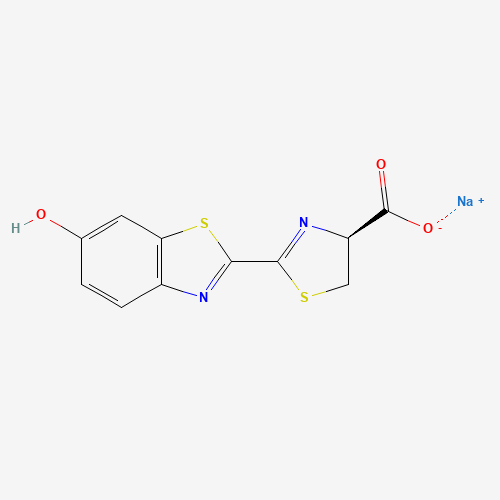
D-Luciferin sodium salt is used as a substrate which, upon oxidation by the enzyme luciferase, produces bioluminescence. This system is employed as a reporter in plants, bacteria, and mammalian cells. Because chemiluminescent techniques are virtually background-free, this reporter gene system is ideal for detecting low-level gene expression. A substrate that produces bioluminescence upon oxidation by the enzyme luciferase.Substrate for firefly luciferase with a Km of approx 2 μM.

All
Chemical Reagents
Biomedicine
Organic raw materials
Inorganic chemical industry
intermediate
Agricultural chemicals
Auxiliaries and catalysts
Fragrances and Flavors
Dyes and Pigments
Daily chemical industry
D-Luciferin sodium salt
Dangerous GoodsCAS number:103404-75-7 molecular formula:C11H7N2NaO3S2
overview
compound introduction
Specs
| Chinese alias | D-荧光素钠盐 | 萤火虫荧光素 钠盐 | 4,5-二氢-2-(6-羟基-2-苯并噻唑基)-4-噻唑羧酸 钠盐 | ( S )-2-(6-羟基-2-苯并噻唑基)-2-噻唑啉-4-羧酸 钠盐 | ||
| English alias | 103404-75-7 | D-Luciferin sodium salt | Sodium (S)-2-(6-hydroxybenzo[d]thiazol-2-yl)-4,5-dihydrothiazole-4-carboxylate | D-Luciferin Sodium | D-Luciferin (sodium) | D-Luciferin sodium salt monohydrate | C11H7N2NaO3S2 | (4S)-4,5-Dihydro-2-(6-hydroxy-2-benz | ||
| CAS number | 103404-75-7 | molecular formula | C11H7N2NaO3S2 |
| molecular weight | 302.3 g/mol | Exact mass | 10mM in DMSO |
| PSA | 139.000 Ų | logp | - |
numbering system
No numbering system information yet
physicochemical properties
No physical and chemical property information yet
Safety information
WGK Germany:
3
Production methods and uses
No production method and use information yet
Related
upstream information
No upstream information yet
downstream information
No downstream information yet
MSDS
Found 0 shareMSDS




