
Arg-Gly-Asp-Ser.It is a key component of the cell attachment domain of fibronectin. The RGDS sequence was found initially to promote the attachment of rat kidney fibroblasts (NRKcells) to fibronectin and synthetic fibronectin peptides coupled to protein-coated plastic. Further investigation indicated that the free RGDS peptide inhibited the attachment of NRK cells to fibronectin coated substrates. The RGDS sequence has been shown to occur in several other proteins, such as the λ receptor on E. coli and the Sindbis coat protein. RGDS is also a target sequence for spirochete adherence of the syphilis bacterium Treponema pallidum.It has been shown to block fibrinogen-induced aggregation of intact erythrocytes and specific binding of fibrinogen to erythrocyte membranes. The effect of RGDS on transforming growth factor β1 (TGFβ1) mRNA expression and secretion in cultured human mesangial cells has been investigated. RGDS has been utilized in a study of integrin-mediated signal transduction in cultured cells from the sponge Suberites domuncula. RGDS has been demonstrated to mitigate the binding of Mycobacterium tuberculosis to murine alveolar macrophages.A tetrapeptide that supports fibroblast attachment and inhibits fibronectin binding. Arg-Gly-Asp-Ser.It is a key component of the cell attachment domain of fibronectin. The RGDS sequence was found initially to promote the attachment of rat kidney fibroblasts (NRKcells) to fibronectin and synthetic fibronectin peptides coupled to protein-coated plastic. Further investigation indicated that the free RGDS peptide inhibited the attachment of NRK cells to fibronectin coated substrates. The RGDS sequence has been shown to occur in several other proteins, such as the λ receptor on E. coli and the Sindbis coat protein. RGDS is also a target sequence for spirochete adherence of the syphilis bacterium Treponema pallidum.It has been shown to block fibrinogen-induced aggregation of intact erythrocytes and specific binding of fibrinogen to erythrocyte membranes. The effect of RGDS on transforming growth factor β1 (TGFβ1) mRNA expression and secretion in cultured human mesangial cells has been investigated. RGDS has been utilized in a study of integrin-mediated signal transduction in cultured cells from the sponge Suberites domuncula. RGDS has been demonstrated to mitigate the binding of Mycobacterium tuberculosis to murine alveolar macrophages. A tetrapeptide that supports fibroblast attachment and inhibits fibronectin binding.
All
Chemical Reagents
Biomedicine
Organic raw materials
Inorganic chemical industry
intermediate
Agricultural chemicals
Auxiliaries and catalysts
Fragrances and Flavors
Dyes and Pigments
Daily chemical industry
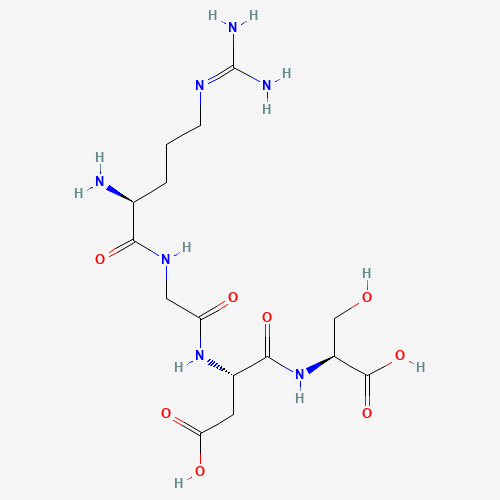
Arg-Gly-Asp-Ser
Dangerous GoodsCAS number:91037-65-9 molecular formula:C15H27N7O8
overview
compound introduction
Specs
| Chinese alias | L-精氨酰甘氨酰-L-alpha-天冬氨酰-L-丝氨酸 | ||
| English alias | RGDS | (S)-3-[2-((S)-2-Amino-5-guanidino-pentanoylamino)-acetylamino]-N-((R)-1-carboxy-2-hydroxy-ethyl)-succinamic acid | A916494 | C77102 | HY-12290 | Q27273860 | 3-[(S)-2-((S)-2-Amino-5-guanidino-pentanoylamino)-acetylamino]-N-(1-carboxy-2-hydroxy-ethyl | ||
| CAS number | 91037-65-9 | molecular formula | C15H27N7O8 |
| molecular weight | 433.42 g/mol | Exact mass | ≥95%(HPLC) |
| PSA | 273.000 Ų | logp | -7.300 |
numbering system
No numbering system information yet
physicochemical properties
No physical and chemical property information yet
Safety information
WGK Germany:
3
Personal protective equipment:
Eyeshields,Gloves,type N95 (US),type P1 (EN143) respirator filter
Production methods and uses
No production method and use information yet
Related
upstream information
No upstream information yet
downstream information
No downstream information yet
MSDS
Found 0 shareMSDS