Fire Potential:
Dangerous fire risk, solution highly flammable.
Adverse Effects:
Occupational hepatotoxin - Secondary hepatotoxins: the potential for toxic effect in the occupational setting is based on cases of poisoning by human ingestion or animal experimentation.
Hazards Summary:
Reacts with water evolving toxic and flammable gases and heat; Reacts violently with water; Extremely flammable; An irritant; May cause serious eye injury; May cause liver injury; Can be absorbed through skin; [MSDSonline] See Cyclohexylmagnesium chloride and Methylmagnesium chloride.
Disposal Methods:
SRP: Recycle any unused portion of the material for its approved use or return it to the manufacturer or supplier. Ultimate disposal of the chemical must consider: the material's impact on air quality; potential migration in air, soil or water; effects on animal, aquatic and plant life; and conformance with environmental and public health regulations. If it is possible or reasonable use an alternative chemical product with less inherent propensity for occupational harm/injury/toxicity or environmental contamination.
Toxicity Summary:
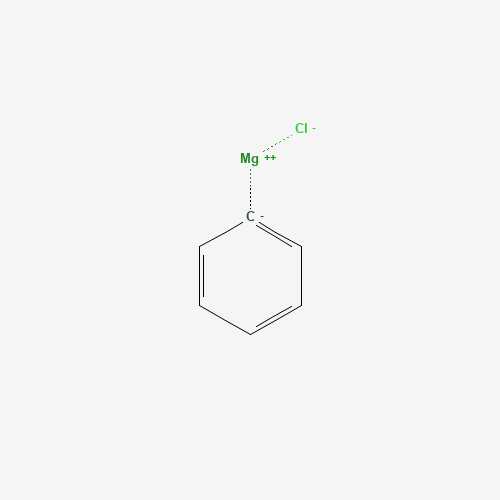
IDENTIFICATION AND USE: Phenylmagnesium chloride is used as a Grignard reagent in organic synthesis, especially in the production of hydrocarbons, alcohols, ketones, organic acids, amines, silicones, boranes. HUMAN STUDIES: There are no data available. ANIMAL STUDIES: There are no data available.
Environmental Fate:
ATMOSPHERIC FATE: Relevant vapor pressure data were not available for phenylmagnesium chloride(SRC, 2017). However, phenylmagnesium chloride reacts violently with water(1) and, therefore, both particulate phase and vapor phase phenylmagnesium chloride are expected to react with precipitation, cloud water, fog and possibly water vapor in the atmosphere(SRC).
Regulatory Information:
REACH Registered Substance: Status: Active Update: 14-06-2022 https://echa.europa.eu/registration-dossier/-/registered-dossier/10694
Soil Adsorption/Mobility:
Phenylmagnesium chloride reacts violently with water(1); therefore, leaching in moist soil is not expected to be an important fate process(SRC).
Artificial Pollution Sources:
Phenylmagnesium chloride's production and use in organic synthesis and as a Grignard reagent(1,2) may result in its release to the environment through various waste streams(SRC). Phenylmagnesium chloride is on the US DEA (Drug Enforcement Administration) list of special surveillance chemicals used in clandestine drug manufacture(3).
Hazard Classes and Categories:
Eye Dam. 1 (61%)
Environmental Bioconcentration:
Phenylmagnesium chloride reacts violently with water(1); therefore, the potential for bioconcentration in aquatic organisms low or non-existent(SRC).
Volatilization from Water/Soil:
Phenylmagnesium chloride reacts violently with water(1); therefore, volatilization from water surfaces or moist soil is not expected to be an important fate process(SRC).
Antidote and Emergency Treatment:
/SRP:/ Advanced treatment: Consider orotracheal or nasotracheal intubation for airway control in the patient who is unconscious, has severe pulmonary edema, or is in severe respiratory distress. Positive-pressure ventilation techniques with a bag valve mask device may be beneficial. Consider drug therapy for pulmonary edema ... . Consider administering a beta agonist such as albuterol for severe bronchospasm ... . Monitor cardiac rhythm and treat arrhythmias as necessary ... . Start IV administration of D5W TKO /SRP: "To keep open", minimal flow rate/. Use 0.9% saline (NS) or lactated Ringer's (LR) if signs of hypovolemia are present. For hypotension with signs of hypovolemia, administer fluid cautiously. Watch for signs of fluid overload ... . Treat seizures with diazepam or lorazepam...
Environmental Abiotic Degradation:
Phenylmagnesium chloride reacts violently with water(1). Phenylmagnesium chloride reacts with water, steam or acids to produce toxic and flammable vapors(2). Hydrolysis of a phenylmagnesium halide produces benzene with a potential release of hydrogen halide vapors such as hydrochloric acid (HCl) vapors(3). Phenylmagnesium chloride is sensitive to light and exposure to sunlight may cause explosive peroxides to form in the commercially sold tetrahydrofuran solutions of phenylmagnesium chloride(4).
Probable Routes of Human Exposure:
Occupational exposure to phenylmagnesium chloride may occur through dermal contact with this compound at workplaces where phenylmagnesium chloride is produced or used(SRC). The general population is not expected to be exposed to phenylmagnesium chloride(SRC). A possible rare exposure to the general population may be possible in the vicinity of its use as a reagent during illicit drug manufacture. Phenylmagnesium chloride is on the US DEA (Drug Enforcement Administration) list of special surveillance chemicals used in clandestine drug manufacture(1).
Environmental Fate/Exposure Summary:
Phenylmagnesium chloride's production and use in organic synthesis and as a Grignard reagent may result in its release to the environment through various waste streams. Phenylmagnesium chloride is on the US DEA (Drug Enforcement Administration) list of special surveillance chemicals used in clandestine drug manufacture. Phenylmagnesium chloride reacts violently with water, therefore, hydrolysis will be the dominant fate process in air, soil and water. Occupational exposure to phenylmagnesium chloride may occur through dermal contact with this compound at workplaces where phenylmagnesium chloride is produced or used. The general population is not expected to be exposed to phenylmagnesium chloride. A possible rare exposure to the general population may be possible in the vicinity of its u...
Hazardous Reactivities and Incompatibilities:
Reacts with water, steam or acids to produce toxic and flammable vapors with evolution of heat