
compound introduction
All
Chemical Reagents
Biomedicine
Organic raw materials
Inorganic chemical industry
intermediate
Agricultural chemicals
Auxiliaries and catalysts
Fragrances and Flavors
Dyes and Pigments
Daily chemical industry
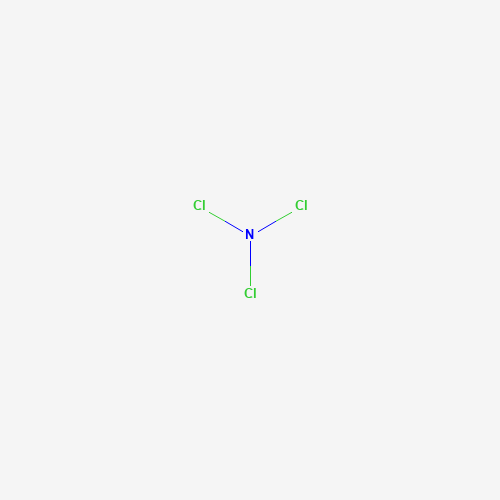
Nitrogen chloride(NCl3) (6CI,7CI,8CI,9CI)
CAS number:10025-85-1 molecular formula:ClN
overview
Specs
| Chinese alias | - | ||
| English alias | Agene; Chlorine nitride; Nitrogen trichloride; Trichloramine; Trichlorine nitride; Trichloroamine | ||
| CAS number | 10025-85-1 | molecular formula | ClN |
| molecular weight | 120.366 | Exact mass | - |
| PSA | - | logp | - |
numbering system
| CAS | 10025-85-1 |
| UNII | VA681HRW8W |
| HMDB ID | HMDB0034827 |
| ChEBI ID | 37382 |
| Wikidata | Q409473 |
| Wikipedia | Nitrogen trichloride |
| DrugBank ID | DB14645 |
| PubChem CID | 61437 |
| Nikkaji Number | J96.482D |
| DSSTox Substance ID | DTXSID4074938 |
| European Community (EC) Number | 233-045-1 |
| PubChem Reference Collection SID | 481107408 |
physicochemical properties
| Odor | Pungent |
| XLogP3 | XLogP3-AA: 2.6 |
| Density | 1.653 @25 °C |
| Color/Form | Yellow, thick, oily liquid |
| Complexity | 8 |
| Exact Mass | 118.909632 |
| Solubility | Soluble in phosphorus trichloride |
| Boiling Point | 160 °F |
| Decomposition | Upon decomposition it emits toxic fumes of Cl(-) and NO(x) |
| Formal Charge | 0 |
| Melting Point | -40 °F |
| Vapor Pressure | 150 [mm Hg] @20 °C |
| Chemical Classes | Nitrogen Compounds -> Other Nitrogen Compounds |
| Heavy Atom Count | 4 |
| Molecular Weight | 120.36 |
| Monoisotopic Mass | 118.909632 |
| Isotope Atom Count | 0 |
| Physical Description | Yellow oily liquid with pungent odor. |
| Rotatable Bond Count | 0 |
| Stability/Shelf Life | ... Evaporates rapidly in air, very unstable. |
| Hydrogen Bond Donor Count | 0 |
| Covalently-Bonded Unit Count | 1 |
| Hydrogen Bond Acceptor Count | 1 |
| Other Experimental Properties | Evaporates rapidly in air ... Decomposes in light |
| Topological Polar Surface Area | 3.2 Ų |
| Defined Atom Stereocenter Count | 0 |
| Defined Bond Stereocenter Count | 0 |
| Undefined Atom Stereocenter Count | 0 |
| Undefined Bond Stereocenter Count | 0 |
Safety information
Interactions:
In this study an in vitro exposure test to investigate toxicological effects of the volatile disinfection by-product trichloramine and of real indoor pool air was established. For this purpose a set-up to generate a well-defined, clean gas stream of trichloramine was combined with biotests. Human alveolar epithelial lung cells of the cell line A-549 were exposed in a CULTEX() device with trichloramine concentrations between 0.1 and 40 mg/cu m for 1 hr. As toxicological endpoints the cell viability and the inflammatory response by the cytokines IL-6 and IL-8 were investigated. A decreasing cell viability could be observed with increasing trichloramine concentration. An increase of IL-8 release could be determined at trichloramine concentrations higher than 10 mg/cu m and an increase of I...
Toxicity Data:
LC50 (rat) = 112 ppm/1H
Adverse Effects:
Asthma - Reversible bronchoconstriction (narrowing of bronchioles) initiated by the inhalation of irritating or allergenic agents.
Hazards Summary:
Occupational asthma in indoor pool workers (lifeguards and a swimming teacher) confirmed by specific bronchoprovocation testing; [Malo] Chloramines include chloramide (NH2Cl), dichloramide (NHCl2), and trichloramide (NCl3). Tricloramide, also called nitrogen chloride or nitrogen trichloride, was the predominant vapor found in the indoor pool environment with a high chlorine to nitrogen ratio. All three swimming pools the study had been treated with sodium hypochlorite. Measured levels of NCl3 ranged from 0.23-0.57 mg/m3 in one pool and 0.1-0.31 in another pool. The concentration used for the challenge tests was 0.5 mg/m3. All 3 workers had immediate asthmatic reactions to the challenge tests, and one had an additional late reaction. [See Reference #1]
Disposal Methods:
SRP: Recycle any unused portion of the material for its approved use or return it to the manufacturer or supplier. Ultimate disposal of the chemical must consider: the material's impact on air quality; potential migration in air, soil or water; effects on animal, aquatic and plant life; and conformance with environmental and public health regulations. If it is possible or reasonable use an alternative chemical product with less inherent propensity for occupational harm/injury/toxicity or environmental contamination.
Toxicity Summary:
IDENTIFICATION AND USE: Nitrogen chloride is a yellow, oily liquid, which explodes easily. It was used as a flour bleach (no longer permitted in US). It is a volatile chlorination by-product and a potent respiratory irritant present in swimming pools. HUMAN STUDIES: The most commonly reported symptoms consisted of cough, dyspnea, tearing eyes and blocked or runny nose. Airway hyperreactivity to histamine was also detected in exposed subjects. Cases of workers who developed occupational asthma following exposure to airborne nitrogen chloride in indoor chlorinated swimming pools are reported. Epidemiology studies show that lifeguards and trainers experience ocular and respiratory irritative symptoms from nitrogen chloride more frequently than employees not exposed. Cleaning and disinfecti...
Preventive Measures:
SRP: The scientific literature for the use of contact lenses by industrial workers is inconsistent. The benefits or detrimental effects of wearing contact lenses depend not only upon the substance, but also on factors including the form of the substance, characteristics and duration of the exposure, the uses of other eye protection equipment, and the hygiene of the lenses. However, there may be individual substances whose irritating or corrosive properties are such that the wearing of contact lenses would be harmful to the eye. In those specific cases, contact lenses should not be worn. In any event, the usual eye protection equipment should be worn even when contact lenses are in place.
Regulatory Information:
The Australian Inventory of Industrial Chemicals: Chemical: Nitrogen chloride (NCl3)
Human Toxicity Excerpts:
/EPIDEMIOLOGY STUDIES/ The hypothesis that attendance at indoor chlorinated swimming pool is a risk factor for irritative ocular and respiratory symptoms and bronchial asthma is well known in literature, although epidemiological evidence is still inconclusive. The aim of this study was to evaluate the association between airborne trichloramine (NCl(3)) levels and irritative symptoms in swimming pool employees in order to obtain detailed data regarding dose-response relationships and to identify the airborne NCl(3) exposure level, if any, without health effects. A total of 20 indoor swimming pools in the Emilia Romagna region of Italy were included in the study. Information about the health status of 128 employees was collected using a self-administered questionnaire. Exposure to airborn...
DOT Hazard Classification:
Hazard Class/Label Code(s): Forbidden explosives/materials (49 eCFR § 173.54/§ 173.21)
Non-Human Toxicity Values:
LC50 Rats, inhalation 112 ppm/1 hr
Non-Human Toxicity Excerpts:
/LABORATORY ANIMALS: Subchronic or Prechronic Exposure/ The subchronic toxicity of 0.2-200 ppm dichloramine and 0.2-90 ppm trichloramine in the drinking water of rats was investigated using biochemical, hematological, and histopathological parameters. Animals in the highest dose groups consumed 5-15% less fluid than controls with no significant decrease in body weight gain. No clinical signs of toxicity were observed in either case. Both males and females dosed with 90 ppm trichloramine had significantly increased relative kidney/body weights and the females had increased hepatic glutathione S-transferase and UPD-glucuronosyltransferase activities. No significant changes were detected in other xenobiotic metabolizing enzymes or in serum biochemistry, urine biochemistry, or hematology. B...
Explosive Limits and Potential:
Nitrogen trichloride is an explosive substance. Even grease from fingers can cause explosion.
Antidote and Emergency Treatment:
/SRP:/ Immediate first aid: Ensure that adequate decontamination has been carried out. If patient is not breathing, start artificial respiration, preferably with a demand-valve resuscitator, bag-valve-mask device, or pocket mask, as trained. Perform CPR if necessary. Immediately flush contaminated eyes with gently flowing water. Do not induce vomiting. If vomiting occurs, lean patient forward or place on left side (head-down position, if possible) to maintain an open airway and prevent aspiration. Keep patient quiet and maintain normal body temperature. Obtain medical attention. /Chlorine and related compounds/
Protective Action Criteria (PAC):
PAC-3: 3.1 [ppm]
Environmental Abiotic Degradation:
Nitrogen chloride is degraded by UV irradiation with low and medium pressure mercury lamps; quantum yield slightly above 2 mol/einstien in purified and pool water(1).
Other Environmental Concentrations:
Nitrogen chloride is formed as a disinfection by-product in recreational pool water(1).
Skin, Eye, and Respiratory Irritations:
An irritant to the eyes, skin, mucous membranes...
Hazardous Reactivities and Incompatibilities:
During preparation of nitrogen trichloride by bubbling chlorine into an aqueous solution of ammonium sulfate and 100 mL of the ether, 50 mL of the ether-NCl3 mixture over ammonium sulfate solution was stored in a refrigerator. Five minutes later, the mixture exploded violently.
Hazard Quotient Level 3 or Cancer Risk Level 1E-04:
Fraction of Contaminant Absorbed Dermally from Soil: 0.1
Hazard Quotient Level 0.1 or Cancer Risk Level 1E-06:
Fraction of Contaminant Absorbed Dermally from Soil: 0.1
Production methods and uses
Production method
Trichloramine is prepared by reaction of (NH4)2SO4 with Cl2 or HOCl with ammonia in a 3:1 M ratio at pH 3-4.
purpose
Bleaching of flour; wastage control of citrus fruit.
Related
upstream information
Methods of Manufacturing:
Trichloramine (CID:61437); ammonia (CID:222); hypochlorous acid (CID:24341); ammonium chloride (CID:25517)
downstream information
No downstream information yet
MSDS
Found 0 shareMSDS