

compound introduction
All
Chemical Reagents
Biomedicine
Organic raw materials
Inorganic chemical industry
intermediate
Agricultural chemicals
Auxiliaries and catalysts
Fragrances and Flavors
Dyes and Pigments
Daily chemical industry
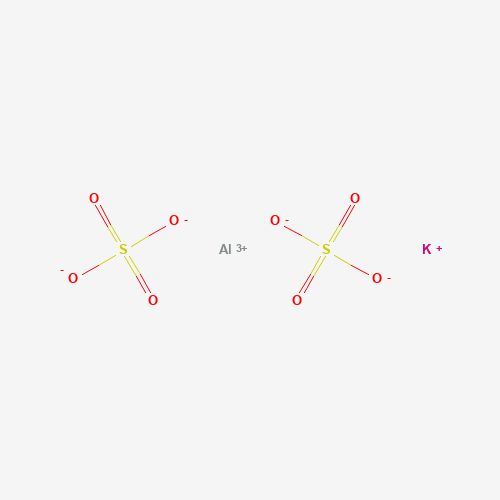
Sulfuric acid, aluminum potassium salt
CAS number:10043-67-1 molecular formula:Al.2O4S.K
overview
Specs
| Chinese alias | - | ||
| English alias | alum potassium; alum, potassium; aluminum potassium disulfate; aluminum potassium sulfate; aluminum potassium sulfate alum; aluminum potassium sulfate, anhydrous; burnt alum | ||
| CAS number | 10043-67-1 | molecular formula | Al.2O4S.K |
| molecular weight | 348.27 | Exact mass | - |
| PSA | - | logp | - |
numbering system
| CAS | 10043-67-1 |
| UNII | 09OXB01F3O |
| RXCUI | 221456 |
| ChEBI ID | 86463 |
| Wikipedia | Kalinite |
| DrugBank ID | DB09087 |
| PubChem CID | 24856 |
| Related CAS | 10043-01-3 (Parent) |
| Deprecated CAS | 2803568-36-5 |
| NCI Thesaurus Code | C82278 |
| DSSTox Substance ID | DTXSID9039234 |
| European Community (EC) Number | 233-141-3 |
| PubChem Reference Collection SID | 505863626 |
| MEP ID | _25Q1B3FND |
physicochemical properties
| pH | Between 3,0 and 4,0 (10 % solution) |
| Taste | STYPTIC |
| Density | ODORLESS; SWEETISH, ASTRINGENT TASTE; DENSITY 1.725; MP 92.5 °C. /POTASSIUM ALUM DODECAHYDRATE/ |
| Color/Form | WHITE POWDER |
| Complexity | 62.2 |
| Exact Mass | 257.8487042 |
| Solubility | 1 G DISSOLVES IN ABOUT 20 ML COLD WATER, ABOUT 1 ML BOILING WATER, INCOMPLETELY; PRACTICALLY INSOL IN ALC. |
| Boiling Point | 200 °C |
| Formal Charge | 0 |
| Melting Point | 92.5 °C |
| Food Additives | FIRMING AGENT, FUMIGANT, PH CONTROL AGENT -> FDA Substance added to food |
| Chemical Classes | Metals -> Metals, Inorganic Compounds |
| Heavy Atom Count | 12 |
| Molecular Weight | 258.21 |
| Refractive Index | INDEX OF REFRACTION: 1.454, 1.4564; HEXAGONAL: 1.456, 1.429 /POTASSIUM ALUM DODECAHYDRATE/ |
| Monoisotopic Mass | 257.8487042 |
| Isotope Atom Count | 0 |
| Physical Description | White hygroscopic solid; Colorless odorless crystals; Partially soluble in water; [MSDSonline] |
| Rotatable Bond Count | 0 |
| Stability/Shelf Life | WHEN KEPT LONG TIME @ 60-65 °C (OR OVER SULFURIC ACID) LOSES 9 H2O WHICH IS REABSORBED ON EXPOSURE TO AIR. /POTASSIUM ALUM DODECAHYDRATE/ |
| Hydrogen Bond Donor Count | 0 |
| Covalently-Bonded Unit Count | 4 |
| Hydrogen Bond Acceptor Count | 8 |
| Topological Polar Surface Area | 177 Ų |
| Defined Atom Stereocenter Count | 0 |
| Defined Bond Stereocenter Count | 0 |
| Undefined Atom Stereocenter Count | 0 |
| Undefined Bond Stereocenter Count | 0 |
Safety information
Treatment:
EYES: irrigate opened eyes for several minutes under running water. INGESTION: do not induce vomiting. Rinse mouth with water (never give anything by mouth to an unconscious person). Seek immediate medical advice. SKIN: should be treated immediately by rinsing the affected parts in cold running water for at least 15 minutes, followed by thorough washing with soap and water. If necessary, the person should shower and change contaminated clothing and shoes, and then must seek medical attention. INHALATION: supply fresh air. If required provide artificial respiration.
Body Burden:
Aluminum content of normal human brain ranged from 0.1-3.9 ug/g dry weight. In a study of 208 samples taken from 7 patients, ... a mean aluminum content of 1.9 + or - 0.07 ug/g dry weight of gray matter /was found/ to be abnormal. In a study of 585 areas sampled from the brain tissue of 10 patients with Alzheimer's disease they found 28% had an aluminum concn > 4 ug/g. The range of the 585 samples was 0.4-107 ug/g. /Aluminum/
Health Effects:
Aluminum targets the nervous system and causes decreased nervous system performance and is associated with altered function of the blood-brain barrier. The accumulation of aluminum in the body may cause bone or brain diseases. High levels of aluminum have been linked to Alzheimer's disease. A small percentage of people are allergic to aluminium and experience contact dermatitis, digestive disorders, vomiting or other symptoms upon contact or ingestion of products containing aluminium. (L739, L740)
Cleanup Methods:
ALUMINUM WAS RECOVERED FROM ALUM SLUDGE AT A WATER TREATMENT PLANT BY ADDN OF SULFURIC ACID. OPTIMUM PH WAS 2.0 FOR ALUMINUM RECOVERY. UNDER OPTIMAL CONDITIONS, THE RECOVERED ALUM IS AS EFFICIENT AS VIRGIN ALUMINUM IN TREATMENT OF SEWAGE FOR PHOSPHORUS REMOVAL. /ALUMINUM/
Exposure Routes:
Oral (L739); inhalation (L739)
Hazards Summary:
An irritant; [MSDSonline] See Aluminum potassium sulfate dodecahydrate. See Aluminum.
Primary Hazards:
Not Classified
FDA Requirements:
Aluminum potassium sulfate used as a general purpose food additive in animal drugs, feeds, and related products is generally recognized as safe when used in accordance with good manufacturing or feeding practice.
Toxicity Summary:
The main target organs of aluminum are the central nervous system and bone. Aluminum binds with dietary phosphorus and impairs gastrointestinal absorption of phosphorus. The decreased phosphate body burden results in osteomalacia (softening of the bones due to defective bone mineralization) and rickets. Aluminum's neurotoxicity is believed to involve several mechanisms. Changes in cytoskeletal protein functions as a results of altered phosphorylation, proteolysis, transport, and synthesis are believed to be one cause. Aluminum may induce neurobehavioral effects by affecting permeability of the blood-brain barrier, cholinergic activity, signal transduction pathways, lipid peroxidation, and impair neuronal glutamate nitric oxide-cyclic GMP pathway, as well as interfere with metabolism of...
Environmental Fate:
Albic and spodic soil horizons were sampled from old growth eastern white pine/mixed northern hardwoods sites in the Adirondacks, and an ochric soil horizon was sampled from the Appalachian Plateau of NY State. 9 Three horizon forest floor, 9 mineral soil (field moist equivalent of 12.0 oven dry albic, spodic, or ochric mineral soil) and 9 forest floor/mineral soil columns were leached with 60 ml of (a) 10 mM ammonium nitrate (control), (b) 1.0 mM nitric acid in 10 mM ammonium nitrate (pH 3), and (c) 1.0 mM ammonium nitrate (pH 3) at the rate of 10 ml/hr. The above procedure was repeated on each mineral soil without a forest floor, except leaching soln were 0.5 mM calcium nitrate or calcium sulfate, each in 10 mM ammonium nitrate. Adding 2 and 0.5 cmol sub c (H+)/kg to forest floor and...
Minimum Risk Level:
Intermediate Oral: 1.0 mg/kg/day (L134) Chronic Oral: 1.0 mg/kg/day (L134)
Signs and Symptoms:
Inhalating aluminum dust causes coughing and abnormal chest X-rays. A small percentage of people are allergic to aluminium and experience contact dermatitis, digestive disorders, vomiting or other symptoms upon contact or ingestion of products containing aluminium. (L739, L740)
Regulatory Information:
New Zealand EPA Inventory of Chemical Status: Aluminum potassium disulphate: Does not have an individual approval but may be used under an appropriate group standard
Acceptable Daily Intakes:
Recommended adult daily allowance for potassium at 1 g. /Potassium; from Table 1/
Other Safety Information:
Chemical Assessment: Evaluation - Use of aluminium in antiperspirants
Carcinogen Classification:
Not listed by IARC. IARC classified aluminum production as carcinogenic to humans (Group 1), but did not implicate aluminum itself as a human carcinogen. (L135) A link between use of aluminum-containing antiperspirants and increased risk of breast cancer has been proposed (A235), but studies have not been able to establish a clear link (A15468).
Natural Pollution Sources:
THE CRUDE LUMP ALUM AS IT OCCURS WITH EARTH ATTACHED HAS BEEN KNOWN AS ROCK ALUM (ALUMEN RUPEUM) AND AS ROMAN ALUM. /ALUM/
Artificial Pollution Sources:
ACTIVITIES OF MAN INCR ALUMINUM CONTENT IN SURFACE WATER ... . /ALUMINUM/
Hazard Classes and Categories:
Not Classified
Antidote and Emergency Treatment:
Deferoxamine has been used to treat dialysis encephalopathy and osteomalacia with symptomatic relief reported. The use of deferoxamine for aluminum-toxic dialysis patients has been suggested for serum levels of aluminum between 100 and 200 ug/ml. Deferoxamine also has been used to diagnose aluminum-related osteodystrophy. After a deferoxamine infusion of 40 mg/kg over 2 hours, an increment in plasma aluminum concentration of 200 ug/l identified 35 of 37 patients with biopsy-proven aluminum-related osteodystrophy (sensitivity, 94%; specificity, 50%). Calcium disodium ethylenediaminetetraacetic acid does not appear as effective as deferoxamine in chelating aluminum. Especially in dialysis patients, aluminum-containing medications should be reduced. /Aluminum/
Probable Routes of Human Exposure:
Electrolytic production of aluminum can lead to a substantial exposure to fluorides and carcinogenic tar oils, including polyaromatic hydrocarbons. /Aluminum/
Environmental Water Concentrations:
The solute and particulate aluminum (Al) chemistry of a relatively unpolluted snowfall associated with a maritime airmass was measured by neutron activation analysis and inductively coupled plasma analysis (soluble fraction) and neutron activation analysis (particulate material), to characterize background conditions for the Scottish Highlands. Aluminum concentrations were compared to those found in a polluted black snowfall with a trajectory that originated over eastern Europe and to those levels found in seasonal snowpack. The variability of the concentration of solute and the chemical composition of particulate material is reported on an intra- and intersite basis. The solute aluminum content of Scottish snowfall in the intersite survey was 19.2 ug/l, and in the intrasite survey 52.2...
Production methods and uses
Production method
ALUM IS PREPARED FROM THE MINERAL BAUXITE AND SULFURIC ACID, WITH ADDITION OF ... POTASSIUM SULFATE ... .
purpose
Uses:
Potassium alum or potash alum is an astringent/styptic and antiseptic and is commonly used in water purification, leather tanning, fireproof textiles, and baking powder. It also has cosmetic uses as a deodorant and as an aftershave treatment. (L776)
Consumer Uses:
Crystal growth modifiers (nucleating agents)
Industry Uses:
Soil amendments (fertilizers)
Use Classification:
Cosmetics -> Deodorant; Antiperspirant
General Manufacturing Information:
Industry Processing Sectors: Food, beverage, and tobacco product manufacturing
Related
upstream information
Methods of Manufacturing:
SULFURIC ACID (CID:1118); POTASSIUM SULFATE (CID:24507); aluminum sulfate (CID:24850); POTASSIUM ALUM (CID:24856); SODIUM BICARBONATE (CID:516892)
downstream information
No downstream information yet
MSDS
Found 0 shareMSDS




