
All
Chemical Reagents
Biomedicine
Organic raw materials
Inorganic chemical industry
intermediate
Agricultural chemicals
Auxiliaries and catalysts
Fragrances and Flavors
Dyes and Pigments
Daily chemical industry

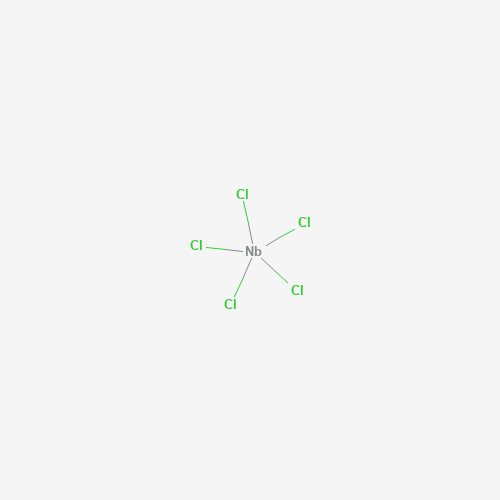
Niobium chloride

Dangerous Goods

CAS number:10026-12-7    molecular formula:NbCl5

overview

compound introduction

用于形成混合的氯-芳族氧化物,如 [Nb(OC6H3-2 6-i-Pr2)2Cl3]2,它们可形成具有六配位扭曲几何构型的吡啶或膦加合物。和水反应。 Used to form mixed chloro-aryloxide compounds, such as [Nb(OC6H3-2,6-i-Pr2)2Cl3]2, which form pyridine or phosphine adducts with a distorted six-coordinate geometry.


Specs

Chinese alias氯化铌(V)
English aliasColumbium pentachloride | UNII-9S1BC7865F | Niobium(V) chloride, Puratronic? | Niobium chloride (NbCl5) | Q417510 | MFCD00011127 | NbCl5 | Niobium(V) chloride, >=99.9% trace metals basis | AMPERTEC? Niobium Pentachloride NbCl5 | DTXSID7044348 | Niobium(V)
CAS number10026-12-7molecular formulaNbCl5
molecular weight270.17 g/molExact mass≥99%
PSA0.000 Ųlogp-

numbering system

CAS10026-12-7
WikipediaNiobium pentachloride
PubChem CID24818
DSSTox Substance IDDTXSID7044348
European Community (EC) Number233-059-8
PubChem Reference Collection SID500809391
MEP ID_25Q1B3FM8

physicochemical properties

Density2.75 @25 °C
Complexity37.1
Exact Mass269.74769
Boiling Point247.4 °C @760 [mm Hg]
Formal Charge0
Melting Point205.8 °C
Chemical ClassesMetals -> Metals, Inorganic Compounds
Heavy Atom Count6
Molecular Weight270.2
Monoisotopic Mass267.75064
Isotope Atom Count0
Physical DescriptionYellow highly deliquescent solid; Yellow lumps with an acidic odor; [Alfa Aesar MSDS]
Rotatable Bond Count0
Hydrogen Bond Donor Count0
Covalently-Bonded Unit Count1
Hydrogen Bond Acceptor Count0
Topological Polar Surface Area0 Ų
Defined Atom Stereocenter Count0
Defined Bond Stereocenter Count0
Undefined Atom Stereocenter Count0
Undefined Bond Stereocenter Count0

Safety information

Adverse Effects:
Toxic Pneumonitis - Inflammation of the lungs induced by inhalation of metal fumes or toxic gases and vapors.
Hazards Summary:
Causes diffuse hepatitis, fatty liver degeneration, and renal tubular changes in oral lethal-dose studies of rats and mice; Causes abnormal liver function tests and other GI changes in 17-week intermittent oral studies of rabbits; [RTECS] Decomposed by moisture forming hydrogen chloride; Reacts with water producing hydrochloric acid; Causes burns; Inhalation may cause corrosive injuries to upper respiratory tract and lungs; Harmful by ingestion; [Alfa Aesar MSDS] See Niobium.
Regulatory Information:
New Zealand EPA Inventory of Chemical Status: Niobium (V) chloride: Does not have an individual approval but may be used under an appropriate group standard
Hazard Classes and Categories:
Skin Corr. 1B (100%)
Protective Action Criteria (PAC):
PAC-3: 280 [mg/m3]

Production methods and uses

purpose
Uses:
Sources/Uses: Used as a Lewis acid catalyst in organic synthesis

Related

upstream information

No upstream information yet

downstream information

No downstream information yet

MSDS

Found 1 shareMSDS
10026-12-7 | Niobium pentachloride | niobium pentachloride