

compound introduction
All
Chemical Reagents
Biomedicine
Organic raw materials
Inorganic chemical industry
intermediate
Agricultural chemicals
Auxiliaries and catalysts
Fragrances and Flavors
Dyes and Pigments
Daily chemical industry
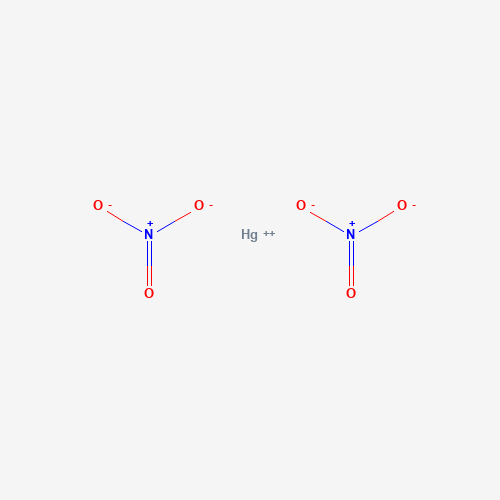
Mercury nitrate
Dangerous GoodsCAS number:10045-94-0 molecular formula:HgN2O6
overview
Specs
| Chinese alias | - | ||
| English alias | Nitric acid, mercury salt; Mercuric nitrate; mercury nitrate; citrine ointment; mercury dinitrate | ||
| CAS number | 10045-94-0 | molecular formula | HgN2O6 |
| molecular weight | 324.6 | Exact mass | - |
| PSA | - | logp | - |
numbering system
| CAS | 10045-94-0 |
| UNII | 2FMV9338BW |
| UN Number | 1625 |
| Wikipedia | Mercury(II)_nitrate |
| ICSC Number | 0980 |
| PubChem CID | 24864 |
| Related CAS | 24670-15-3 (Parent) |
| Deprecated CAS | 820986-03-6 |
| DSSTox Substance ID | DTXSID9044162 |
| European Community (EC) Number | 233-152-3 |
| PubChem Reference Collection SID | 518180300 |
| MEP ID | _25Q1B3FNI |
physicochemical properties
| Odor | Sharp odor |
| Density | 4.4 g/cm³ |
| Color/Form | White granules or crystalline powder; colorless, rhombic crystals. |
| Complexity | 18.8 |
| Exact Mass | 325.946279 |
| Solubility | Solubility in water: good |
| Corrosivity | Solution will corrode most metals. |
| Formal Charge | 0 |
| Melting Point | 79 °C |
| Chemical Classes | Metals -> Mercury Compounds, Inorganic |
| Heavy Atom Count | 9 |
| Molecular Weight | 324.60 |
| Monoisotopic Mass | 325.946279 |
| Isotope Atom Count | 0 |
| Physical Description | COLOURLESS CRYSTALS OR WHITE HYGROSCOPIC POWDER. |
| Rotatable Bond Count | 0 |
| Stability/Shelf Life | Decomposed by heat |
| Hydrogen Bond Donor Count | 0 |
| Covalently-Bonded Unit Count | 3 |
| Hydrogen Bond Acceptor Count | 6 |
| Other Experimental Properties | With much water or on boiling with water an insol basic salt is formed; deliquescent odor of nitric acid; white or slightly yellow crystalline powder; density: 4.3; sol in small amt water; sol in dilute acids /Mercuric nitrate hydrate/ |
| Topological Polar Surface Area | 126 Ų |
| Defined Atom Stereocenter Count | 0 |
| Defined Bond Stereocenter Count | 0 |
| Undefined Atom Stereocenter Count | 0 |
| Undefined Bond Stereocenter Count | 0 |
Safety information
DOT Label:
Poison
First Aid:
ERG2024, Guide 141 (Mercuric nitrate): In Canada, an Emergency Response Assistance Plan (ERAP) may be required for this product. Please consult the shipping paper and/or the "ERAP" section.
Treatment:
Mercury poisoning is treated by immediate decontamination and chelation therapy using DMSA, DMPS, DPCN, or dimercaprol. Methemoglobinemia can be treated with supplemental oxygen and methylene blue 1% solution administered intravenously slowly over five minutes followed by IV flush with normal saline. Methylene blue restores the iron in hemoglobin to its normal (reduced) oxygen-carrying state. (L1613, A7)
Fire Hazards:
Not combustible but enhances combustion of other substances. Gives off irritating or toxic fumes (or gases) in a fire.
Safe Storage:
Separated from combustible substances, reducing agents and food and feedstuffs. See Chemical Dangers. Keep in the dark. Store in an area without drain or sewer access. Provision to contain effluent from fire extinguishing. Well closed. Store only in original container.
Fire Fighting:
In case of fire in the surroundings, use appropriate extinguishing media.
Toxicity Data:
LD50: 26 mg/kg (Oral, Rat) (L443) LD50: 75 mg/kg (Dermal, Rat) (L443) LD50: 7 mg/kg (Intraperitoneal, Mouse) (L443)
Eye Prevention:
Wear face shield or eye protection in combination with breathing protection.
Fire Potential:
May increase the intensity of fire if in contact with burning material. Solid in contact with wood or paper may cause fire. /Mercuric nitrate monohydrate/
Health Effects:
Mercury mainly affects the nervous system. Exposure to high levels of metallic, inorganic, or organic mercury can permanently damage the brain, kidneys, and developing fetus. Effects on brain functioning may result in irritability, shyness, tremors, changes in vision or hearing, and memory problems. Acrodynia, a type of mercury poisoning in children, is characterized by pain and pink discoloration of the hands and feet. Mercury poisoning can also cause Hunter-Russell syndrome and Minamata disease. Nitrate and nitrite poisoning causes methemoglobinemia. Nitrites may cause pregnancy complications and developmental effects. They may also be carcinogenic. (L1137, L7)
Health Hazards:
ERG2024, Guide 141 (Mercuric nitrate): · Runoff from fire control or dilution water may cause environmental contamination.
OSHA Standards:
Vacated 1989 OSHA PEL still enforced in some states: Hg vapor, TWA 0.05 mg/cu m, skin; Non-alkyl cmpds, Ceiling 0.1 mg/cu m, skin. /Mercury cmpd, as Hg, (except (organo) alkyls)/
Reactive Group:
Nitrate and Nitrite Compounds, Inorganic
Adverse Effects:
Reproductive Toxin - A chemical that is toxic to the reproductive system, including defects in the progeny and injury to male or female reproductive function. Reproductive toxicity includes developmental effects. See Guidelines for Reproductive Toxicity Risk Assessment.
Exposure Routes:
Oral (L7); inhalation (L7); dermal (L7)
Hazards Summary:
See Mercury; Very toxic by ingestion; Cases of poisoning reported after inhalation exposures of 1.2-8.5 mg/m 3; [CAMEO] See Mercury, inorganic compounds and the linked diseases.
Inhalation Risk:
A harmful concentration of airborne particles can be reached quickly when dispersed.
Skin Prevention:
Protective gloves. Protective clothing.
DOT ID and Guide:
1625 141
Disposal Methods:
Generators of waste (equal to or greater than 100 kg/mo) containing this contaminant, EPA hazardous waste number D009, must conform with USEPA regulations in storage, transportation, treatment and disposal of waste.
Toxicity Summary:
High-affinity binding of the divalent mercuric ion to thiol or sulfhydryl groups of proteins is believed to be the major mechanism for the activity of mercury. Through alterations in intracellular thiol status, mercury can promote oxidative stress, lipid peroxidation, mitochondrial dysfunction, and changes in heme metabolism. Mercury is known to bind to microsomal and mitochondrial enzymes, resulting in cell injury and death. For example, mercury is known to inhibit aquaporins, halting water flow across the cell membrane. It also inhibits the protein LCK, which causes decreased T-cell signalling and immune system depression. Mercury is also believed to inhibit neuronal excitability by acting on the postsynaptic neuronal membrane. It also affects the nervous system by inhibiting protein...
EC Classification:
Symbol: T+, N; R: 26/27/28-33-50/53; S: (1/2)-13-28-45-60-61; Note: A, 1
RCRA Requirements:
D009; A solid waste containing mercury may or may not become characterized as a hazardous waste when subjected to the Toxicity Characteristic Leaching Procedure listed in 40 CFR 261.24, and if so characterized, must be managed as a hazardous waste. /Mercury/
Reactivity Alerts:
Strong Oxidizing Agent
Spillage Disposal:
Consult an expert! Personal protection: complete protective clothing including self-contained breathing apparatus. Do NOT let this chemical enter the environment. Sweep spilled substance into covered containers. Carefully collect remainder. Then store and dispose of according to local regulations. Do NOT absorb in saw-dust or other combustible absorbents.
UN Classification:
UN Hazard Class: 6.1; UN Pack Group: II
First Aid Measures:
Ingestion First Aid: Rinse mouth. Give one or two glasses of water to drink. Refer for medical attention .
Minimum Risk Level:
Chronic Inhalation: 0.0002 mg/m3 (L134)
Reactivity Profile:
MERCURIC NITRATE is noncombustible, but, as an oxidizing agent, will accelerate the burning of combustible materials. If large quantities are involved in a fire or the combustible material is finely divided, an explosion may result. Light sensitive. Mixtures with alkyl esters may explode, owing to the formation of alkyl nitrates. Mixtures with phosphorus, tin(II) chloride, or other reducing agents may react explosively [Bretherick 1979. p. 108-109]. Acetylene forms a sensitive acetylide when passed into an aqueous solution of mercuric nitrate [Mellor 4:933. 1946-47]. Should not be mixed with alcohols as explosive mercury fulminates may be formed [Bahme 1961. p. 9]. Is violently reduced by hypophosphoric acid [Mellor 4:993. 1946-47]. Reacts with phosphine to give a yellow precipitate tha...
Signs and Symptoms:
Common symptoms include peripheral neuropathy (presenting as paresthesia or itching, burning or pain), skin discoloration (pink cheeks, fingertips and toes), edema (swelling), and desquamation (dead skin peels off in layers). Nitrate and nitrite poisoning causes methemoglobinemia. Symptoms include cyanosis, cardiac dysrhythmias and circulatory failure, and progressive central nervous system (CNS) effects. CNS effects can range from mild dizziness and lethargy to coma and convulsions. (L1137, A5)
Storage Conditions:
Storage temperature: Ambient; Venting: Open
Exposure Prevention:
AVOID ALL CONTACT! IN ALL CASES CONSULT A DOCTOR!
Preventive Measures:
Preventative measure: adequate ventilation; careful attention to good housekeeping, e.g., avoidance of spills, and prompt and proper cleaning if a spill occurs; all containers of mercury and its compounds should be kept tightly closed; should be washed on a regular basis with dilute calcium sulfide solution or other suitable reactant; floors should be nonporous; all workers directly involved in the plant operation should shower thoroughly each day before leaving. /Mercury compounds/
Ingestion Prevention:
Do not eat, drink, or smoke during work. Wash hands before eating.
Inhalation Prevention:
Use local exhaust or breathing protection.
NIOSH Recommendations:
Recommended Exposure Limit: Ceiling Value: 0.1 mg/cu m, skin. /Mercury compounds [except (organo) alkyls] (as Hg)/
Nonfire Spill Response:
LARGE SPILL: Dike far ahead of spill for later disposal. (ERG, 2024)
Air and Water Reactions:
Deliquescent. Soluble in a small amount of water. With much water or on boiling with water, an insoluble basic salt is formed.
ICSC Environmental Data:
The substance is very toxic to aquatic organisms. Bioaccumulation of this chemical may occur in aquatic organisms. It is strongly advised not to let the chemical enter into the environment because it is persistent.
Packaging and Labelling:
Unbreakable packaging. Put breakable packaging into closed unbreakable container. Do not transport with food and feedstuffs. Severe marine pollutant.
Fire Fighting Procedures:
If material on fire or involved in fire: Flood with water. Cool all affected containers with flooding quantities of water. Apply water from as far a distance as possible.
Isolation and Evacuation:
Evacuation: ERG2024, Guide 141 (Mercuric nitrate): · If tank, rail tank car or highway tank is involved in a fire, ISOLATE for 800 meters (1/2 mile) in all directions; also, consider initial evacuation for 800 meters (1/2 mile) in all directions.
Other Safety Information:
Chemical Assessment: IMAP assessments - Nitric acid, mercury(2+) salt: Human health tier I assessment
Carcinogen Classification:
Ingested nitrate or nitrite under conditions that result in endogenous nitrosation is probably carcinogenic to humans (Group 2A). Inorganic mercury compounds are not classifiable as to their carcinogenicity to humans (Group 3). (L135)
DOT Hazard Classification:
Placard/Label(s)
Toxic Combustion Products:
Vapors from fire may contain toxic mercury & oxides of nitrogen. /Mercuric nitrate monohydrate/
EPA Hazardous Waste Number:
D009; Mercury. A waste containing mercury may or may not be characterized as a hazardous waste following testing by the Toxicity Characteristic Leaching Procedure as prescribed by the Resource Conservation and Recovery Act (RCRA) regulations. /Mercury/
Accidental Release Measures:
Spill or Leak: ERG2024, Guide 141 (Mercuric nitrate): · Dike far ahead of spill for later disposal.
Non-Human Toxicity Excerpts:
... /Some/ ointments contain ... mercuric nitrate (Hg(HNO3)2.2H2O). ... Dogs & cats are particularly susceptible to toxic effects of mercury from mercurial ointments, due to both direct absorption & to licking of parts to which the ointment has been applied. Poisoning in cattle has also been recorded after use of ointments containing ... mercuric nitrate. ... The sensitivity ... /of sheep & cattle/ is so great that fatal cases of poisoning have occurred as result of treatment, with ointments containing mercury, of other animals kept in the same house.
Threshold Limit Values (TLV):
(as Hg): 0.025 mg/m
Effects of Long Term Exposure:
Repeated or prolonged contact may cause skin sensitization. The substance may have effects on the central nervous system, kidneys and peripheral nervous system. This may result in ataxia, sensory and memory disturbances, tremors, muscle weakness and kidney impairment. The substance may have effects on male fertility. May cause heritable genetic damage to human germ cells.
Hazard Classes and Categories:
Hazardous to the aquatic environment (Long-term) - Category 1
Effects of Short Term Exposure:
The substance is severely irritating to the eyes, skin and respiratory tract. The substance may cause effects on the gastrointestinal tract and kidneys. This may result in tissue lesions and kidney failure. Medical observation is indicated.
Standard Transportation Number:
49 187 69; Mercuric nitrate, oxidizer
Permissible Exposure Limit (PEL):
0.1 [mg/m3], as Hg
Probable Routes of Human Exposure:
Although mercuric nitrate was the material used to treat fur from which felt was made /in the fur-cutting and felt-hat industries/, the mercury was gradually released from the fur amd felt in the form of metalic mercury vapor. Thus the workers had a mixed exposure to dust of mercury compounds (esp nitrate) & to vapor of the element.
Occupational Exposure Limits (OEL):
MAK (Maximale Arbeitsplatz Konzentration): (as Hg, inhalable fraction): 0.02 mg/m
Personal Protective Equipment (PPE):
Personnel protection: ... Wear appropriate chemical protective gloves, boots, and goggles. ... Wear positive pressure self-contained breathing apparatus when fighting fires involving this material.
Shipping Name/ Number DOT/UN/NA/IMO:
IMO 6.1; MERCURIC NITRATE
Emergency Response Planning Guidelines:
Emergency Response: ERG2024, Guide 141 (Mercuric nitrate): · For massive fire, use unmanned master stream devices or monitor nozzles; if this is impossible, withdraw from area and let fire burn.
Exposure Control and Personal Protection:
Maximum Allowable Concentration (MAK): 0.02 [mg/m3], as Hg, inhalable fraction[German Research Foundation (DFG)]
Other Standards Regulations and Guidelines:
On the basis of toxicity expts on lab animals with exposure to mercuric nitrate, a value of 0.05 mg/cu m was obtained as the max permissible Hg concn in the workplace air. For very short and occasional exposures, the 0.2 mg/cu m value is acceptable.
Hazardous Reactivities and Incompatibilities:
Phosphinic ('hypophosphorus') acid violently reduces the salt to the metal.
Immediately Dangerous to Life or Health (IDLH):
10 mg/cu m (as Hg) /Mercury cmpd (except (organo) alkyl compounds (as Hg)/
Production methods and uses
Production method
By action of hot nitric acid on mercury.
purpose
Uses:
Mercury(II) nitrate is used mainly in the synthesis of other mercuric compounds. (L441)
Related
upstream information
Methods of Manufacturing:
nitric acid (CID:944)
downstream information
No downstream information yet
MSDS
Found 1 shareMSDS
10045-94-0 | mercury nitrate | mercuric nitrate




