

Ginsenoside Rh3 is a bacterial metabolite of Ginsenoside Rg5. Ginsenoside Rh3 treatment in human retinal cells induces Nrf2 activation. In Vitro Ginsenoside Rh3 inhibits UV-induced oxidative damages in retinal cells via activating nuclear-factor-E2-related factor 2 (Nrf2) signaling. Ginsenoside Rh3 treatment in retinal cells induces Nrf2 activation. The potential activity of Ginsenoside Rh3 is tested on Nrf2 signaling in the retinal pigment epithelium cells (RPEs). The qRT-PCR assay results demonstrate that treatment with Ginsenoside Rh3 dose-dependently increases mRNA transcription and expression of key Nrf2-regulated genes, including HO1 , NQO1 and GCLC . Consequently, protein expressions of these Nrf2-dependent genes (HO1, NQO1 and GCLC) are also significantly increased in Ginsenoside Rh3 (3-10 μM)-treated RPEs. Notably, although Nrf2 mRNA level is unchanged after Ginsenoside Rh3 treatment, its protein level is significantly increased by Rh3. EZ-Cytox assay is used to assess the effect of ginsenoside-Rh3 on SP 1-keratinocytes viability. Ginsenoside Rh3 (0.01, 0.1, 1 and 10 μM) shows no cytotoxic effect at all concentrations. MCE has not independently confirmed the accuracy of these methods. They are for reference only. In Vivo The potential effect of Ginsenoside Rh3 is examined on mouse retina, using the light-induced retinal damage model. Ginsenoside Rh3 intravitreal injection (5 mg/kg body weight, 30 min pre-treatment) significantly attenuates light-induced decrease of both a- and b-wave amplitude. The electroretinography (ERG)'s a-wave decreases to 46.03±1.62% % of control level after light exposure, which is back to 71.84±7.51% with Ginsenoside Rh3 administration. The b-wave is 40.19±3.34% of control level by light exposure, and Rh3 intravitreal injection brings back to 80.01±2.37% of control level . MCE has not independently confirmed the accuracy of these methods. They are for reference only. Cell Assay SP-1 keratinocytes are seeded in 96 well plates (2×10 4 cells/well). After 24 h, the media is replaced with media containing various concentrations of (A) SKRG, or (B) Ginsenoside Rh3 (0.01, 0.1, 1 and 10 μM) . Control cells are treated with DMSO at a final concentration of 0.1%. After 24 h, the media containing the compounds or DMSO is replaced with media containing 10% EZ-Cytox. The cells are then incubated at 37°C for 1 h, and the absorbance is measured using a microplate reader at a wavelength of 450 nm. All assays are performed in triplicate. MCE has not independently confirmed the accuracy of these methods. They are for reference only. Form:Solid IC50& Target:Nrf2
All
Chemical Reagents
Biomedicine
Organic raw materials
Inorganic chemical industry
intermediate
Agricultural chemicals
Auxiliaries and catalysts
Fragrances and Flavors
Dyes and Pigments
Daily chemical industry
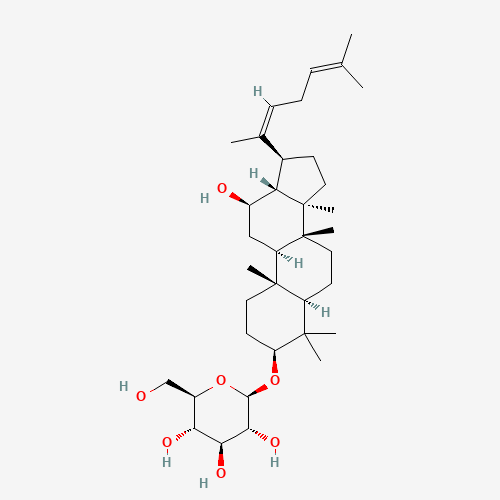
Ginsenoside Rh3
CAS number:105558-26-7 molecular formula:C36H60O7
overview
compound introduction
Specs
| Chinese alias | 人参皂苷Rh3 | ||
| English alias | CHEBI:172004 | MS-30663 | HY-N0606 | DTXSID401317008 | beta-D-Glucopyranoside, (3beta,12beta,20Z)-12-hydroxydammara-20(22),24-dien-3-yl | AKOS037514676 | (2R,3S,4S,5R,6R)-2-(hydroxymethyl)-6-[[(3S,5R,8R,9R,10R,12R,13R,14R,17S)-12-hydroxy-4,4,8,10,14-penta | ||
| CAS number | 105558-26-7 | molecular formula | C36H60O7 |
| molecular weight | 604.86 g/mol | Exact mass | ≥99% |
| PSA | 120.000 Ų | logp | 7.000 |
numbering system
No numbering system information yet
physicochemical properties
No physical and chemical property information yet
Safety information
No safety information yet
Production methods and uses
No production method and use information yet
Related
upstream information
No upstream information yet
downstream information
No downstream information yet
MSDS
Found 0 shareMSDS




