
PTP inhibitor II is a cell-permeable, covalent and potent PTP (protein tyrosine phosphatase) inhibitor. The compound acts by binding the catalytic domain of the SH2 domain-containing phosphatase SHP-1(DSH2). PTP inhibitor II binds with lower affinity than PTP Inhibitor I (Ki = 128 μM and Ki = 43 μM respectively). The inhibition can be reversed by irradiation of the inactivated PTP at 350 nm. PTP inhibitors have demonstrated enhanced clonogenic survival, mutagenesis and cell growth. PTP inhibitors can also be useful for probing signal transduction pathways as well as drμgs for treatment of PTP-related diseases. PTP Inhibitor II is an inhibitor of PTP1B and SH-PTP1.A cell-permeable, covalent and potent protein tyrosine phosphatase inhibitor. PTP inhibitor II is a cell-permeable, covalent and potent PTP (protein tyrosine phosphatase) inhibitor. The compound acts by binding the catalytic domain of the SH2 domain-containing phosphatase SHP-1(DSH2). PTP inhibitor II binds with lower affinity than PTP Inhibitor I (Ki = 128 μM and Ki = 43 μM respectively). The inhibition can be reversed by irradiation of the inactivated PTP at 350 nm. PTP inhibitors have demonstrated enhanced clonogenic survival, mutagenesis and cell growth. PTP inhibitors can also be useful for probing signal transduction pathways as well as drugs for treatment of PTP-related diseases. PTP Inhibitor II is an inhibitor of PTP1B and SH-PTP1. A cell-permeable, covalent and potent protein tyrosine phosphatase inhibitor.
All
Chemical Reagents
Biomedicine
Organic raw materials
Inorganic chemical industry
intermediate
Agricultural chemicals
Auxiliaries and catalysts
Fragrances and Flavors
Dyes and Pigments
Daily chemical industry
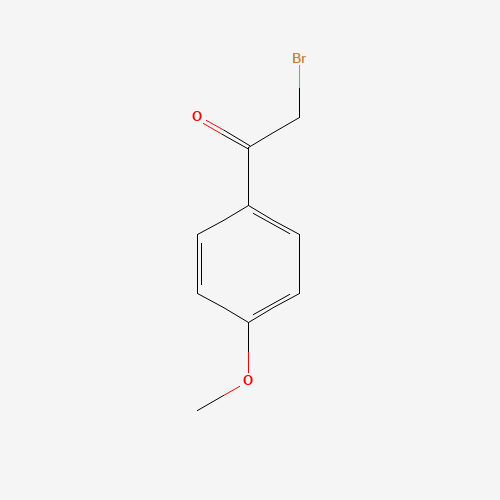
2-bromo-1-(4-methoxyphenyl)ethanone
Dangerous GoodsCAS number:2632-13-5 molecular formula:C9H9BrO2
overview
compound introduction
Specs
| Chinese alias | 4-甲氧基苯甲酰基甲基溴 | ω-溴-4-甲氧基苯乙酮 | α-溴-4-甲氧基苯乙酮 | 4-(溴乙酰基)苯甲醚 | 2-溴-4'-甲氧基苯乙酮 | ||
| English alias | 2-Bromo-p-methoxyacetophenone | Z104496012 | 4'-Methoxy-2-bromoacetophenone | Bromomethyl p-anisyl ketone | HSCI1_000017 | 2-Bromo-4'-methoxyacetophenone, Pract. | A19696 | 4-(Bromoacetyl)anisole | 4'-Methoxyphenacyl bromide | 4-Methoxyphenacyl bromide | | ||
| CAS number | 2632-13-5 | molecular formula | C9H9BrO2 |
| molecular weight | 229.07 | Exact mass | ≥98% |
| PSA | 26.3 | logp | 2.5 |
numbering system
| CAS | 2632-13-5 |
| UNII | PV5M69J53H |
| Wikidata | Q72451195 |
| ChEMBL ID | CHEMBL103009 |
| NSC Number | NSC Number: NSC129010 |
| PubChem CID | 4965 |
| Nikkaji Number | J192.152E |
| DSSTox Substance ID | DTXSID20180934 |
| European Community (EC) Number | 220-118-8 |
| PubChem Reference Collection SID | 505566095 |
physicochemical properties
| XLogP3 | 2.5 |
| 复杂性 | 151 |
| Exact Mass | 227.97859 |
| 化学类别 | 其他类别 -> 芳香酮类,卤代 |
| 形式电荷 | 0 |
| 物理描述 | 带刺激性气味的淡黄白色结晶粉末;[Alfa Aesar MSDS] |
| 重原子计数 | 12 |
| Molecular Weight | 229.07 |
| Monoisotopic Mass | 227.97859 |
| 内分泌干扰物 | 潜在的内分泌干扰物 <<<211>>熏蒸剂 -> FDA添加到食品中的物质 |
| 可旋转键计数 | 3 |
| 氢键供体计数 | 0 |
| 氢键受体计数 | 2 |
| 共价键单元计数 | 1 |
| 同位素原子计数 | 0 |
| 拓扑极性表面积 | 26.3 Ų |
| 定义键立体中心计数 | 0 |
| 定义原子立体中心计数 | 0 |
| 未定义键立体中心计数 | 0 |
| 未定义原子手性中心计数 | 0 |
Safety information
危害摘要:
引起灼伤和流泪;吸入可能对上呼吸道和肺部造成腐蚀性损伤;[Alfa Aesar MSDS] 见4-乙酰茴香醚。
有害效应:
毒性肺炎 - 因吸入金属烟雾或有毒气体和蒸汽引起的肺部炎症。
法规信息:
新西兰EPA化学品清单状态:2-溴-4-甲氧基苯乙酮:没有单独批准,但可在适当的团体标准下使用
危害类别和分类:
特定靶器官毒性-单次接触 3级 (83.7%)
Production methods and uses
purpose
工业应用参考:
工业分类参考:食品制造业。
应用场景参考:在环境监测、水资源分析、矿产检测、农残筛查和大气污染研究等方向具备潜在应用空间 。
作用参考:在科研材料体系中具备较强的组合应用潜力,价值往往取决于具体配方、纯度等级和工艺设计 。
选型提示:实际选型应结合产品定位、纯度要求、设备精细化程度和现场环境综合判断,不宜仅凭单一指标决定 。
Related
upstream information
No upstream information yet
downstream information
No downstream information yet
MSDS
Found 1 shareMSDS
2632-13-5 | 2-Bromo-4′-methoxyacetophenone.pdf