
compound introduction
All
Chemical Reagents
Biomedicine
Organic raw materials
Inorganic chemical industry
intermediate
Agricultural chemicals
Auxiliaries and catalysts
Fragrances and Flavors
Dyes and Pigments
Daily chemical industry
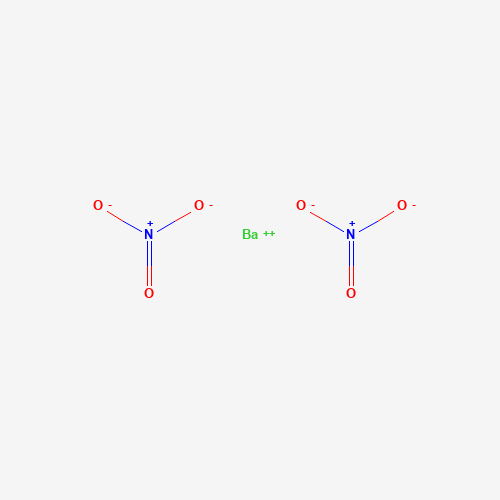
Barium nitrate
Dangerous GoodsCAS number:10022-31-8 molecular formula:BaN2O6
overview
Specs
| Chinese alias | - | ||
| English alias | Barium nitrate | ||
| CAS number | 10022-31-8 | molecular formula | BaN2O6 |
| molecular weight | 261.34 | Exact mass | - |
| PSA | - | logp | - |
numbering system
| CAS | 10022-31-8 |
| UNII | MDC5SW56XC |
| ChEBI ID | 190440 |
| ChEMBL ID | CHEMBL3184584 |
| UN Number | 1446 |
| Wikipedia | Nitrobarite |
| ICSC Number | 1480 |
| PubChem CID | 24798 |
| RTECS Number | CQ9625000 |
| Deprecated CAS | 2952711-59-8 |
| DSSTox Substance ID | DTXSID8049200 |
| European Community (EC) Number | 233-020-5 |
| PubChem Reference Collection SID | 481106924 |
| MEP ID | _25Q1B3FLN |
physicochemical properties
| Odor | Odorless |
| Density | 3.24 |
| Color/Form | Crystals or crystalline powder |
| Complexity | 18.8 |
| Exact Mass | 261.880883 |
| Pesticides | Active substance -> EU Pesticides database: Not approved |
| Solubility | 9% |
| Boiling Point | Decomposes |
| Decomposition | The substance decomposes on heating producing nitrogen oxides. |
| Formal Charge | 0 |
| Melting Point | 1094 °F |
| Vapor Pressure | Low |
| Chemical Classes | Metals -> Metals, Inorganic Compounds |
| Heavy Atom Count | 9 |
| Molecular Weight | 261.34 |
| Monoisotopic Mass | 261.880883 |
| Isotope Atom Count | 0 |
| Physical Description | White, odorless solid. |
| Rotatable Bond Count | 0 |
| Hydrogen Bond Donor Count | 0 |
| Covalently-Bonded Unit Count | 3 |
| Hydrogen Bond Acceptor Count | 6 |
| Topological Polar Surface Area | 126 Ų |
| Defined Atom Stereocenter Count | 0 |
| Defined Bond Stereocenter Count | 0 |
| Undefined Atom Stereocenter Count | 0 |
| Undefined Bond Stereocenter Count | 0 |
Safety information
DOT Label:
Oxidizer Poison
First Aid:
Swallow: Medical attention immediately - If this chemical has been swallowed, get medical attention immediately.
Treatment:
Intravenous infusion of potassium often relieves many of the symptoms of barium toxicity. Methemoglobinemia can be treated with supplemental oxygen and methylene blue 1% solution administered intravenously slowly over five minutes followed by IV flush with normal saline. Methylene blue restores the iron in hemoglobin to its normal (reduced) oxygen-carrying state. (L1613, L214)
Fire Hazards:
Not combustible but enhances combustion of other substances. Risk of fire and explosion on contact with combustible substances or reducing agents.
Safe Storage:
Separated from combustible substances, reducing agents, powdered metals and food and feedstuffs. Store in an area without drain or sewer access.
Fire Fighting:
In case of fire in the surroundings, use appropriate extinguishing media. NO carbon dioxide.
Target Organs:
Eyes, skin, respiratory system, heart, central nervous system
Toxicity Data:
LD50: 355 mg/kg (Oral, Rat) (T26)
Eye Prevention:
Wear safety goggles.
Fire Potential:
Not combustible but enhances combustion of other substances.
Health Effects:
The health effects of the different barium compounds depend on how well the compound dissolves in water or the stomach contents. At low doses, barium acts as a muscle stimulant, while higher doses affect the nervous system, causing cardiac irregularities, tremors, weakness, anxiety, dyspnea, paralysisand possibly death. Barium may also cause gastrointestinal disturbances, damage the kidneys and cause decreases in body weight. Nitrate and nitrite poisoning causes methemoglobinemia. Nitrites may cause pregnancy complications and developmental effects. They may also be carcinogenic. (L1137, L214)
Health Hazards:
ERG2024, Guide 141 (Barium nitrate): · Runoff from fire control or dilution water may cause environmental contamination.
Reactive Group:
Nitrate and Nitrite Compounds, Inorganic
Adverse Effects:
Methemoglobinemia - The presence of increased methemoglobin in the blood; the compound is classified as secondary toxic effect
Exposure Routes:
Oral (L214); inhalation (L214)
Fire Prevention:
NO contact with flammables.
Hazards Summary:
A skin, eye, nose, and throat irritant; A skin, eye, and respiratory tract irritant; Exposure could cause hypokalemia, resulting in cardiac disorders and muscular disorders. Exposure may result in death. [ICSC] An irritant; [MSDSonline] See Barium. See NITRATES and NITRITES.
Inhalation Risk:
Evaporation at 20 °C is negligible; a harmful concentration of airborne particles can, however, be reached quickly when dispersed, especially if powdered.
Skin Prevention:
Protective gloves.
DOT ID and Guide:
1446 141
Disposal Methods:
Package lots. Place in a separate labeled container for recycling or disposal. Small quantities. Wear nitrile rubber gloves, laboratory coat, and eye protection. Avoid breathing dust. Dissolve the barium salt in the minimum volume of water. For each gram of barium salt, add 15 mL of 10% sodium sulfate solution. Let stand for 1 week. Test for completeness of precipitation by adding a few drops of 10% sodium sulfate solution. If required, add more sodium sulfate solution until no further precipitation occurs. Decant supernatant liquid or filter solid. Treat solid as normal refuse. Wash liquid into drain. /Barium salt/
Flammable Limits:
Flammability: Noncombustible Solid, but will accelerate the burning of combustible materials.
Toxicity Summary:
Barium is a competitive potassium channel antagonist that blocks the passive efflux of intracellular potassium, resulting in a shift of potassium from extracellular to intracellular compartments. The intracellular translocation of potassium results in a decreased resting membrane potential, making the muscle fibers electrically unexcitable and causing paralysis. Some of these barium's effects may also be due to barium induced neuromuscular blockade and membrane depolarization. Nitrate's toxicity is a result of it's conversion to nitrite once in the body. Nitrite causes the autocatalytic oxidation of oxyhemoglobin to hydrogen peroxide and methemoglobin. This elevation of methemoglobin levels is a condition known as methemoglobinemia, and is characterized by tissue hypoxia, as methemoglob...
EC Classification:
Symbol: Xn; R: 20/22; S: (2)-28
RCRA Requirements:
D005; A solid waste containing barium may or may not become characterized as a hazardous waste when subjected to the Toxicity Characteristic Leaching Procedure listed in 40 CFR 261.24, and if so characterized, must be managed as a hazardous waste. /Barium/
Reactivity Alerts:
Strong Oxidizing Agent
Spillage Disposal:
Sweep spilled substance into covered containers. If appropriate, moisten first to prevent dusting. Then wash away with plenty of water. Do NOT let this chemical enter the environment. Personal protection: particulate filter respirator adapted to the airborne concentration of the substance.
UN Classification:
UN Hazard Class: 5.1; UN Subsidiary Risks: 6.1; UN Pack Group: II
Ecotoxicity Values:
EC50; Species: Daphnia magna (Water flea, age <24 hr neonate); Conditions: freshwater, static, 21 °C, pH 7.6; Concentration: 0.512 mM for 24 hr; Effect: intoxication, immobilization
First Aid Measures:
Ingestion First Aid: Induce vomiting (ONLY IN CONSCIOUS PERSONS!). Refer for medical attention .
Minimum Risk Level:
Intermediate Oral: 0.2 mg/kg/day (L134) Chronic Oral: 0.2 mg/kg/day (L134)
Reactivity Profile:
Mixtures of metal nitrates with alkyl esters may explode, owing to the formation of alkyl nitrates. Mixtures of nitrates with phosphorus, tin(II) chloride, or other reducing agents may react explosively [Bretherick 1979 p. 108-109].
Signs and Symptoms:
Ingesting excess barium may cause vomiting, abdominal cramps, diarrhea, difficulties in breathing, increased or decreased blood pressure, numbness around the face, and muscle weakness. High levels may result in changes in heart rhythm or paralysis and possibly death. Nitrate and nitrite poisoning causes methemoglobinemia. Symptoms include cyanosis, cardiac dysrhythmias and circulatory failure, and progressive central nervous system (CNS) effects. CNS effects can range from mild dizziness and lethargy to coma and convulsions. (L1137, L214)
Storage Conditions:
Barium nitrate is packed and stored in 25kg polyethylene-lined multilayer paper bags.
Exposure Prevention:
PREVENT DISPERSION OF DUST! STRICT HYGIENE!
Firefighting Hazards:
It is non-combustible but it will accelerate the burning of combustible materials. If large quantities of the material are involved in the fire or the combustible material is finely divided an explosion may result. Prolonged exposure of the material to fire or heat may result in an explosion.
Ingestion Prevention:
Do not eat, drink, or smoke during work.
Inhalation Prevention:
Use local exhaust or breathing protection.
NIOSH Recommendations:
Recommended Exposure Limit: 10 Hour Time-Weighted Average: 0.5 mg/cu m /Barium nitrate (as Ba)/
Nonfire Spill Response:
LARGE SPILL: Dike far ahead of spill for later disposal. (ERG, 2024)
Air and Water Reactions:
Soluble in water.
ICSC Environmental Data:
The substance is harmful to aquatic organisms.
Packaging and Labelling:
Do not transport with food and feedstuffs. Marine pollutant.
Fire Fighting Procedures:
Wear positive pressure self-contained breathing apparatus when fighting fires involving this material.
Isolation and Evacuation:
Evacuation: ERG2024, Guide 141 (Barium nitrate): · If tank, rail tank car or highway tank is involved in a fire, ISOLATE for 800 meters (1/2 mile) in all directions; also, consider initial evacuation for 800 meters (1/2 mile) in all directions.
Other Safety Information:
Chemical Assessment: Evaluation - Chemicals that are unlikely to require further regulation to manage risks to human health
Carcinogen Classification:
Ingested nitrate or nitrite under conditions that result in endogenous nitrosation is probably carcinogenic to humans (Group 2A). (L135)
DOT Hazard Classification:
Placard/Label(s)
Natural Pollution Sources:
Nitrobarite is found in/ the mineral Nitrobarite, which in turn is found in Chile and was discovered in 1882(1).
Non-Human Toxicity Values:
LD50 Rat oral 355 mg/kg bw
Toxic Combustion Products:
Toxic oxides of nitrogen are produced in fires involving this material.
EPA Hazardous Waste Number:
D005; A waste containing barium may or may not be characterized as a hazardous waste following testing by the Toxicity Characteristic Leaching Procedure as prescribed by the Resource Conservation and Recovery Act (RCRA) regulations. /Barium/
Respirator Recommendations:
Important additional information about respirator selection
Accidental Release Measures:
Spill or Leak: ERG2024, Guide 141 (Barium nitrate): · Dike far ahead of spill for later disposal.
Populations at Special Risk:
Protect from exposure those individuals with diseases of kidney & lung.
Evidence for Carcinogenicity:
A4; Not classifiable as a human carcinogen. /Barium and soluble compounds, as Ba/
Threshold Limit Values (TLV):
0.5 [mg/m3], as Ba
Hazard Classes and Categories:
Specific target organ toxicity - Single exposure - Category 1 (cardiovascular system, muscle), Category 2 (nervous system, kidney), Category 3 (respiratory tract irritation, narcotic effects)
Effects of Short Term Exposure:
The substance is irritating to the eyes, skin and respiratory tract. Exposure could cause hypokalaemia. This may result in cardiac disorders and muscular disorders. Exposure could cause death.
Explosive Limits and Potential:
Will turn shock-sensitive if contaminated with magnesium-aluminium alloys, sulfur powder or light metal powder.
Standard Transportation Number:
49 187 09; Barium nitrate
State Drinking Water Standards:
(CA) CALIFORNIA 1000 ug/L /Barium/
State Drinking Water Guidelines:
(MN) MINNESOTA 2000 ug/L /Barium/
Federal Drinking Water Standards:
EPA 2000 ug/L /Barium/
Permissible Exposure Limit (PEL):
TWA 0.5 mg/m3 [*Note: The PEL also applies to other soluble barium compounds (as Ba) except Barium sulfate.]
Protective Action Criteria (PAC):
PAC-3: 440 [mg/m3]
Recommended Exposure Limit (REL):
TWA 0.5 mg/m3 [*Note: The REL also applies to other soluble barium compounds (as Ba) except Barium sulfate.]
Shipment Methods and Regulations:
The International Maritime Dangerous Goods Code lays down basic principles for transporting hazardous chemicals. Detailed recommendations for individual substances and a number of recommendations for good practice are included in the classes dealing with such substances. A general index of technical names has also been compiled. This index should always be consulted when attempting to locate the appropriate procedures to be used when shipping any substance or article.
Federal Drinking Water Guidelines:
EPA 2000 ug/L /Barium/
Probable Routes of Human Exposure:
NIOSH (NOES Survey 1981-1983) has statistically estimated that 19,320 workers (5,165 of these were female) were potentially exposed to barium nitrate in the US(1).
Occupational Exposure Limits (OEL):
EU-OEL: (as Ba): 0.5 mg/m
Shipping Name/ Number DOT/UN/NA/IMO:
IMO 5.1; Barium nitrate
Emergency Response Planning Guidelines:
Emergency Response: ERG2024, Guide 141 (Barium nitrate): · For massive fire, use unmanned master stream devices or monitor nozzles; if this is impossible, withdraw from area and let fire burn.
Skin, Eye, and Respiratory Irritations:
Soluble barium compounds may cause local irritation of the eyes, nose, throat, bronchial tubes, and skin. /Soluble barium cmpd (as barium)/
Exposure Control and Personal Protection:
Maximum Allowable Concentration (MAK): 0.5 [mg/m3], as Ba, inhalable fraction(soluble compds)[German Research Foundation (DFG)]
Hazardous Reactivities and Incompatibilities:
Acids, oxidizers, aluminum-magnesium alloys (barium dioxide + zinc) [Note: Contact with combustible material may cause fire].
Immediately Dangerous to Life or Health (IDLH):
See: IDLH INDEX
Production methods and uses
Production method
By the action of nitric acid on barium carbonate or sulfide.
purpose
Uses:
Barium nitrate is used in explosives, to produce barium oxide, in vacuum tubes, and to produce green fire in pyrotechnics. (L207)
Consumer Uses:
Not Known or Reasonably Ascertainable
Industry Uses:
Not Known or Reasonably Ascertainable
General Manufacturing Information:
Industry Processing Sectors: All Other Chemical Product and Preparation Manufacturing
Related
upstream information
Methods of Manufacturing:
nitric acid (CID:944); barium carbonate (CID:10563); sodium nitrate (CID:24268); barium chloride (CID:25204); barium nitrate (CID:24798); nitrate (CID:943); barium sulfide (CID:6857597); barium hydroxide (CID:6093286); calcium nitrate (CID:24963)
downstream information
No downstream information yet
MSDS
Found 1 shareMSDS
10022-31-8 | barium nitrate | barium nitrate