

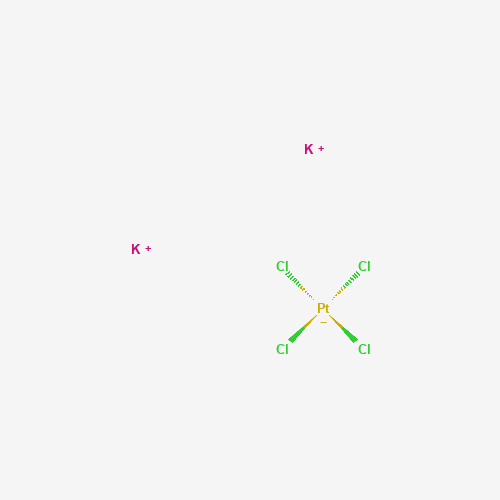
与双二硫醇盐反应生成金属-双二硫醇盐,可用于激光器 Q 开关材料、液晶、光盘记录介质、条形码材料和超导体。与封端聚合物反应形成形状控制的胶体铂纳米粒子,用于催化和光催化作用。 Reacts with bis(dithiolates) to form metal-bis(dithiolates) with applications in laser Q-switch materials, liquid crystals, optical CD recording media, bar code materials and superconductivity.Reacts with capping polymers to form shape-control colloidal platinum nanoparticles for catalysis and photocatalysts. Potassium tetrachloroplatinate(II) is a crystalline solid that is insoluble in water and soluble in organic solvents. It is widely used in the field of nanomaterial synthesis, catalysis, and energy storage

All
Chemical Reagents
Biomedicine
Organic raw materials
Inorganic chemical industry
intermediate
Agricultural chemicals
Auxiliaries and catalysts
Fragrances and Flavors
Dyes and Pigments
Daily chemical industry
Potassium tetrachloroplatinate
Dangerous GoodsCAS number:10025-99-7 molecular formula:K2PtCl4
overview
compound introduction
Specs
| Chinese alias | 四氯铂(II)酸钾 | ||
| English alias | CCRIS 6621 | RVRDLMCWUILSAH-UHFFFAOYSA-J | Potassium tetrachloroplatinate | DIPOTASSIUM TETRACHLOROPLATINATE | FT-0688906 | UNII-B74O00UCWC | dipotassium;tetrachloroplatinum(2-) | Platinous potassium chloride | ||
| CAS number | 10025-99-7 | molecular formula | K2PtCl4 |
| molecular weight | 415.09 g/mol | Exact mass | ≥99.9% metals basis |
| PSA | 0.000 Ų | logp | - |
numbering system
| CAS | 10025-99-7 |
| Wikipedia | Potassium_tetrachloroplatinate |
| AIDS Number | 004157 |
| PubChem CID | 61440 |
| Related CAS | 13965-91-8 (Parent) |
| Deprecated CAS | 3026699-69-1 |
| DSSTox Substance ID | DTXSID10904020 |
| European Community (EC) Number | 233-050-9 |
| PubChem Reference Collection SID | 505863964 |
| MEP ID | _25Q1B3FM4 |
physicochemical properties
| Complexity | 19.1 |
| Exact Mass | 414.764668 |
| Formal Charge | 0 |
| Chemical Classes | Inorganics |
| Heavy Atom Count | 7 |
| Molecular Weight | 415.1 |
| Monoisotopic Mass | 412.767618 |
| Isotope Atom Count | 0 |
| Physical Description | Ruby-red solid; Soluble in water; Red powder; [Sigma-Aldrich MSDS] |
| Rotatable Bond Count | 0 |
| Hydrogen Bond Donor Count | 0 |
| Covalently-Bonded Unit Count | 3 |
| Hydrogen Bond Acceptor Count | 1 |
| Topological Polar Surface Area | 0 Ų |
| Defined Atom Stereocenter Count | 0 |
| Defined Bond Stereocenter Count | 0 |
| Undefined Atom Stereocenter Count | 0 |
| Undefined Bond Stereocenter Count | 0 |
Safety information
Adverse Effects:
Asthma - Reversible bronchoconstriction (narrowing of bronchioles) initiated by the inhalation of irritating or allergenic agents.
Hazards Summary:
Corrosive to skin; Human ingestion of 8.57 mg/kg causes gastritis, depressed renal function tests, and eosinophilia; [RTECS] An irritant that may cause serious eye injury; May cause skin sensitization; Inhalation may cause allergy, asthma symptoms, or difficulty breathing; Toxic by ingestion; [Sigma-Aldrich MSDS] See Platinum, soluble salts.
Regulatory Information:
REACH Registered Substance: Status: Active Update: 28-09-2021 https://echa.europa.eu/registration-dossier/-/registered-dossier/21632
Other Safety Information:
Chemical Assessment: IMAP assessments - Platinate(2-), tetrachloro-, dipotassium, (SP-4-1)-: Human health tier I assessment
Threshold Limit Values (TLV):
0.002 [mg/m3], as Pt (soluble salts)
Hazard Classes and Categories:
Skin Sens. 1
Permissible Exposure Limit (PEL):
0.002 [mg/m3], as Pt (soluble salts)
Immediately Dangerous to Life or Health (IDLH):
4.0 [mg/m3], as Pt (soluble salts)
Production methods and uses
purpose
Industrial Processes with risk of exposure: Photographic Processing [Category: Other]
Related
upstream information
No upstream information yet
downstream information
No downstream information yet
MSDS
Found 1 shareMSDS
10025-99-7 | Potassium tetrachloroplatinate(II).pdf




