

compound introduction
All
Chemical Reagents
Biomedicine
Organic raw materials
Inorganic chemical industry
intermediate
Agricultural chemicals
Auxiliaries and catalysts
Fragrances and Flavors
Dyes and Pigments
Daily chemical industry
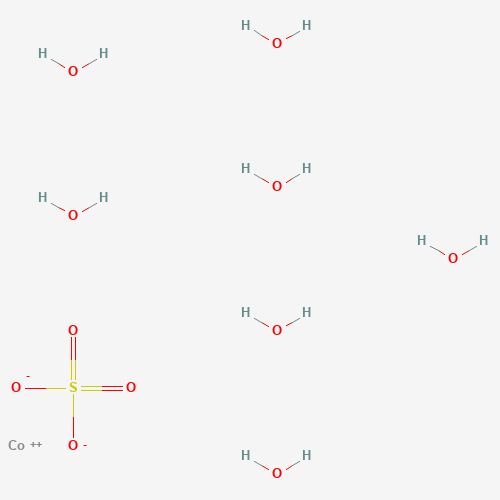
Cobalt sulfate heptahydrate
CAS number:10026-24-1 molecular formula:CoH14O11S
overview
Specs
| Chinese alias | - | ||
| English alias | Cobaltous sulfate heptahydrate; Cobalt(II) sulfate heptahydrate | ||
| CAS number | 10026-24-1 | molecular formula | CoH14O11S |
| molecular weight | 281.1 | Exact mass | - |
| PSA | - | logp | - |
numbering system
| CAS | 10026-24-1 |
| UNII | Y8N698ZE0T |
| KEGG ID | C19215 |
| ChEBI ID | 91244 |
| Wikidata | Q27163155 |
| ICSC Number | 1396 |
| PubChem CID | 61444 |
| Related CAS | 10124-43-3 (Parent) |
| DSSTox Substance ID | DTXSID7020340 |
| European Community (EC) Number | 600-050-9 |
| PubChem Reference Collection SID | 483925155 |
| MEP ID | _25Q1B3FMB |
physicochemical properties
| Density | 3.71 @25 °C |
| Complexity | 62.2 |
| Exact Mass | 280.958876 |
| Solubility | Solubility in water, g/100ml at 3 °C: 60.4 |
| Animal Drugs | Pharmaceuticals -> UK Veterinary Medicines Directorate List |
| Boiling Point | 420 °C |
| Formal Charge | 0 |
| Melting Point | 735 °C |
| Heavy Atom Count | 13 |
| Molecular Weight | 281.11 |
| Monoisotopic Mass | 280.958876 |
| Isotope Atom Count | 0 |
| Physical Description | PINK-TO-RED CRYSTALS. |
| Rotatable Bond Count | 0 |
| Hydrogen Bond Donor Count | 7 |
| Covalently-Bonded Unit Count | 9 |
| Hydrogen Bond Acceptor Count | 11 |
| Topological Polar Surface Area | 95.6 Ų |
| Defined Atom Stereocenter Count | 0 |
| Defined Bond Stereocenter Count | 0 |
| Undefined Atom Stereocenter Count | 0 |
| Undefined Bond Stereocenter Count | 0 |
Safety information
First Aid:
INGESTION: DO NOT INDUCE VOMITING. If the victim is conscious and not convulsing, give 1 or 2 glasses of water to dilute the chemical and IMMEDIATELY call a hospital or poison control center. Be prepared to transport the victim to a hospital if advised by a physician. If the victim is convulsing or unconscious, do not give anything by mouth, ensure that the victim's airway is open and lay the victim on his/her side with the head lower than the body. DO NOT INDUCE VOMITING. IMMEDIATELY transport the victim to a hospital. (NTP, 1992)
Fire Hazards:
Not combustible. Gives off irritating or toxic fumes (or gases) in a fire.
Safe Storage:
Separated from strong oxidants.
Fire Fighting:
In case of fire in the surroundings, use appropriate extinguishing media.
Eye Prevention:
Wear safety goggles or eye protection in combination with breathing protection if powder.
Health Hazards:
ACUTE/CHRONIC HAZARDS: This compound is readily absorbed through the skin. When heated to decomposition it emits toxic fumes of SOx. It may also emit toxic fumes of CoOx. It may cause irritation. (NTP, 1992)
Reactive Group:
Salts, Acidic
Exposure Routes:
The substance can be absorbed into the body by inhalation of its aerosol and by ingestion.
Inhalation Risk:
Evaporation at 20 °C is negligible; a harmful concentration of airborne particles can, however, be reached quickly when dispersed.
Skin Prevention:
Protective gloves. Protective clothing.
EC Classification:
Symbol: T, N; R: 49-22-42/43-50/53; S: (2)-22-53-45-60-61; Note: E
Spillage Disposal:
Personal protection: particulate filter respirator adapted to the airborne concentration of the substance. Do NOT let this chemical enter the environment. Sweep spilled substance into covered containers. If appropriate, moisten first to prevent dusting. Carefully collect remainder. Then store and dispose of according to local regulations.
First Aid Measures:
Ingestion First Aid: Rinse mouth. Give one or two glasses of water to drink. Refer for medical attention .
Reactivity Profile:
Acidic salts, such as COBALT SULFATE HEPTAHYDRATE, are generally soluble in water. The resulting solutions contain moderate concentrations of hydrogen ions and have pH's of less than 7.0. They react as acids to neutralize bases. These neutralizations generate heat, but less or far less than is generated by neutralization of inorganic acids, inorganic oxoacids, and carboxylic acid. They usually do not react as either oxidizing agents or reducing agents but such behavior is not impossible. Many of these compounds catalyze organic reactions.
Signs and Symptoms:
Ingestion Exposure: Abdominal pain. Nausea. Vomiting.
Exposure Prevention:
AVOID ALL CONTACT! IN ALL CASES CONSULT A DOCTOR!
Ingestion Prevention:
Do not eat, drink, or smoke during work. Wash hands before eating.
RAIS Toxicity Values:
Inhalation Unit Risk Reference: CALEPA
Inhalation Prevention:
Use local exhaust or breathing protection.
Nonfire Spill Response:
STORAGE PRECAUTIONS: You should store this material under ambient temperatures, and protect it from moisture. (NTP, 1992)
Regulatory Information:
EFSA Legal Basis: Regulation (EC) No 1831/2003 (amended)
Air and Water Reactions:
Water soluble. The resulting solution is acidic.
Other Safety Information:
Chemical Assessment: IMAP assessments - Soluble cobalt (II) and salts: Human health tier II assessment
Carcinogen Classification:
Summary: Exposure to cobalt sulfate heptahydrate caused a spectrum of inflammatory, fibrotic, and proliferative lesions in the respiratory tract of male and female rats and mice.
Threshold Limit Values (TLV):
(as Co, inhalable fraction): 0.02 mg/m
Effects of Long Term Exposure:
Repeated or prolonged contact may cause skin sensitization. Repeated or prolonged inhalation may cause asthma. The substance may have effects on the heart, thyroid and bone marrow. This may result in cardiomyopathy, goiter and polycythemia. This substance is possibly carcinogenic to humans. Animal tests show that this substance possibly causes toxic effects upon human reproduction. Animal tests show that this substance possibly causes malformations in human babies.
Hazard Classes and Categories:
Carcinogenicity - Category 1B
Effects of Short Term Exposure:
The substance is irritating to the eyes, skin and respiratory tract.
Protective Action Criteria (PAC):
PAC-3: 120 [mg/m3]
Occupational Exposure Limits (OEL):
MAK (Maximale Arbeitsplatz Konzentration): (as Co, inhalable fraction): skin absorption (H); sensitization of respiratory tract and skin (SAH); carcinogen category: 2; germ cell mutagen group: 3A
Personal Protective Equipment (PPE):
RECOMMENDED RESPIRATOR: Where the neat test chemical is weighed and diluted, wear a NIOSH-approved half face respirator equipped with an organic vapor/acid gas cartridge (specific for organic vapors, HCl, acid gas and SO2) with a dust/mist filter. (NTP, 1992)
Production methods and uses
purpose
Uses:
CPDat Chemical and Product Categories (PUC): cpdat
Industry Uses:
Flavoring and nutrient
General Manufacturing Information:
Industry Processing Sectors: All Other Basic Inorganic Chemical Manufacturing
Related
upstream information
No upstream information yet
downstream information
No downstream information yet
MSDS
Found 0 shareMSDS




