
compound introduction
All
Chemical Reagents
Biomedicine
Organic raw materials
Inorganic chemical industry
intermediate
Agricultural chemicals
Auxiliaries and catalysts
Fragrances and Flavors
Dyes and Pigments
Daily chemical industry
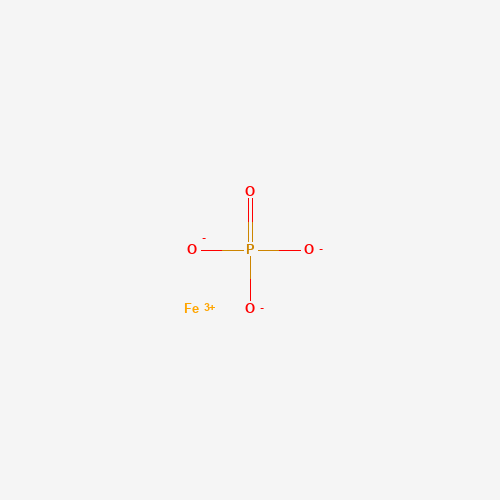
Ferric phosphate
CAS number:10045-86-0 molecular formula:FeO4P
overview
Specs
| Chinese alias | - | ||
| English alias | Ferric orthophosphate; Iron(III) phosphate | ||
| CAS number | 10045-86-0 | molecular formula | FeO4P |
| molecular weight | 150.82 | Exact mass | - |
| PSA | - | logp | - |
numbering system
| CAS | 10045-86-0 |
| UNII | N6BAA189V1 |
| HMDB ID | HMDB0303426 |
| ChEBI ID | 131371 |
| Wikipedia | Iron(III) phosphate |
| PubChem CID | 24861 |
| Related CAS | 51833-68-2 (unspecified hydrate) |
| Deprecated CAS | 58782-48-2 |
| NCI Thesaurus Code | C83714 |
| DSSTox Substance ID | DTXSID9035672 |
| European Community (EC) Number | 233-867-0 |
| PubChem Reference Collection SID | 505594813 |
| MEP ID | _25Q1B3FNG |
physicochemical properties
| Density | 2.87 @25 °C |
| Polymers | Plastics -> N.a. |
| Complexity | 36.8 |
| Exact Mass | 150.888356 |
| Pesticides | Active substance -> EU Pesticides database: Approved |
| Formal Charge | 0 |
| Food Additives | NUTRIENT SUPPLEMENT -> FDA Substance added to food |
| Chemical Classes | Metals -> Phosphates, Metallic Salts |
| Heavy Atom Count | 6 |
| Molecular Weight | 150.82 |
| Monoisotopic Mass | 150.888356 |
| Isotope Atom Count | 0 |
| Physical Description | Dihydrate: White, grayish-white, or light-pink solid, practically insoluble in water; Loses water above 140 deg C; Whitish odorless crystals or powder; [MSDSonline] |
| Rotatable Bond Count | 0 |
| Hydrogen Bond Donor Count | 0 |
| Covalently-Bonded Unit Count | 2 |
| Hydrogen Bond Acceptor Count | 4 |
| Other Experimental Properties | Soluble in sulfuric acid /Dihydrate/ |
| Topological Polar Surface Area | 86.3 Ų |
| Defined Atom Stereocenter Count | 0 |
| Defined Bond Stereocenter Count | 0 |
| Undefined Atom Stereocenter Count | 0 |
| Undefined Bond Stereocenter Count | 0 |
Safety information
Adverse Effects:
Occupational hepatotoxin - Secondary hepatotoxins: the potential for toxic effect in the occupational setting is based on cases of poisoning by human ingestion or animal experimentation.
Hazards Summary:
An eye irritant; [eChemPortal: ERMA] May cause irritation; [MSDSonline] See Iron oxide (Fe2O3).
Disposal Methods:
The following wastewater treatment technologies have been investigated for iron (Fe+2): Concentration process: Biological treatment. /Iron (Fe+2)/
FDA Requirements:
Ferric phosphate used as a nutrient and/or dietary supplement in animal drugs, feeds, and related products is generally recognized as safe when used in accordance with good manufacturing or feeding practice.
Ecotoxicity Values:
LD50 Bobwhite quail oral >2000 mg/kg
FIFRA Requirements:
An exemption from the requirement of a tolerance is established for residues of the biochemical pesticide, ferric phosphate in or on all food commodities.
Preventive Measures:
All ... /iron/ preparations should be kept in child-proof bottles. /Iron preparations/
Allowable Tolerances:
An exemption from the requirement of a tolerance is established for residues of the biochemical pesticide, ferric phosphate in or on all food commodities.
Regulatory Information:
New Zealand EPA Inventory of Chemical Status: Iron (III) phosphate: Does not have an individual approval but may be used under an appropriate group standard
Other Safety Information:
Chemical Assessment: Evaluation - Chemicals that are unlikely to require further regulation to manage risks to human health
Natural Pollution Sources:
...In small quantities in practically all phosphate rock and in rather large quantities in some of lower grades of rock.
Non-Human Toxicity Excerpts:
/ALTERNATIVE IN VITRO TESTS/ ...Guinea-pig exudate cells were cultured with varying concentrations of the dusts of interest. The end point was defined as the smallest concentration of dust required to reduce the number of cells to <10% of the inoculum within 3 days. ...Ferric-phosphate were tested at concentrations up to 120 ug)/1,000,000 cells. ...Ferric-phosphate had negligible effects on cultures.
Hazard Classes and Categories:
Eye Irrit. 2 (100%)
Antidote and Emergency Treatment:
Hemodialysis and hemoperfusion are not effective for removing iron but may be necessary to remove iron-deferoxamine complex in patients with renal failure. Exchange transfusion is occasionally used for massive pediatric ingestions but is of questionable efficacy.
Protective Action Criteria (PAC):
PAC-3: 360 [mg/m3]
Federal Drinking Water Guidelines:
EPA 300 ug/L /Iron/
Skin, Eye, and Respiratory Irritations:
If inhaled, iron is a local irritant to the lung and gastrointestinal tract. /Iron compounds/
Other Standards Regulations and Guidelines:
Australia (1978); Belgium (1978); Finland (1975); Italy (1978); Netherlands (1978); and Switzerland (1978): 1 mg/cu m. /From table/ /Ferric salts, as Fe/
Production methods and uses
Production method
By adding a solution of sodium phosphate to a solution of ferric chloride. The product is then filtered and dried.
purpose
Uses:
Catalysts, pigments, drugs, agriculture, nutrition, metallurgy, and leather tanning. /Iron compounds/
Consumer Uses:
Flavoring and nutrient
Industry Uses:
Pigment
Household Products:
Household & Commercial/Institutional Products: • Pesticides
Use Classification:
Plastics -> Pigments agents
General Manufacturing Information:
Industry Processing Sectors: Synthetic Dye and Pigment Manufacturing
Related
upstream information
Methods of Manufacturing:
sodium phosphate (CID:21225609); ferric chloride (CID:24380)
downstream information
No downstream information yet
MSDS
Found 1 shareMSDS
10045-86-0 | Iron(III) phosphate for analysis calcined(max. 0.001% SO4) EMSURE®.pdf