
compound introduction
All
Chemical Reagents
Biomedicine
Organic raw materials
Inorganic chemical industry
intermediate
Agricultural chemicals
Auxiliaries and catalysts
Fragrances and Flavors
Dyes and Pigments
Daily chemical industry
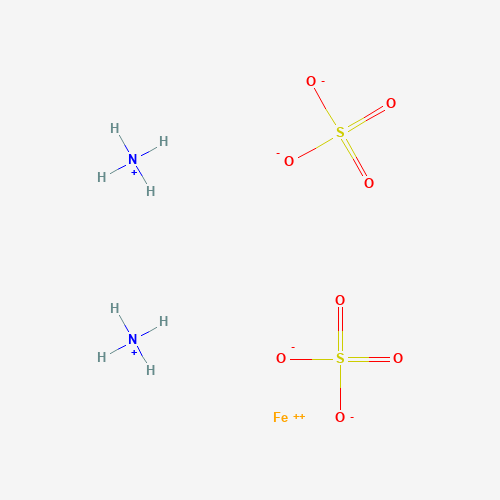
Ammonium iron(II) sulfate
CAS number:10045-89-3 molecular formula:Fe.(NH4)2.(SO4)2
overview
Specs
| Chinese alias | - | ||
| English alias | Diammonium iron bis(sulphate) | ||
| CAS number | 10045-89-3 | molecular formula | Fe.(NH4)2.(SO4)2 |
| molecular weight | 284.05 | Exact mass | - |
| PSA | - | logp | - |
numbering system
| CAS | 10045-89-3 |
| UNII | 9Q764AYJ9G |
| ChEBI ID | 76243 |
| Wikipedia | Ammonium iron(II) sulfate |
| PubChem CID | 24863 |
| Related CAS | 19864-63-2 (Parent) |
| Deprecated CAS | 220710-26-9 |
| DSSTox Substance ID | DTXSID4041028 |
| European Community (EC) Number | 233-151-8 |
| PubChem Reference Collection SID | 518176695 |
| MEP ID | _25Q1B3FNH |
physicochemical properties
| Density | 1.865 @25 °C |
| Complexity | 62.2 |
| Exact Mass | 283.907143 |
| Solubility | 26.9 G SOL IN 100 CC WATER @ 20 °C; 73 G SOL IN 100 CC WATER @ 80 °C; INSOL IN ETHANOL. /FERROUS AMMONIUM SULFATE HEXAHYDRATE/ |
| Formal Charge | 0 |
| Chemical Classes | Metals -> Metals, Inorganic Compounds |
| Heavy Atom Count | 13 |
| Molecular Weight | 284.1 |
| Refractive Index | INDEX OF REFRACTION: 1.487, 1.492, 1.499 /FERROUS AMMONIUM SULFATE HEXAHYDRATE/ |
| Monoisotopic Mass | 283.907143 |
| Isotope Atom Count | 0 |
| Physical Description | Light green crystals, deliquescent and soluble in water; [CAMEO] |
| Rotatable Bond Count | 0 |
| Stability/Shelf Life | Slowly oxidizes in air. /Ferrous ammonium sulfate hexahydrate/ |
| Food Contact Substances | FCS -> FDA Inventory of Food Contact Substances Listed in 21 CFR |
| Hydrogen Bond Donor Count | 2 |
| Covalently-Bonded Unit Count | 5 |
| Hydrogen Bond Acceptor Count | 8 |
| Other Experimental Properties | Sugar, glycerin, & many organic hydroxy acids hinder precipitation. In neutral solution, soluble carbonates, phosphates, & oxalates produce precipitation. /Ferrous salts/ |
| Topological Polar Surface Area | 179 Ų |
| Defined Atom Stereocenter Count | 0 |
| Defined Bond Stereocenter Count | 0 |
| Undefined Atom Stereocenter Count | 0 |
| Undefined Bond Stereocenter Count | 0 |
Safety information
First Aid:
EYES or SKIN: flush with water. (USCG, 1999)
Fire Hazards:
Special Hazards of Combustion Products: Irritating and toxic ammonia and oxides of nitrogen may form in fires. (USCG, 1999)
Fire Potential:
Not flammable /Ferrous ammonium sulfate hexahydrate/
Health Hazards:
Inhalation of dust irritates nose and throat. Ingestion causes irritation of mouth and stomach. Dust irritates eyes and can irritate skin on prolonged contact. (USCG, 1999)
OSHA Standards:
Vacated 1989 OSHA PEL TWA 1 mg/cu m is still enforced in some states. /Iron salts (soluble, as Fe)/
Reactive Group:
Salts, Acidic
Adverse Effects:
Occupational hepatotoxin - Secondary hepatotoxins: the potential for toxic effect in the occupational setting is based on cases of poisoning by human ingestion or animal experimentation.
Cleanup Methods:
Environmental considerations: Land spill: Big a pit, pond, lagoon, holding area to contain liquid or solid material. /SRP: If time permits, pits, ponds, lagoons, soak holes, or holding areas should be sealed with an impermeable flexible membrane liner./ Cover soldis with a plastic sheet to prevent dissolving in rain or fire fighting water.
Hazards Summary:
A skin and eye irritant; [CAMEO] LD50 (rats) = 0.5-5 g/kg; Could cause iron poisoning and liver damage if ingested; [MSDSonline] See Iron, soluble compounds.
Primary Hazards:
Not Classified
Disposal Methods:
The following wastewater treatment technologies have been investigated for iron (Fe+2): Concentration process: Biological treatment. /Iron (Fe+2)/
Reactivity Profile:
FERROUS AMMONIUM SULFATE releases irritating and toxic ammonia and oxides of nitrogen if burned (USCG, 1999).
Storage Conditions:
Keep well closed & protected from light. /Hexahydrate/
NIOSH Recommendations:
Recommended Exposure Limit: 10 Hr Time-Weighted Avg: 1 mg/cu m. /Iron salts (soluble, as Fe)/
Regulatory Information:
New Zealand EPA Inventory of Chemical Status: Sulfuric acid, ammonium iron(II) salt: Does not have an individual approval but may be used under an appropriate group standard
Air and Water Reactions:
Soluble in water that forms weakly acidic solutions. Deliquesces in air.
Human Toxicity Excerpts:
/HUMAN EXPOSURE STUDIES/ Inhalation of dust irritates nose and throat. Ingestion causes irritation of mouth and stomach. Dust irritates eyes and can irritate skin on prolonged contact.
Fire Fighting Procedures:
If material involved in fire: Extinguish fire using agent suitable for type of surrounding fire. (Material itself does not burn or burns with difficulty.)
Other Safety Information:
Chemical Assessment: IMAP assessments - Sulfuric acid, ammonium iron(2+) salt (2:2:1): Human health tier I assessment
Non-Human Toxicity Values:
LD50 Rat oral 3,250 mg/kg bw /Hexahydrate/
Toxic Combustion Products:
Irritating and toxic ammonia and oxides of nitrogen may form in fires. /Ferrous ammonium sulfate hexahydrate/
Non-Human Toxicity Excerpts:
/ALTERNATIVE IN VITRO TESTS/ The effect of vitamin E deficiency on brain mitochondrial oxidative phosphorylation was studied using brain mitochondria isolated from control and vitamin E-deficient rats (13 months of deficiency) after exposure to iron, an inducer of oxidative stress. Mitochondria were treated with iron (2 to 50 microM) added as ferrous ammonium sulfate. Rates of state 3 and state 4 respiration, respiratory control ratios, and /the ratio of ADP molecules phosphorylated to oxygen atoms reduced/ (ADP/O) were not affected by vitamin E deficiency alone. However, iron uncoupled oxidative phosphorylation in vitamin E deficient mitochondria, but not in controls. In vitamin E deficient mitochondria, iron decreased ADP/O ratios and markedly stimulated state 4 respiration; iron had...
Hazard Classes and Categories:
Not Classified
Standard Transportation Number:
49 633 57; Ferrous ammonium sulfate, fertilizer grade
Antidote and Emergency Treatment:
Advanced treatment: Consider orotracheal or nasotracheal intubation for airway control in the patient who is unconscious. Monitor cardiac rhythm and treat arrhythmias if necessary ... . Start an IV with lactated Ringer's /SRP: "To keep open", minimal flow rate/. Watch for signs of fluid overload. For hypotension with signs of hypovolemia, administer fluid cautiously. Watch for signs of fluid overload ... . Use proparacaine hydrochloride to assist eye irrigation ... . /Iron and related compounds/
Protective Action Criteria (PAC):
PAC-3: 470 [mg/m3]
Federal Drinking Water Guidelines:
EPA 300 ug/L /Iron/
Personal Protective Equipment (PPE):
Dust mask; goggles or face shield; protective gloves. /Ferrous ammonium sulfate hexahydrate/
Skin, Eye, and Respiratory Irritations:
If inhaled, iron is a local irritant to the lung and gastrointestinal tract. /Iron compounds/
Other Standards Regulations and Guidelines:
Australia, Belgium, Finland, Italy, Netherlands, & Switzerland: 1 mg/cu m. /Iron salts/
Production methods and uses
Production method
Mfr from iron, sulfuric acid, & ammonia.
Related
upstream information
Methods of Manufacturing:
sulfuric acid (CID:1118); ammonia (CID:222); ferrous sulfate (CID:24393); ammonium sulfate (CID:6097028); Ferrous ammonium sulfate (CID:24863)
downstream information
No downstream information yet
MSDS
Found 0 shareMSDS