

compound introduction
All
Chemical Reagents
Biomedicine
Organic raw materials
Inorganic chemical industry
intermediate
Agricultural chemicals
Auxiliaries and catalysts
Fragrances and Flavors
Dyes and Pigments
Daily chemical industry
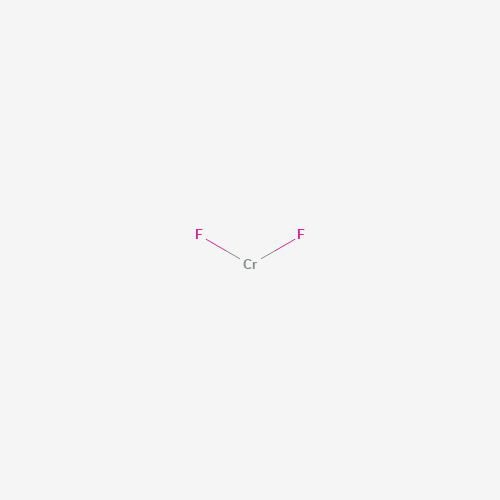
Chromium difluoride
CAS number:10049-10-2 molecular formula:CrF2
overview
Specs
| Chinese alias | - | ||
| English alias | Chromium(II) fluoride | ||
| CAS number | 10049-10-2 | molecular formula | CrF2 |
| molecular weight | 89.99 | Exact mass | - |
| PSA | - | logp | - |
numbering system
| CAS | 10049-10-2 |
| Wikipedia | Chromium(II) fluoride |
| PubChem CID | 66229 |
| DSSTox Substance ID | DTXSID30143338 |
| European Community (EC) Number | 233-168-0 |
| PubChem Reference Collection SID | 505572781 |
| MEP ID | _25Q1B3FNN |
physicochemical properties
| Complexity | 2.8 |
| Exact Mass | 89.937311 |
| Formal Charge | 0 |
| Chemical Classes | Metals -> Chromium Compounds, Inorganic |
| Heavy Atom Count | 3 |
| Molecular Weight | 89.993 |
| Monoisotopic Mass | 89.937311 |
| Isotope Atom Count | 0 |
| Physical Description | Blue-green, iridescent crystals Steel-gray lustrous crystals; [MSDSonline] |
| Rotatable Bond Count | 0 |
| Hydrogen Bond Donor Count | 0 |
| Covalently-Bonded Unit Count | 1 |
| Hydrogen Bond Acceptor Count | 2 |
| Topological Polar Surface Area | 0 Ų |
| Defined Atom Stereocenter Count | 0 |
| Defined Bond Stereocenter Count | 0 |
| Undefined Atom Stereocenter Count | 0 |
| Undefined Bond Stereocenter Count | 0 |
Safety information
Hazards Summary:
The relatively unstable divalent (chromous) ion is rapidly oxidized to the trivalent (Cr(III); chromic] form. [Nordberg, p. 718] Bivalent compounds are unstable and have little commercial value. [Asthma in the Workplace, p. 296] May be harmful after ingestion, inhalation, or skin contact; May damage eyes; Stable under recommended storage conditions. [MSDSonline] A strong eye and skin irritant; [Hawley] See Chromium.
Regulatory Information:
New Zealand EPA Inventory of Chemical Status: Chromium fluoride (CrF2): Does not have an individual approval but may be used as a component in a product covered by a group standard. It is not approved for use as a chemical in its own right.
Threshold Limit Values (TLV):
2.5 [mg/m3], as F
Hazard Classes and Categories:
Eye Dam. 1 (86.4%)
Permissible Exposure Limit (PEL):
0.5 [mg/m3], as Cr (2.5 mg/m3, as F)
Exposure Control and Personal Protection:
Maximum Allowable Concentration (MAK): 1.0 [mg/m3], as F, inhalable fraction[German Research Foundation (DFG)]
Production methods and uses
purpose
Sources/Uses: Used in chromizing, as a catalyst, and in nuclear reactor fuels
Related
upstream information
No upstream information yet
downstream information
No downstream information yet
MSDS
Found 0 shareMSDS




