

compound introduction
All
Chemical Reagents
Biomedicine
Organic raw materials
Inorganic chemical industry
intermediate
Agricultural chemicals
Auxiliaries and catalysts
Fragrances and Flavors
Dyes and Pigments
Daily chemical industry
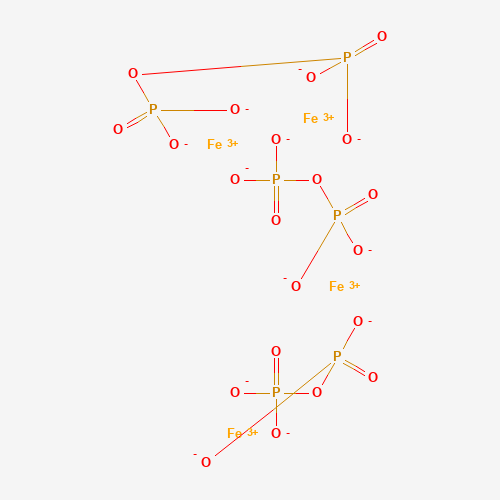
Iron(III) pyrophosphate
Dangerous GoodsCAS number:10058-44-3 molecular formula:Fe4(P2O7)3
overview
Specs
| Chinese alias | 焦磷酸铁 | ||
| English alias | iron(3+) diphosphate (4/3) | CCRIS 1900 | FERRIC PYROPHOSPHATE [MI] | Diphosphoric acid iron(3+) salt (3:4) | Diphosphoric acid, iron(3+) salt (3:4) | Iron (III) pyrophosphate | iron(3+) diphosphate | Iron(III) diphosphate | Sunactive Fe | Q9207442 | Ferr | ||
| CAS number | 10058-44-3 | molecular formula | Fe4(P2O7)3 |
| molecular weight | 745.21 g/mol | Exact mass | - |
| PSA | 407.000 Ų | logp | - |
numbering system
| CAS | 10058-44-3 |
| UNII | QK8899250F |
| HMDB ID | HMDB0303470 |
| ChEBI ID | 132767 |
| Wikidata | Q9207442 |
| ChEMBL ID | CHEMBL4297752 |
| Wikipedia | Iron(III) pyrophosphate |
| DrugBank ID | DB09147 |
| PubChem CID | 24877 |
| Deprecated CAS | 65214-07-5 |
| NCI Thesaurus Code | C82284 |
| DSSTox Substance ID | DTXSID6047600 |
| European Community (EC) Number | 233-190-0 |
| PubChem Reference Collection SID | 505594815 |
physicochemical properties
| LogP | 3.4 |
| Complexity | 124 |
| Exact Mass | 745.47552 |
| Pesticides | Active substance -> EU Pesticides database: Not approved |
| Solubility | Soluble after treatment with citric acid and sodium hydroxyde |
| Formal Charge | 0 |
| Melting Point | Decomposes |
| Food Additives | NUTRIENT SUPPLEMENT -> FDA Substance added to food |
| Chemical Classes | Metals -> Phosphates, Metallic Salts |
| Heavy Atom Count | 31 |
| Molecular Weight | 745.21 |
| Monoisotopic Mass | 745.47552 |
| Isotope Atom Count | 0 |
| Physical Description | Nonahydrate: Yellowish-white solid, practically insoluble in water; Beige crystalline solid; [MSDSonline] |
| Rotatable Bond Count | 0 |
| Dissociation Constants | pKa: 22.2 |
| Hydrogen Bond Donor Count | 0 |
| Covalently-Bonded Unit Count | 7 |
| Hydrogen Bond Acceptor Count | 21 |
| Other Experimental Properties | Soluble in acid. /Nonahydrate/ |
| Topological Polar Surface Area | 407 Ų |
| Defined Atom Stereocenter Count | 0 |
| Defined Bond Stereocenter Count | 0 |
| Undefined Atom Stereocenter Count | 0 |
| Undefined Bond Stereocenter Count | 0 |
Safety information
Interactions:
...Mice were treated orally with ciprofloxacin (50 mg/kg) alone, the iron compound (ferrous sulphate, sodium ferrous citrate or ferric pyrophosphate; 50 mg elemental iron/kg) alone, ciprofloxacin with each iron compound or ciprofloxacin in combination with each iron compound and ascorbic acid (250 mg/kg). The maximum serum concentration of ciprofloxacin was significantly (P<0.01) reduced from 1.15+/-0.11 ug/mL (ciprofloxacin alone) to 0.17+/-0.01, 0.27+/-0.01 or 0.28+/-0.02 ug/mL, respectively, when ferrous sulphate, sodium ferrous citrate or ferric pyrophosphate was administered along with ciprofloxacin. The addition of ascorbic acid did not affect the inhibitory effects of each iron compound on the absorption of ciprofloxacin. Ciprofloxacin did not affect the variation of serum iron l...
Hazards Summary:
May cause irritation; [MSDSonline] See Iron oxide (Fe2O3).
Primary Hazards:
Not Classified
Disposal Methods:
The following wastewater treatment technologies have been investigated for iron (Fe+2): Concentration process: Biological treatment. /Iron (Fe+2)/
FDA Requirements:
Ferric pyrophosphate used as a nutrient and/or dietary supplement in animal drugs, feeds, and related products is generally recognized as safe when used in accordance with good manufacturing or feeding practice.
Preventive Measures:
All ... /iron/ preparations should be kept in child-proof bottles. /Iron preparations/
Regulatory Information:
New Zealand EPA Inventory of Chemical Status: Diphosphoric acid, iron(3+) salt (3:4): Does not have an individual approval but may be used under an appropriate group standard
Other Safety Information:
Chemical Assessment: IMAP assessments - Diphosphoric acid, iron(3+) salt (3:4): Human health tier I assessment
Non-Human Toxicity Excerpts:
/GENOTOXICITY/ A number of ferrous and ferric salts have been tested for mutagenicity using the following organisms. Saccharomyces cerevisiae strain D-4, Salmonella typhimurium strains. TA-1535, TA-1537, and TA-1538 with and without activation. Plate tests as well as suspension tests were run with the Salmonella strains. ...Ferric pyrophosphate... /was/ inactive in all the systems used.
Populations at Special Risk:
...There is concern that the individual with metabolic defects that impair the ability to regulate iron absorption will be at risk from excessive exposure to iron, primarily as a result of acceleration of accumulation of iron in the body and an earlier onset of clinical symptoms of the disease. /Iron salts/
Hazard Classes and Categories:
Not Classified
State Drinking Water Standards:
(NC) NORTH CAROLINA 300 ug/L /Iron/
State Drinking Water Guidelines:
(ME) MAINE 340 ug/L /Iron/
Antidote and Emergency Treatment:
Hemodialysis and hemoperfusion are not effective for removing iron but may be necessary to remove iron-deferoxamine complex in patients with renal failure. Exchange transfusion is occasionally used for massive pediatric ingestions but is of questionable efficacy.
Federal Drinking Water Guidelines:
EPA 300 ug/L /Iron/
Skin, Eye, and Respiratory Irritations:
If inhaled, iron is a local irritant to the lung and gastrointestinal tract. /Iron compounds/
Other Standards Regulations and Guidelines:
Australia (1978); Belgium (1978); Finland (1975); Italy (1978); Netherlands (1978); and Switzerland (1978): 1 mg/cu m. /From table/ /Ferric salts, as Fe/
Production methods and uses
purpose
Uses:
Catalysts, pigments, drugs, agriculture, nutrition, metallurgy, and leather tanning. /Iron compounds/
Related
upstream information
No upstream information yet
downstream information
No downstream information yet
MSDS
Found 1 shareMSDS
10058-44-3 | Iron(III) pyrophosphate.pdf




