
Fluorescent Dye Carboxylic Acids and Their Succinimidyl Esters Succinimidyl esters are proven to be the best reagents for amine modifications because the amide bonds that are formed are essentially identical to, and as stable as the natural peptide bonds. These reagents are generally stable and show good reactivity and selectivity with aliphatic amines. There are few factors that need be considered when SE compounds are used for conjugation reaction: 1). Solvents:For the most part, reactive dyes are hydrophobic molecules and should be dissolved in anhydrous dimethylformamide (DMF) or dimethylsulfoxide (DMSO). 2). Reaction pH:The labeling reactions of amines with succinimidyl esters are strongly pH dependent. Amine-reactive reagents react with non-protonated aliphatic amine groups, including the terminal amines of proteins and the e-amino groups of lysines. Thus amine acylation reactions are usually carried out above pH 7.5. Protein modifications by succinimidyl esters can typically be done at pH 7.5-8.5, whereas isothiocyanates may require a pH 9.0-10.0 for optimal conjugations. 3).Reaction Buffers:Buffers that contain free amines such as Tris and glycine and thiol compounds must be avoided when using an amine-reactive reagent. Ammonium salts (such as ammonium sulfate and ammonium acetate) that are widely used for protein precipitation must also be removed (such as viadinlysis) before performing dye conjugations. 4). Reaction Temperature:Most conjugations are done at room temperature. However, either elevated or reduced temperature may be required for a particular labeling reaction. Features and Biological Applications 5-TAMRA is the purified single isomer of 5(6)-TAMRA. It is widely used to label peptides and proteins. It is preferred for some complicated biological applications where reproducibility is more critical than material cost since the minor positional difference between 5-TAMRA and 6-TAMRA might affect some biological properties of the underlying conjugates. Product parameter Ex(nm):541 Em(nm):568 References 1. Evans NA, et al. (2001). Visualizing differences in ligand-induced beta-arrestin-GFP interactions and trafficking between three recently characterized G protein-coupled receptors. J Neurochem77, 476-85. 2. Hahn, M., et al., Influence of fluorophor dye labels on the migration behavior of polymerase chain reaction—amplified short tandem repeats during denaturing capillary electrophoresis.Electrophoresis2001, 22, 2691-700. 3. Yoo H and Juliano RL (2000). Enhanced delivery of antisense oligonucleotides with fluorophore- conjugated PAMAM dendrimers. Nucleic Acids Res28, 4225-31. Fluorescent Dye Carboxylic Acids and Their Succinimidyl Esters Succinimidyl esters are proven to be the best reagents for amine modifications because the amide bonds that are formed are essentially identical to, and as stable as the natural peptide bonds. These reagents are generally stable and show good reactivity and selectivity with aliphatic amines. There are few factors that need be considered when SE compounds are used for conjugation reaction: 1). Solvents:For the most part, reactive dyes are hydrophobic molecules and should be dissolved in anhydrous dimethylformamide (DMF) or dimethylsulfoxide (DMSO). 2). Reaction pH:The labeling reactions of amines with succinimidyl esters are strongly pH dependent. Amine-reactive reagents react with non-protonated aliphatic amine groups, including the terminal amines of proteins and the e-amino groups of lysines. Thus amine acylation reactions are usually carried out above pH 7.5. Protein modifications by succinimidyl esters can typically be done at pH 7.5-8.5, whereas isothiocyanates may require a pH 9.0-10.0 for optimal conjugations. 3).Reaction Buffers:Buffers that contain free amines such as Tris and glycine and thiol compounds must be avoided when using an amine-reactive reagent. Ammonium salts (such as ammonium sulfate and ammonium acetate) that are widely used for protein precipitation must also be removed (such as viadinlysis) before performing dye conjugations. 4). Reaction Temperature:Most conjugations are done at room temperature. However, either elevated or reduced temperature may be required for a particular labeling reaction. Features and Biological Applications 5-TAMRA is the purified single isomer of 5(6)-TAMRA. It is widely used to label peptides and proteins. It is preferred for some complicated biological applications where reproducibility is more critical than material cost since the minor positional difference between 5-TAMRA and 6-TAMRA might affect some biological properties of the underlying conjugates. Product parameter Ex(nm):541 Em(nm):568 References 1. Evans NA, et al. (2001). Visualizing differences in ligand-induced beta-arrestin-GFP interactions and trafficking between three recently characterized G protein-coupled receptors. J Neurochem77, 476-85. 2. Hahn, M., et al., Influence of fluorophor dye labels on the migration behavior of polymerase chain reaction—amplified short tandem repeats during denaturing capillary electrophoresis.Electrophoresis2001, 22, 2691-700. 3. Yoo H and Juliano RL (2000). Enhanced delivery of antisense oligonucleotides with fluorophore- conjugated PAMAM dendrimers. Nucleic Acids Res28, 4225-31.
All
Chemical Reagents
Biomedicine
Organic raw materials
Inorganic chemical industry
intermediate
Agricultural chemicals
Auxiliaries and catalysts
Fragrances and Flavors
Dyes and Pigments
Daily chemical industry
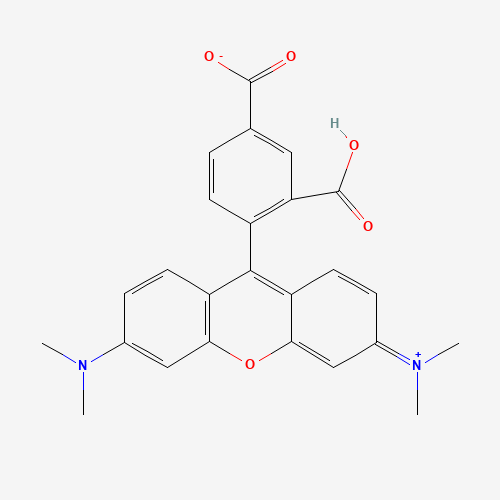
5-TAMRA
Dangerous GoodsCAS number:91809-66-4 molecular formula:C25H22N2O5
overview
compound introduction
Specs
| Chinese alias | - | ||
| English alias | 2-[3,6-bis(dimethylamino)xanthenium-9-yl]-5-carboxybenzoate | 2-(3,6-Bis(dimethylamino)xanthylium-9-yl)-5-carboxybenzoate | 5(6)-TAMRA Acid | BCP20413 | AKOS032949753 | BP-23469 | 5-Carboxytetramethyl Rhodamine | AKOS016000326 | DTXSID20376330 | F12248 | | ||
| CAS number | 91809-66-4 | molecular formula | C25H22N2O5 |
| molecular weight | 430.45 g/mol | Exact mass | ≥97% |
| PSA | 92.900 Ų | logp | 3.200 |
numbering system
No numbering system information yet
physicochemical properties
No physical and chemical property information yet
Safety information
WGK Germany:
3
Personal protective equipment:
Eyeshields,Gloves,type N95 (US),type P1 (EN143) respirator filter
Production methods and uses
No production method and use information yet
Related
upstream information
No upstream information yet
downstream information
No downstream information yet
MSDS
Found 1 shareMSDS
91809-66-4 | 5-Carboxytetramethylrhodamine.pdf