

Information Dovitinib (TKI258, CHIR258) Lactate is the Lactate of Dovitinib, which is a multitargeted RTK inhibitor, mostly for class III (FLT3/c-Kit) withIC50of 1 nM/2 nM, also potent to class IV (FGFR1/3) and class V (VEGFR1-4) RTKs withIC50of 8-13 nM, less potent to InsR, EGFR, c-Met, EphA2, Tie2, IGFR1 and HER2. Phase 4. Targets FLT3 ; c-Kit ; FGFR1 ; VEGFR3/FLT4 ; FGFR3 ;1 nM; 2 nM; 8 nM; 8 nM; 9 nM In vitro Dovitinib potently inhibits the FGF-stimulated growth of WT and F384L-FGFR3-expressing B9 cells with IC50 of 25 nM. In addition, Dovitinib inhibits proliferation of B9 cells expressing each of the various activated mutants of FGFR3. Interestingly, there are minimal observed differences in the sensitivity of the different FGFR3 mutations to Dovitinib, with the IC50 ranging from 70 to 90 nM for each of the various mutations. IL-6-dependent B9 cells containing vector only (B9-MINV cells are resistant to the inhibitory activity of Dovitinib at concentrations up to 1 μM. Dovitinib inhibits cell proliferation of KMS11 (FGFR3-Y373C), OPM2 (FGFR3-K650E), and KMS18 (FGFR3-G384D) cells with IC50 of 90 nM (KMS11 and OPM2) and 550 nM, respectively. Dovitinib inhibits FGF-mediated ERK1/2 phosphorylation and induces cytotoxicity in FGFR3-expressing primary MM cells. BMSCs does confer a modest degree of resistance with 44.6% growth inhibition for cells treated with 500 nM Dovitinib and cultured on stroma compared with 71.6% growth inhibition for cells grown without BMSCs. Dovitinib inhibits proliferation of M-NFS-60, an M-CSF growth-driven mouse myeloblastic cell line with a median effective concentration (EC50) of 220 nM. Treatment of SK-HEP1 cells with Dovitinib results in a dose-dependent reduction in cell number and G2/M phase arrest with reduction in the G0/G1 and S phases, inhibition of anchorage-independent growth and blockage of bFGF-induced cell motility. The IC50 for Dovitinib in SK-HEP1 cells is approximately 1.7 μM. Dovitinib also significantly reduces the basal phosphorylation levels of FGFR-1, FGFR substrate 2α (FRS2-α) and ERK1/2 but not Akt in both SK-HEP1 and 21-0208 cells. In 21-0208 HCC cells, Dovitinib significantly inhibits bFGF-induced phosphorylation of FGFR-1, FRS2-α, ERK1/2 but not Akt. In vivo Dovitinib induces both cytostatic and cytotoxic responses in vivo resulting in regression of FGFR3-expressing tumors. Dovitinib shows a dose- and exposure-dependent inhibition of target receptor tyrosine kinases (RTKs) expressed in tumor xenografts. Dovitinib potently inhibits tumor growth of six HCC lines. Inhibition of angiogenesis correlated with inactivation of FGFR/PDGFRβ/VEGFR2 signaling pathways. In an orthotopic model, Dovitinib potently inhibits primary tumor growth and lung metastasis and significantly prolonged mouse survival. Administration of Dovitinib results in significant tumor growth inhibition and tumor regressions, including large, established tumors (500-1,000 mm 3 ). Cell Research(from reference) Cell lines:B9 cells, MM cell lines Concentrations:100 nM Incubation Time:48-96 hours
All
Chemical Reagents
Biomedicine
Organic raw materials
Inorganic chemical industry
intermediate
Agricultural chemicals
Auxiliaries and catalysts
Fragrances and Flavors
Dyes and Pigments
Daily chemical industry
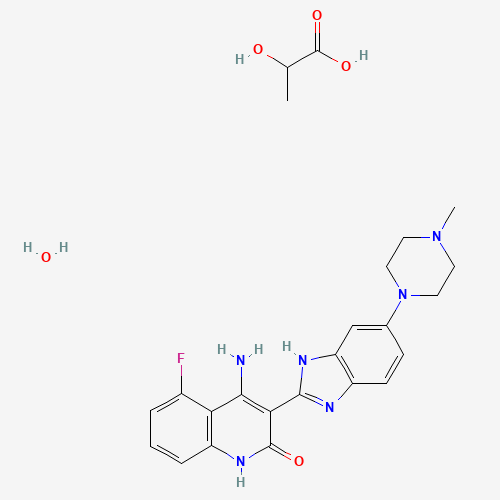
Dovitinib (TKI258) Lactate
Dangerous GoodsCAS number:915769-50-5 molecular formula:C24H29FN6O5
overview
compound introduction
Specs
| Chinese alias | - | ||
| English alias | InChI=1/C15H12O4/c16-11-4-1-10(2-5-11)3-8-14(18)13-7-6-12(17)9-15(13)19/h1-9,16-17,19H/b8-3 | BCP0726000101 | 4-Amino-5-fluoro-3-[6-(4-methylpiperazin-1-yl)-1H-benzimidazol-2-yl]quinolin-2(1H)-one mono 2-hydroxypropanoate hydrate | A843990 | 4-amino-5-flu | ||
| CAS number | 915769-50-5 | molecular formula | C24H29FN6O5 |
| molecular weight | 500.53 g/mol | Exact mass | 10mM in DMSO |
| PSA | 149.000 Ų | logp | - |
numbering system
No numbering system information yet
physicochemical properties
No physical and chemical property information yet
Safety information
pictogram:
GHS08 , GHS09 , GHS07
Signal word:
Danger
Hazard Statement:
H341: 怀疑引起遗传缺陷 H351: 怀疑引起遗传缺陷 H302: 吞食有害 H400: 对水生生物有剧毒 H410: 对水生生物有剧毒并具有长期持续影响 H372: 通过长时间或反复暴露对器官造成损害 H340: 可能导致遗传缺陷 H361: 怀疑破坏生育力或未出生的孩子
Statement of Preventive Measures:
P273: 避免释放到环境中。 P280: 戴防护手套/穿防护服/戴防护眼罩/戴防护面具。 P405: 密闭存放 P501: 将内容物/容器处理到。。。 P264: 处理后要彻底洗手。 P260: 不要吸入灰尘/烟雾/气体/雾/蒸汽/喷雾。 P281: 根据需要使用个人防护设备。 P270: 使用本产品时,请勿进食、饮水或吸烟。 P391: 收集溢出物 P330: 漱口 P203: 使用前,获取、阅读并遵守所有安全说明。 P301+P317: 如果被吞咽:请寻求医疗帮助。 P318: 如果暴露或担心,请就
Production methods and uses
No production method and use information yet
Related
upstream information
No upstream information yet
downstream information
No downstream information yet
MSDS
Found 0 shareMSDS




