

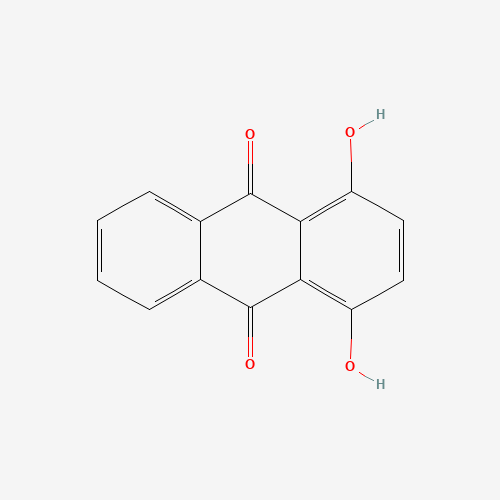
Description 1,4-Dihydroxyanthraquinone is an organic dye molecule with an aromatic structure. It is a derivative of anthraquinone bearing hydroxyl moieties. They may find uses in pharmacological, biochemical and dye industries. Anthraquinone dye are resistant to degradation.1,4-Dihydroxyanthraquinone may be used in the synthesis of cyclopentanoids by cyclization of α,β-unsaturated aldehyde with 1, 4 1,4-Dihydroxyanthraquinone. It has been studied as a long range emissive ratiometric fluorescent probe for live cell imaging.

All
Chemical Reagents
Biomedicine
Organic raw materials
Inorganic chemical industry
intermediate
Agricultural chemicals
Auxiliaries and catalysts
Fragrances and Flavors
Dyes and Pigments
Daily chemical industry
1,4-dihydroxyanthracene-9,10-dione
Dangerous GoodsCAS number:81-64-1 molecular formula:C14H8O4
overview
compound introduction
Specs
| Chinese alias | 醌茜;奎札因 | ||
| English alias | 9,10-Anthracenedione, 1,4-dihydroxy- | 1,4-Doa | Q906609 | 1,4-Dioxyanthraquinone [Russian] | BBL010354 | EN300-6486266 | Macrolex Orange GG | SR-01000637713-1 | 1,4-Dihydroxyanthra-9,10-quinone # | NCGC00160196-02 | Quinizarin; 1,4-Dihydroxyanthraquinone | ||
| CAS number | 81-64-1 | molecular formula | C14H8O4 |
| molecular weight | 240.21 | Exact mass | purum |
| PSA | 74.6 | logp | 3.7 |
numbering system
| CAS | 81-64-1 |
| UNII | 8S496ZV3CS |
| HMDB ID | HMDB0257042 |
| ChEBI ID | 37487 |
| Wikidata | Q906609 |
| ChEMBL ID | CHEMBL17594 |
| Wikipedia | 1,4-Dihydroxyanthraquinone |
| NSC Number | NSC Number: NSC15367 |
| 废弃 CAS | 103220-12-8 |
| AIDS 编号 | 526782 |
| PubChem CID | 6688 |
| Nikkaji Number | J3.861J |
| DSSTox Substance ID | DTXSID8044464 |
| 生态与环境部编号 | _25Q1B3A9N |
| Metabolomics Workbench ID | 55594 |
| European Community (EC) Number | 201-368-7 |
| PubChem Reference Collection SID | 482024109 |
physicochemical properties
| XLogP3 | 3.7 |
| 闪点 | 222 °C |
| 复杂性 | 342 |
| 蒸气压 | 0.00000002 [mmHg] |
| Exact Mass | 240.04225873 |
| 化学类别 | 醌类 |
| 形式电荷 | 0 |
| 物理描述 | 黄红色、橙色或深红色固体; 橙色粉末; [MSDSonline] |
| 解离常数 | iupacpka |
| 重原子计数 | 18 |
| Molecular Weight | 240.21 |
| Monoisotopic Mass | 240.04225873 |
| 可旋转键计数 | 0 |
| 氢键供体计数 | 2 |
| 氢键受体计数 | 4 |
| Kovats 保留指数 | 半标准非极性: 366 |
| 共价键单元计数 | 1 |
| 同位素原子计数 | 0 |
| 拓扑极性表面积 | 74.6 Ų |
| Collision Cross Section | 148.9 Ų [M-H]- [CCS类型: DT; 缓冲气体: N2; 电离: ESI-; 数据集: TOXCAST; 源标识符: DTXSID8044464] |
| 定义键立体中心计数 | 0 |
| 定义原子立体中心计数 | 0 |
| 未定义键立体中心计数 | 0 |
| 未定义原子手性中心计数 | 0 |
Safety information
危害摘要:
一种诱变剂和刺激物; 高剂量动物研究中的影响包括肾小管变化和体重减轻; [RTECS] 紧急处理: 刺激物; 刺激物; [MSDSonline]
法规信息:
新西兰EPA化学品清单状态:9,10-蒽醌,1,4-二羟基-:没有单独批准,但可在适当的团体标准下使用
生态毒性值:
USDA APHIS化学效应: collection=usda_chemeffect&query_type=synonym&query='^81-64-1$'
危害类别和分类:
对水生环境有害(长期)- 1类
Production methods and uses
purpose
用途:
用于防治白粉病的杀菌剂
行业用途:
中间体
一般制造信息:
工业加工部门:合成染料和颜料制造
工业应用参考:
工业分类参考:食品制造业。
应用场景参考:适合对材料精细度、设备条件和应用环境要求较高的场景,通常需要结合工艺目标做进一步筛选 。
作用参考:可作为基础工业材料参与合成、提纯或改性过程,为后续产品制造和工艺放大提供支撑 。
选型提示:实际选型应结合产品定位、纯度要求、设备精细化程度和现场环境综合判断,不宜仅凭单一指标决定 。
Related
upstream information
制造方法:
对氯苯胺(CID:7812); 邻苯二甲酸酐(CID:6811); 蒽醌(CID:6780); 过硫酸铵(CID:62648); 硫酸(CID:1118); 对氯苯酚(CID:4684); 氯化铝(CID:24012)
downstream information
No downstream information yet
MSDS
Found 0 shareMSDS




