

compound introduction
All
Chemical Reagents
Biomedicine
Organic raw materials
Inorganic chemical industry
intermediate
Agricultural chemicals
Auxiliaries and catalysts
Fragrances and Flavors
Dyes and Pigments
Daily chemical industry
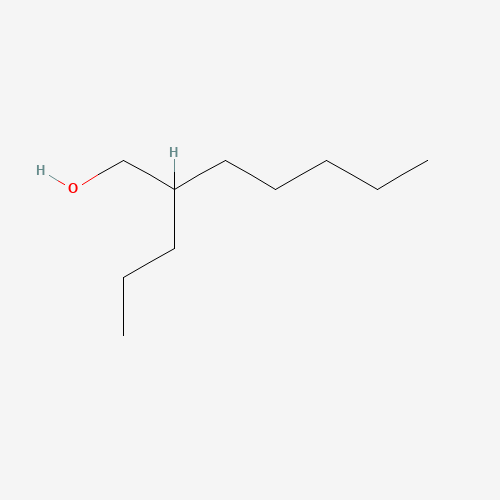
2-Propylheptan-1-ol
Dangerous GoodsCAS number:10042-59-8 molecular formula:C10H22O
overview
Specs
| Chinese alias | 2-丙基庚醇 | 2-丙基庚基醇 | 2-正丙基-1-庚醇 | ||
| English alias | CAS-10042-59-8 | 1-Heptanol, 2-propyl- | AI3-25311 | BRN 1361442 | 2-Propylheptan-1-ol | 2-Propylheptanol | DTXSID9029302 | UNII-ROZ1V94YZK | 2-propyl heptanol | 2-PROPYL-1-HEPTANOL | MFCD00046768 | 2-n-Propyl-1-Heptanol | 2-Propylheptyl Alcohol | EINECS | ||
| CAS number | 10042-59-8 | molecular formula | C10H22O |
| molecular weight | 158.28 g/mol | Exact mass | ≥96% |
| PSA | 20.200 Ų | logp | 3.800 |
numbering system
| CAS | 10042-59-8 |
| UNII | ROZ1V94YZK |
| Wikidata | Q7250471 |
| ChEMBL ID | CHEMBL3186950 |
| Wikipedia | 2-Propylheptanol |
| PubChem CID | 24847 |
| Nikkaji Number | J49.364C |
| DSSTox Substance ID | DTXSID9029302 |
| European Community (EC) Number | 233-126-1 |
| PubChem Reference Collection SID | 505478993 |
| MEP ID | _25Q1B3TFH |
physicochemical properties
| XLogP3 | XLogP3-AA: 3.8 |
| Complexity | 71.3 |
| Exact Mass | 158.167065321 |
| Formal Charge | 0 |
| Heavy Atom Count | 11 |
| Molecular Weight | 158.28 |
| Monoisotopic Mass | 158.167065321 |
| Isotope Atom Count | 0 |
| Physical Description | Liquid; CBI |
| Rotatable Bond Count | 7 |
| Hydrogen Bond Donor Count | 1 |
| Covalently-Bonded Unit Count | 1 |
| Hydrogen Bond Acceptor Count | 1 |
| Topological Polar Surface Area | 20.2 Ų |
| Defined Atom Stereocenter Count | 0 |
| Defined Bond Stereocenter Count | 0 |
| Undefined Atom Stereocenter Count | 1 |
| Undefined Bond Stereocenter Count | 0 |
Safety information
Regulatory Information:
New Zealand EPA Inventory of Chemical Status: 1-Heptanol, 2-propyl-: Does not have an individual approval but may be used as a component in a product covered by a group standard. It is not approved for use as a chemical in its own right.
Hazard Classes and Categories:
Aquatic Chronic 3 (66.2%)
Production methods and uses
purpose
Consumer Uses:
Plasticizer
Industry Uses:
Plasticizer
General Manufacturing Information:
Industry Processing Sectors: All Other Basic Organic Chemical Manufacturing
Related
upstream information
No upstream information yet
downstream information
No downstream information yet
MSDS
Found 0 shareMSDS




