All
Chemical Reagents
Biomedicine
Organic raw materials
Inorganic chemical industry
intermediate
Agricultural chemicals
Auxiliaries and catalysts
Fragrances and Flavors
Dyes and Pigments
Daily chemical industry

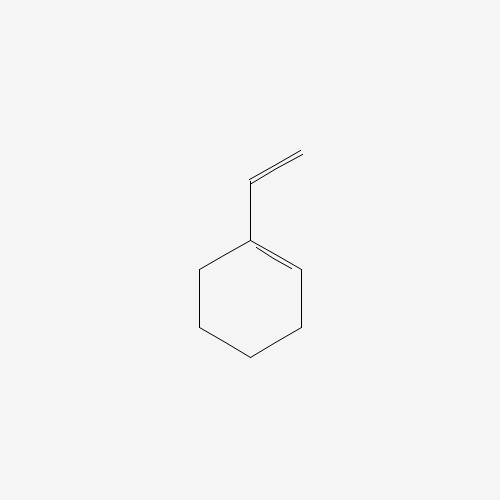
1-ethenylcyclohexene

Dangerous Goods

CAS number:100-40-3    molecular formula:C8H12

overview

compound introduction

物理描述|乙烯基环己烯是无色液体。浮于水面。(美国海岸警卫队,1999)

Specs

Chinese alias4-乙烯基-1-环己烯
English alias4-05-00-00406 (Beilstein Handbook Reference) | BRN 1901553 | V0023 | DTXCID601437 | LS-13442 | 4-Ethenyl-1-cyclohexene | 212JQJ15PS | 4-Vinyl-1-cyclohexene, analytical standard | 4-VINYLCYCLOHEXENE [IARC] | CHEBI:82377 | EN300-123688 | Tox21_200388 | 4 vi
CAS number100-40-3molecular formulaC8H12
molecular weight108.18Exact mass≥97%
PSA0.000 Ųlogp2.8

numbering system

CAS100-40-3
HMDB IDHMDB0244016
WikidataQ81984873
UN Number1993
PubChem CID17497
Deprecated CAS92619-43-7
Nikkaji NumberJ192.129K
DSSTox Substance IDDTXSID6051934
European Community (EC) Number220-070-8
PubChem Reference Collection SID518192337
MEP ID_25Q1B3AQC

physicochemical properties

XLogP3XLogP3-AA: 2.8
Density0.83
Complexity109
Exact Mass108.093900383
SolubilityINSOL IN WATER; SOL IN ETHER & BENZENE; VERY SOLUBLE IN METHYL ALCOHOL
Flash Point60 °F
Boiling Point259-261 °F
Formal Charge0
Melting Point-150 °F
Vapor Density3.76
Vapor Pressure15 mmHg at 77 °F
Chemical ClassesOther Classes -> Other Organic Compounds
Heavy Atom Count8
Molecular Weight108.18
Refractive IndexMAXIMUM ABSORPTION (ALCOHOL): 230 NM (LOG E= 4.32); INDEX OF REFRACTION 1.4915 @ 20 °C/D
Monoisotopic Mass108.093900383
Isotope Atom Count0
Physical DescriptionColorless liquid.
Rotatable Bond Count1
Autoignition Temperature517 °F (USCG, 1999)
Hydrogen Bond Donor Count0
Covalently-Bonded Unit Count1
Hydrogen Bond Acceptor Count0
Topological Polar Surface Area0 Ų
Defined Atom Stereocenter Count0
Defined Bond Stereocenter Count0
Undefined Atom Stereocenter Count0
Undefined Bond Stereocenter Count0

Safety information

DOT Label:
Flammable Liquid
First Aid:
OTHER: Since this chemical is a known or suspected carcinogen you should contact a physician for advice regarding the possible long term health effects and potential recommendation for medical monitoring. Recommendations from the physician will depend upon the specific compound, its chemical, physical and toxicity properties, the exposure level, length of exposure, and the route of exposure. (NTP, 1992)
Fire Hazards:
Behavior in Fire: Vapors can flow along surfaces to distant ignition source and flash back. (USCG, 1999)
Fire Fighting:
Fire Extinguishing Agents: Dry chemical, alcohol foam, or carbon dioxide. (USCG, 1999)
Toxicity Data:
LC50 (rat) = 10,500 mg/m3/4hr
Health Hazards:
Exposure can cause irritation of eyes, nose and throat. High concentrations have a narcotic effect. (USCG, 1999)
Reactive Group:
Hydrocarbons, Aliphatic Unsaturated
Adverse Effects:
ACGIH Carcinogen - Confirmed Animal.
Hazards Summary:
Causes male and female reproductive damage in high-dose animal studies; [ACGIH] Narcosis/anesthesia induced when inhaled at high concentrations
Reactivity Alerts:
Peroxidizable Compound
Reactivity Profile:
VINYLCYCLOHEXENE can react with oxidizing materials. It is also incompatible with peroxide catalysts. Prolonged exposure to oxygen-containing gases leads to discoloration and gum formation. (NTP, 1992).
Nonfire Spill Response:
STORAGE PRECAUTIONS: You should keep this material in a tightly closed container under an inert atmosphere, and store it in an explosion-proof refrigerator. STORE AWAY FROM SOURCES OF IGNITION. (NTP, 1992)
Regulatory Information:
New Zealand EPA Inventory of Chemical Status: 4-Vinyl cyclohexene: Does not have an individual approval but may be used under an appropriate group standard
Air and Water Reactions:
Highly flammable. This chemical oxidizes in air to form hydroperoxides. Slightly soluble in water.
Isolation and Evacuation:
FIRE: If tank, rail tank car or highway tank is involved in a fire, ISOLATE for 800 meters (1/2 mile) in all directions; also, consider initial evacuation for 800 meters (1/2 mile) in all directions. (ERG, 2024)
Other Safety Information:
Chemical Assessment: IMAP assessments - Cyclohexene, 4-ethenyl-: Environment tier I assessment
Peroxide Forming Chemical:
Additional Reference(s): https://toxnet.nlm.nih.gov/cgi-bin/sis/search2/r?dbs+hsdb:@term+@rn+@rel+100-40-3
NFPA Hazard Classification:
NFPA Instability Rating: 2 - Materials that readily undergo violent chemical changes at elevated temperatures and pressures.
Lower Explosive Limit (LEL):
1%
Upper Explosive Limit (UEL):
5.9%
Threshold Limit Values (TLV):
TLV-TWA (Time Weighted Average): 0.1 ppm [1994]
Personal Protective Equipment (PPE):
Full impervious protective clothing, including boots and gloves. Where splashing is possible wear full face shield or chemical safety goggles. Use approved respirator to protect against vapors. (USCG, 1999)

Production methods and uses

Production method
POSSIBLY BY PARTIAL HYDROGENATION OF STYRENE; MAY BE A BYPRODUCT IN THE MFR OF C4 OLEFINS & THEIR DIMERS
purpose
Consumer Uses:
Solvent
Industry Uses:
Fuel agents
General Manufacturing Information:
Industry Processing Sectors: Synthetic Rubber Manufacturing

Related

upstream information
Methods of Manufacturing:
STYRENE (CID:7501)
downstream information

No downstream information yet

MSDS

Found 1 shareMSDS
100-40-3 | 4-Ethylene-1-cyclohexene | 4-vinyl-1-cyclohexene