

Information CHIR-99021 (CT99021) HCl is hydrochloride of CHIR-99021, which is aGSK-3α/βinhibitor withIC50of 10 nM/6.7 nM; CHIR-99021 shows greater than 500-fold selectivity for GSK-3 versus its closest homologs Cdc2 and ERK2. CHIR-99021 is a potent pharmacological activators of theWnt/beta-cateninsignaling pathway. CHIR-99021 significantly rescues light-inducedautophagyand augments GR, RORα and autophagy-related proteins. Targets GSK-3β (Cell-free assay); GSK-3α (Cell-free assay) 6.7 nM; 10 nM In vitro CHIR-99021 shows greater than 500-fold selectivity for GSK-3 versus its closest homologs CDC2 and ERK2, as well as other protein kinases. Furthermore, CHIR-99021 shows only weak binding to a panel of 22 pharmacologically relevant receptors and little inhibitory activity against a panel of 23 nonkinase enzymes. CHIR-99021 induces the activation of glycogen synthase (GS) in insulin receptor-expressing CHO-IR cells with EC50 of 0.763 μM. In addition to simulating the actions of insulin, inhibition of GSK-3 by CHIR-99021 (3 μM) increases free cytosolic β-catenin by 1.9-fold, mimicking the canonical Wnt signaling pathway in 3T3-L1 preadipocytes. During any of the first 3 days of differentiation, CHIR-99021 treatment inhibits the preadipocyte differentiation with IC50 of 0.3 μM by blocking induction of CCAAT/enhancer-binding protein α (C/EBPα) and peroxisome proliferator-activated receptor γ (PPARγ). Unlike lithium chloride and AR-A014418, CHIR-99021 treatment does not reduce the viability of INS-1E cells even at high concentrations. Instead, CHIR-99021 robustly increases the rate of proliferation of INS-1E cells in a dose-dependent manner, and significantly inhibits INS-E cell death induced by high glucose and high palmitate in a concentration-dependent manner. CHIR-99021 promotes primary beta cell replication in isolated rat islets at concentrations as low as 1 μM, with 2-3 fold increase of cell replication at 5 μM of CHIR-99021 treatment. In vivo Oral administration of CHIR-99021 at 30 mg/kg enhances glucose metabolism in a rodent model of type 2 diabetes, with a maximal plasma glucose reduction of nearly 150 mg/dl 3-4 hours after administration, while plasma insulin remains at or below control levels. Oral administration of CHIR-99021 at 16 or 48 mg/kg 1 hour before oral glucose challenges in ZDF rats significantly improves glucose tolerance with 14% and 33% reduction in plasma glucose at 16 mg/kg and 48 mg/kg, respectively, and the higher dose of CHIR-99021 also reduces hyperglycemia before the oral glucose challenge. Administration of CHIR-99021 significantly augments hematopoietic repopulation in recipient mice transplanted with mouse or human hematopoietic stem cells (HSCs), suggesting that GSK-3 is a specific modulator of HSC activity. Cell Research(from reference) Cell lines:INS-1E Concentrations:Dissolved in DMSO, final concentrations ~ 20 μM Incubation Time:1, or 4 days
All
Chemical Reagents
Biomedicine
Organic raw materials
Inorganic chemical industry
intermediate
Agricultural chemicals
Auxiliaries and catalysts
Fragrances and Flavors
Dyes and Pigments
Daily chemical industry
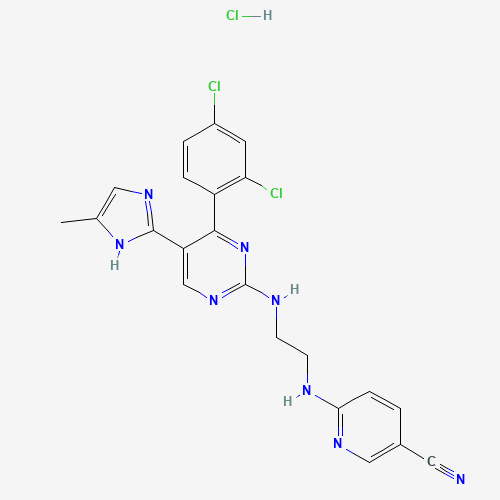
CHIR-99021 (CT99021) HCl
Dangerous GoodsCAS number:1797989-42-4 molecular formula:C22H19Cl3N8
overview
compound introduction
Specs
| Chinese alias | - | ||
| English alias | AS-19380 | CHIR 99021 hydrochloride | Laduviglusib (monohydrochloride) | CHIR-99021 (monohydrochloride) | s2924 | SCHEMBL17165152 | AC-33146 | 5AW8G37ZX5 | UNII-5AW8G37ZX5 | 6-((2-((4-(2,4-Dichlorophenyl)-5-(5-methyl-1H-imidazol-2-yl)pyrimidin-2-yl)amino) | ||
| CAS number | 1797989-42-4 | molecular formula | C22H19Cl3N8 |
| molecular weight | 501.8 g/mol | Exact mass | ≥97% |
| PSA | 115.000 Ų | logp | - |
numbering system
No numbering system information yet
physicochemical properties
No physical and chemical property information yet
Safety information
Signal word:
Warning
Hazard Statement:
H315: 引起皮肤刺激 H319: 引起严重眼睛刺激 H335: 可能引起呼吸道刺激 H302: 吞食有害
Statement of Preventive Measures:
P261: 避免吸入灰尘/烟雾/气体/雾/蒸汽/喷雾 P305+P351+P338: 如进入眼睛:用水小心冲洗几分钟。如戴隐形眼镜并可方便地取出,取出隐形眼镜。继续冲洗。
Production methods and uses
No production method and use information yet
Related
upstream information
No upstream information yet
downstream information
No downstream information yet
MSDS
Found 0 shareMSDS




