

Information UNBS5162 UNBS5162 is a pan-antagonist of CXCL chemokine expression with in vitro cytotoxic activity (IC50 range of 0.5-5 µM) against a range of human cancer cell lines including glioblastoma (Hs683 and U373MG), colorectal (HCT-15 and LoVo), non-small-cell lung (A549) and breast (MCF-7). Targets CXCL In vitro Exposure of PC-3 cells to UNBS5162 (1 µM for 5 successive days) dramatically decreases the expression of the proangiogenic CXCL chemokines. UNBS5162 displays weak in vitro antiproliferative activity with IC50 values of 17.3 μM, 16 μM, 4.7 μM, 8.5 μM, 28.8 μM, 8.9 μM, 46.5 μM, 21.2 μM, 9.1 μM in PC-3, DU-145, U373-MG, Hs683, HCT-15, LoVo, MCF-7, A549 and Bx-PC-3 cells. At 10 µM UNBS5162 markedly impairs PC-3 tumor cell growth kinetics, without inducing senescence, whereas the reverse feature is observed with respect to DU-145 cells. This difference might result from their respective p53 status and/or the extent of p16 expression. At 1 µM, UNBS5162 induces no such antitumor effects. UNBS5162 at 10 µM markedly increased the levels of heterochromatin in PC-3 cells through an increase in number of histones, at least at the mRNA levels. UNBS5162 has been identified to decrease levels of CXC chemokine ligand (CXCL) chemokines, including CXCL1, CXCL5 and CXCL8, in experimental prostate cancer and has a good inhibitory effect on the proliferation of tumour cells in vitro and in vivo. It inhibits cell proliferation, invasion and migration, and promote cell apoptosis, potentially through the PI3K/AKT signalling pathway in SKOV3 ovarian cancer cells. In vivo In vivo UNBS5162 after repeat administration significantly increases survival in orthotopic human prostate cancer models. In female mice for testing the pharmacokinetic profiles of UNBS5162, Systemic exposure after oral administration of 80 mg/kg is relatively low (Cmax = 510 ng/ml and AUC0-∞ = 886 ng·h/ml) reflected in an absolute bioavailability calculated to be only 3.84%. The volume of distribution (Vd) and the total clearance are estimated to be 18.9 L/kg and 3.47 L/h per kilogram, respectively. The half-life after i.v. administration of 20-mg/kg UNBS5162 is estimated to be 3.8 hours. Post-i.v. UNBS5162 plasma levels of 10 µM are only maintained for approximately 30 minutes, whereas 1-µM levels are sustained for maximally 2 hours. Cell Research(from reference) Cell lines:PC-3 and DU- 145 cells Concentrations:10 µM Incubation Time:72 h
All
Chemical Reagents
Biomedicine
Organic raw materials
Inorganic chemical industry
intermediate
Agricultural chemicals
Auxiliaries and catalysts
Fragrances and Flavors
Dyes and Pigments
Daily chemical industry
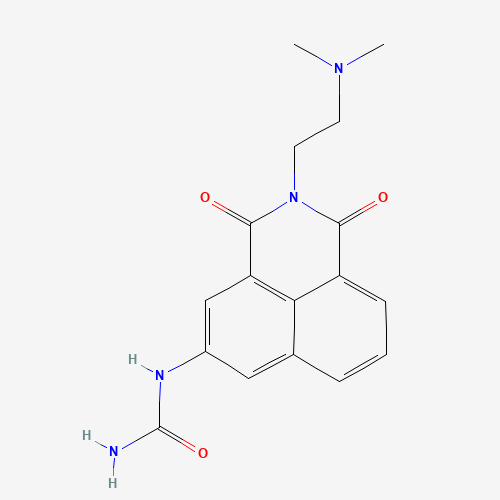
UNBS5162
Dangerous GoodsCAS number:956590-23-1 molecular formula:C17H18N4O3
overview
compound introduction
Specs
| Chinese alias | - | ||
| English alias | JY9JF7D78N | n-{2-[2-(dimethylamino)ethyl]-1,3-dioxo-2,3-dihydro-1h-benzo[de]isoquinolin-5-yl}urea | AC-35979 | SCHEMBL4188839 | A858960 | AKOS026750504 | BCP23948 | [2-[2-(dimethylamino)ethyl]-1,3-dioxobenzo[de]isoquinolin-5-yl]urea | UNII-JY9JF7D78N | U | ||
| CAS number | 956590-23-1 | molecular formula | C17H18N4O3 |
| molecular weight | 326.35 g/mol | Exact mass | ≥98% |
| PSA | 95.700 Ų | logp | 0.8 |
numbering system
No numbering system information yet
physicochemical properties
No physical and chemical property information yet
Safety information
Signal word:
Warning
Hazard Statement:
H315: 引起皮肤刺激 H319: 引起严重眼睛刺激 H335: 可能引起呼吸道刺激 H302: 吞食有害
Statement of Preventive Measures:
P261: 避免吸入灰尘/烟雾/气体/雾/蒸汽/喷雾 P305+P351+P338: 如进入眼睛:用水小心冲洗几分钟。如戴隐形眼镜并可方便地取出,取出隐形眼镜。继续冲洗。
Production methods and uses
No production method and use information yet
Related
upstream information
No upstream information yet
downstream information
No downstream information yet
MSDS
Found 0 shareMSDS




