

JNJ-40418677 is an orally active modulator of γ-secretase , can cross the blood-brain barrier. JNJ-40418677 inhibits Aβ42 and NS2B-NS3 protease , with IC 50 s of 200 nM and 3.9 μM, respectively. JNJ-40418677 displays good biological tolerance, can be use for Alzheimer’s disease research. Form:Solid IC50& Target:IC50: 185 nM (rat Aβ42); 200 nM (human Aβ42); 3.9 μM (ZIKV NS2B-NS3 protease) In Vitro:JNJ-40418677 (0.2 nM-0.3 mM; 16 h) selectively reduces Aβ42 secretion in cell culture supernatants of human neuroblastoma cells with mean IC 50 of 200 nM and (0.2 nM-0.3 mM; 48 h) of rat primary neurons with mean IC 50 of 185 nM. JNJ-40418677 (10 μM, 100 μM; 18 h) does not inhibit Notch processing or (6 nM-20 μM; 18 h) not affect formation of other amyloid precursor protein cleavage (CTF-β, CTF-α) products, and shows no inhibitory activity against COX-1/2 at a high concentration of 60 μM. JNJ-40418677 suppresses ZIKV in human neuronal stem cells with an EC 50 value of 3.2 μM, and inhibits ZIKV NS2B-NS3 protease with an IC 50 value of 3.9 μM. MCE has not independently confirmed the accuracy of these methods. They are for reference only. Western Blot AnalysisCell Line: HEK293 cells Concentration: 10 μM Incubation Time: 18 h Result: Resulted Aβ42 decreasing, Aβ38 increasing and Aβ40 levels remained unchanged. In Vivo:JNJ-40418677 (10-300 mg/kg; p.o.) decreases Aβ42 brain levels in a dose-dependent manner 4 h after treatment, while increasing Aβ38 level in non-transgenic mouse brain. JNJ-40418677 (30 mg/kg; p.o.; once) shows the mean brain and plasma levels 4 h after single dose are both 17 μM, indicating good brain penetration in non-transgenic mouse brain. JNJ-40418677 (20-120 mg/kg; p.o.; 7 months) has good biological tolerance with no adverse effects in a chronic treatment in Tg2576 mice. JNJ-40418677 (20-120 mg/kg; p.o.; 7 months) decreases the plaque number and the area occupied by plaques in Tg2576 mice dose-dependently. MCE has not independently confirmed the accuracy of these methods. They are for reference only. Animal Model: Non-transgenic mouse (6-month-old) Dosage: 10, 30, 100, 300 mg/kg Administration: Oral gavage; once Result: Reduced the Aβ42 brain levels dose-dependently, with 82%, 64%, 39%, and 31% at the doses of 10, 30, 100, 300 mg/kg, respectively. Animal Model: Tg2576 mice (6-month-old) Dosage: 20, 60, 120 mg/kg Administration: Oral gavage; 7 months Result: Exhibited well tolerated activity, without adverse effects on body weight. Showed no influence on the steady state levels of full-length APP, CTF-a, and CTF-b at a dosage of 120 mg/kg. Significantly reduced plaque area fraction and number of plaques.
All
Chemical Reagents
Biomedicine
Organic raw materials
Inorganic chemical industry
intermediate
Agricultural chemicals
Auxiliaries and catalysts
Fragrances and Flavors
Dyes and Pigments
Daily chemical industry
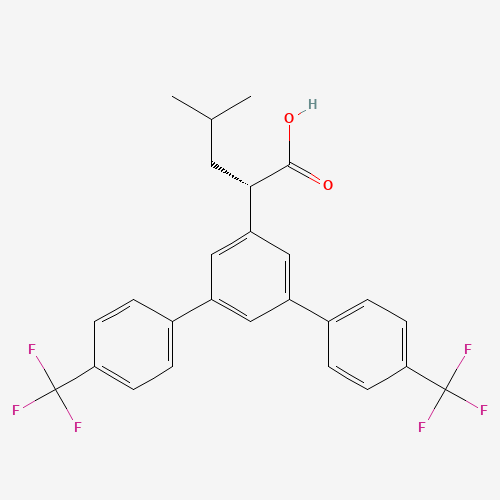
JNJ-40418677
Dangerous GoodsCAS number:1146594-87-7 molecular formula:C26H22F6O2
overview
compound introduction
Specs
| Chinese alias | - | ||
| English alias | UNII-Z1CWW31SGG | BDBM50114790 | RQOWDDLKGBMJFX-QHCPKHFHSA-N | Q27294866 | (2S)-2-[3,5-bis[4-(trifluoromethyl)phenyl]phenyl]-4-methylpentanoic acid | AS-16391 | AKOS037643428 | JNJ40418677 | JNJ-40418677 | (1,1':3',1''-Terphenyl)-5'-acetic acid, alpha-(2- | ||
| CAS number | 1146594-87-7 | molecular formula | C26H22F6O2 |
| molecular weight | 480.44 g/mol | Exact mass | ≥99% |
| PSA | 37.300 Ų | logp | 8.1 |
numbering system
No numbering system information yet
physicochemical properties
No physical and chemical property information yet
Safety information
Signal word:
Danger
Hazard Statement:
H413: 可能对水生生物造成长期的有害影响 H300: 吞咽致命
Statement of Preventive Measures:
P301+P310: 如误吞咽:立即呼叫急救中心/医生。 P264: 处理后要彻底洗手。
WGK Germany:
3
Production methods and uses
No production method and use information yet
Related
upstream information
No upstream information yet
downstream information
No downstream information yet
MSDS
Found 0 shareMSDS




