
APD668是有效的GPR119激动剂,对人源GPR119和大鼠GPR119的EC50值分别为2.7 nM和33 nM。 Information APD668 APD668 (JNJ28630368) is a potent GPR119 agonist with EC50s of 2.7 and 33 nM for human and rat forms, respectively. Targets human GPR119 ; rat GPR119 2.7 nM(EC50); 33 nM(EC50) In vitro APD668 is shown to increase adenylate cyclase activation in HEK293 cells transfected with human GPR119 (but not in non-transfected cells) in a concentration-dependent manner with an EC50 of 23 nM. APD668 also enhanced insulin release from both rat and human isolated pancreatic islets in a glucose-dependent manner. In a standard panel of around 80 known receptors and ion channels, APD668 did not show any binding in excess of 50% of control to any other proteins at concentrations up to 10 μM. In vivo Chronic treatment with APD668 showed that blood glucose and glycated hemoglobin (HbA1c) levels could be significantly reduced in Zucker Diabetic Fatty (ZDF) rats over several weeks of dosing. APD668 is highly bound to plasma proteins of male and female cynomolgus monkeys and humans (P99%), but was less extensively bound to male (93.0%) and female (96.6%) rats. In pharmacokinetic assessments across multiple species using single oral doses of APD668, absorption was rapid to moderate (Tmax 62 h) in mice, Sprague-Dawley (SD) rats, and monkeys, but slower in dogs (Tmax = 6 h) and showed a dose-dependent increase in rats and monkeys. In general, exposure was dose-dependent at lower doses and appeared to plateau at doses greater than 300 mg/kg. Exposure was greater in female rats compared with males. Absolute oral bioavailability was moderate to good in mice, rats, and monkeys (44–79%), but was lower in dogs (22%). The volume of distribution (Vdss) values were somewhat variable ranging from 0.1 L/kg in monkey to 2.6 L/kg in rats. Elimination, based on mean T1/2 after intravenous (iv) dosing, was rapid to moderate in mice, rats, dogs, and monkeys (0.8-3.9 h). The pharmacokinetic profile of APD668 in Zucker fa/fa rats was somewhat different from that in SD rats. After oral administration, the tmax and T1/2 were longer, and the AUC and the oral bioavailability were greater in the Zucker compared with the SD rats. Following iv administration, the Zucker rats also had larger AUC values, longer T1/2 values and greater Vdss values.
All
Chemical Reagents
Biomedicine
Organic raw materials
Inorganic chemical industry
intermediate
Agricultural chemicals
Auxiliaries and catalysts
Fragrances and Flavors
Dyes and Pigments
Daily chemical industry
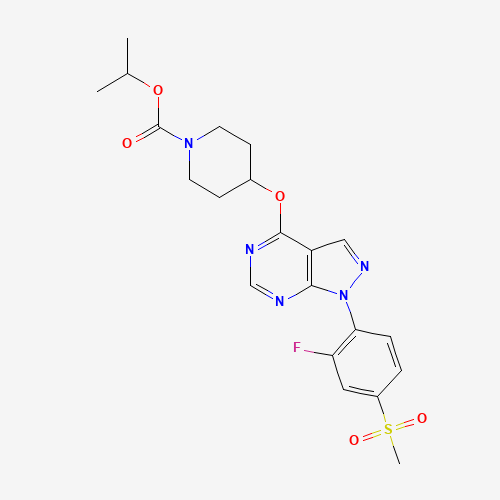
APD668
Dangerous GoodsCAS number:832714-46-2 molecular formula:C21H24FN5O5S
overview
compound introduction
Specs
| Chinese alias | - | ||
| English alias | BCP10207 | HY-Y1031A | ISOPROPYL 4-{[1-(2-FLUORO-4-METHANESULFONYLPHENYL)PYRAZOLO[3,4-D]PYRIMIDIN-4-YL]OXY}PIPERIDINE-1-CARBOXYLATE | propan-2-yl 4-{[1-(2-fluoro-4-methanesulfonylphenyl)-1H-pyrazolo[3,4-d]pyrimidin-4-yl]oxy}piperidine-1-carboxylate | SCHE | ||
| CAS number | 832714-46-2 | molecular formula | C21H24FN5O5S |
| molecular weight | 477.51 g/mol | Exact mass | - |
| PSA | 125.000 Ų | logp | 2.67 |
numbering system
No numbering system information yet
physicochemical properties
No physical and chemical property information yet
Safety information
pictogram:
GHS07
Signal word:
Warning
Hazard Statement:
H315: 引起皮肤刺激 H319: 引起严重眼睛刺激 H335: 可能引起呼吸道刺激 H302: 吞食有害
Statement of Preventive Measures:
P264: 处理后要彻底洗手。 P270: 使用本产品时,请勿进食、饮水或吸烟。 P301+P312+P330: 如误吞咽:如感觉不适,呼叫急救中心/医生。漱口
Production methods and uses
No production method and use information yet
Related
upstream information
No upstream information yet
downstream information
No downstream information yet
MSDS
Found 0 shareMSDS