

Lometrexol (DDATHF), an antipurine antifolate , can inhibit the activity of glycinamide ribonucleotide formyltransferase (GARFT) but do not induce detectable levels of DNA strand breaks. Lometrexol can further inhibit de novo purine synthesis, causing abnormal cell proliferation and apoptosis , even cell cycle arrest. Lometrexol has anticancer activity. Lometrexol also is a potent human Serine hydroxymethyltransferase1/2 ( hSHMT1/2 ) inhibitor . In Vitro Lometrexol (DDATHF) binds tightly to GART, resulting in a rapid and prolonged depletion of intracellular purine ribonucleotides. Lometrexol (1-30 μM; 2-10 hours) induces rapid and complete growth inhibition in L1210 cells. Lometrexol (1 μM; 2-24 hours) induces cell cycle arrest in murine leukemia L1210 cells. MCE has not independently confirmed the accuracy of these methods. They are for reference only. Cell Viability AssayCell Line: Mouse leukemia L1210 cells Concentration: 1, 30 μM Incubation Time: 2, 4, 6, 8, 10 hours Result: Induced rapid and complete growth inhibition. Cell Cycle AnalysisCell Line: L1210 cells Concentration: 1 μM Incubation Time: 2, 4, 8, 12, 24 hours Result: Caused a rapid loss of the G2/M phase population of cells and an early S phase accumulation of cells by 8 hours. By 24 h, the S phase population appeared to be slowly shifting to higher DNA content, and hence, from mid-to-late S phase. In Vivo Lometrexol (DDATHF; i.p.; 15-60 mg/kg; on gestation day 7.5) induces neural tube defects (NTDs) by disturbing purine metabolism and increases the rate of embryonic resorption and growth retardation in a dose-dependent manner . Lometrexol (i.p.; 40 mg/kg; on gestation day 7.5) decreases glycinamide ribonucleotide formyl transferase (GARFT) activity and Changes of ATP, GTP, dATP and dGTP levels . Lometrexol (i.p.; 40 mg/kg; on gestation day 7.5) induces abnormal proliferation and apoptosis exist in neural tube defects (NTDs) . MCE has not independently confirmed the accuracy of these methods. They are for reference only. Animal Model: C57BL/6 mice (7-8 week, 18-20 g) Dosage: 15, 30, 35, 40, 45 and 60 mg/kg Administration: Intraperitoneal injection; on gestation day 7.5 Result: Increased the rate of embryonic resorption and growth retardation in a dose-dependent manner. Animal Model: C57BL/6 mice (7-8 week, 18-20 g) Dosage: 40 mg/kg Administration: Intraperitoneal injection; on gestation day 7.5, for 0, 6, 24, 48 and 96 hours Result: Inhibited glycinamide ribonucleotide formyl transferase (GARFT) activity and GARFT activity was maximally inhibited after at 6 hours. Decreased the levels of ATP, GTP, dATP, and dGTP of NTDs embryonic brain tissue significantly at 6 hours. Animal Model: C57BL/6 mice (7-8 week, 18-20 g) Dosage: 40 mg/kg Administration: Intraperitoneal injection; on gestation day 7.5, for 4 days Result: Decreased the expression of proliferation-related genes (Pcna, Foxg1 and Ptch1) and increased the expression of apoptosis-related genes (Bax, Casp8 and Casp9) in NTD groups. Form:Solid
All
Chemical Reagents
Biomedicine
Organic raw materials
Inorganic chemical industry
intermediate
Agricultural chemicals
Auxiliaries and catalysts
Fragrances and Flavors
Dyes and Pigments
Daily chemical industry
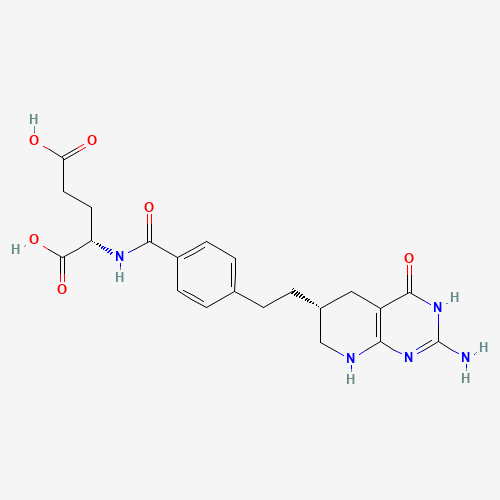
Lometrexol
Dangerous GoodsCAS number:106400-81-1 molecular formula:C21H25N5O6
overview
compound introduction
Specs
| Chinese alias | 洛美曲索 | ||
| English alias | NCGC00485206-02 | (4-(2-((R)-2-Amino-4-oxo-3,4,5,6,7,8-hexahydropyrido[2,3-d]pyrimidin-6-yl)ethyl)benzoyl)-L-glutamic acid | CCG-222045 | HY-14521 | DB12769 | Lometrexol | L-Glutamic acid, N-[4-[2-[(6R)-2-amino-3,4,5,6,7,8-hexahydro-4-oxopyrido[2,3-d]pyri | ||
| CAS number | 106400-81-1 | molecular formula | C21H25N5O6 |
| molecular weight | 443.5 g/mol | Exact mass | ≥95% |
| PSA | 183.000 Ų | logp | 0.300 |
numbering system
No numbering system information yet
physicochemical properties
No physical and chemical property information yet
Safety information
pictogram:
GHS06
Signal word:
Danger
Hazard Statement:
H301: 吞咽会中毒
Statement of Preventive Measures:
P321: 特殊处理(请参阅此标签上的...)。 P405: 密闭存放 P501: 将内容物/容器处理到。。。 P264: 处理后要彻底洗手。 P270: 使用本产品时,请勿进食、饮水或吸烟。 P330: 漱口 P301+P316: 如果吞咽:立即寻求紧急医疗救助。
Production methods and uses
No production method and use information yet
Related
upstream information
No upstream information yet
downstream information
No downstream information yet
MSDS
Found 0 shareMSDS




