

Information Pacritinib (SB1518) is a potent and selective inhibitor ofJanus Kinase 2 (JAK2)andFms-Like Tyrosine Kinase-3 (FLT3)withIC50sof 23 and 22 nM in cell-free assays, respectively. Phase 3. Targets FLT3 (D835Y) (Cell-free assay); JAK2 (V617F) (Cell-free assay); FLT3 (Cell-free assay); JAK2 (Cell-free assay); TYK2 (Cell-free assay) 14593, In vitro Pacritinib is a potent inhibitor of both wild-type JAK2 and JAK2 V617F mutant (IC50= 19 nM) that is present in high frequencies among patients with MPD. Relative to JAK2, Pacritinib is two-fold less potent against TYK2 (IC50= 50 nM), 23-fold less potent against JAK3 (IC50= 520 nM) and 56-fold less potent against JAK1 (IC50= 1280 nM). Pacritinib effectively permeates cells to modulate signaling pathways downstream of JAK2, whether agonist activated or mutationally activated. Pacritinib induces apoptosis, cell cycle arrest and antiproliferative effects in JAK2 WT - and JAK2 V617F -dependent cells. Pacritinib inhibits cell proliferation of Karpas 1106P and Ba/F3-JAK2 V617F with IC50 of 348 and 160 nM, respectively. Pacritinib inhibits endogenous colony growth derived from erythroid and myeloid progenitors with IC50 of 63 and 53 nM , respectively. SB1518 also inhibits FLT3 and its mutant FLT3-D835Y(IC50= 6 nM ). Pacritinib inhibits FLT3 phosphorylation and downstream STAT, MAPK and PI3K signaling in FLT3-internal-tandem duplication (ITD), FLT3-wt cells and primary AML blast cells. Pacritinib treatment leads to a dose-dependent decrease of pFLT3, pSTAT5, pERK1/2 and pAkt in FLT3-ITD harboring MV4-11 cells with IC50 of 80, 40, 33 and 29 nM , respectively. Treatment of the primary AML blast cells with Pacritinib for 3 h leads to a dose-dependent decrease of pFLT3, pSTAT3 and pSTAT5 with an IC50 below 0.5 μM. Pacritinib induces apoptosis, cell cycle arrest and anti-proliferative effects in FLT3-mutant and FLT3-wt cells. Pacritinib inhibits cell proliferation of FLT3-ITD-harboring cells MV4-11 and primary AML blast cells with IC50s of 47 nM and 0.19-1.3 μM, respectively. In vivo Pacritinib administrated at 150 mg/kg p.o. q.d. to JAK2 V617F -dependent xenograft model, significantly ameliorates splenomegaly and hepatomegaly symptoms, with 60% normalization of spleen weight and 92% normalization of liver weight and is well tolerated without significant weight loss or any hematological toxicities, including thrombocytopenia and anemia. Pacritinib induces dose-dependent inhibition of tumor growth of JAK2 V617F -dependent SET-2 xenograft model (40% for 75 mg/kg and 61% for 150 mg/kg). Pacritinib is efficacious in FLT3-ITD-bearing MV4-11 xenograft models. Pacritinib treated once daily for 21 consecutive days, induces dose-dependent inhibition of tumor growth (38% for 25 mg/kg, 92% for 50 mg/kg and 121% for 100 mg/kg). Complete regression is observed in 3/10 and 8/8 mice for the 50 and 100 mg/kg/day groups, respectively. Cell Research(from reference) Cell lines:Karpas 1106P cells Concentrations:~10 μM Incubation Time:2 days
All
Chemical Reagents
Biomedicine
Organic raw materials
Inorganic chemical industry
intermediate
Agricultural chemicals
Auxiliaries and catalysts
Fragrances and Flavors
Dyes and Pigments
Daily chemical industry
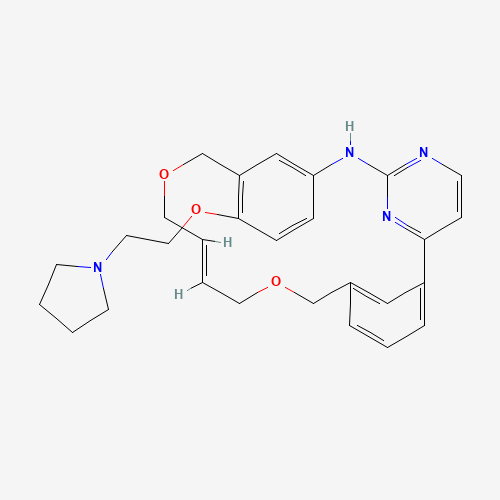
Pacritinib (SB1518)
Dangerous GoodsCAS number:937272-79-2 molecular formula:C28H32N4O3
overview
compound introduction
Specs
| Chinese alias | - | ||
| English alias | Pacritinib (SB1518) | (16E)-11-(2-pyrrolidin-1-ylethoxy)-14,19-dioxa-5,7,27-triazatetracyclo[19.3.1.12,6.18,12]heptacosa-1(24),2(27),3,5,8(26),9,11,16,21(25),22-decaene | Oral JAK2 Inhibitor SB1518 | SCHEMBL22819303 | AKOS037515687 | DB11697 | NCGC0038156 | ||
| CAS number | 937272-79-2 | molecular formula | C28H32N4O3 |
| molecular weight | 472.58 g/mol | Exact mass | - |
| PSA | 68.700 Ų | logp | 4.547 |
numbering system
No numbering system information yet
physicochemical properties
No physical and chemical property information yet
Safety information
pictogram:
GHS07
Signal word:
Warning
Hazard Statement:
H302: 吞食有害 H317: 可能引起皮肤过敏反应
Statement of Preventive Measures:
P280: 戴防护手套/穿防护服/戴防护眼罩/戴防护面具。
Production methods and uses
No production method and use information yet
Related
upstream information
No upstream information yet
downstream information
No downstream information yet
MSDS
Found 0 shareMSDS




