

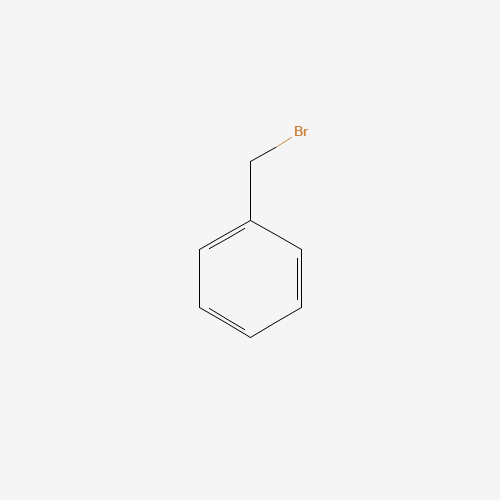
- DOT Label: Poison Corrosive
- First Aid: ERG2024, Guide 156 (Benzyl bromide): In Canada, an Emergency Response Assistance Plan (ERAP) may be required for this product. Please consult the shipping paper and/or the "ERAP" section.
- Treatment: EYES: irrigate opened eyes for several minutes under running water. INGESTION: do not induce vomiting. Rinse mouth with water (never give anything by mouth to an unconscious person). Seek immediate medical advice. SKIN: should be treated immediately by rinsing the affected parts in cold running water for at least 15 minutes, followed by thorough washing with soap and water. If necessary, the person should shower and change contaminated clothing and shoes, and then must seek medical attention. INHALATION: supply fresh air. If required provide artificial respiration.
- Fire Hazards: Combustible. Gives off irritating or toxic fumes (or gases) in a fire. Above 79 °C explosive vapour/air mixtures may be formed.
- Safe Storage: Separated from strong oxidants, strong bases and food and feedstuffs. Dry. Well closed.
- Fire Fighting: Use water spray, powder, foam, carbon dioxide. In case of fire: keep drums, etc., cool by spraying with water.
- Eye Prevention: Wear face shield or eye protection in combination with breathing protection.
- Fire Potential: Combustible. Gives off irritating or toxic fumes (or gases) in a fire.
- Health Effects: Bromine vapour causes irritation and direct damage to the mucous membranes. Elemental bromine also burns the skin. The bromide ion is a central nervous system depressant and chronic exposure produces neuronal effects. This is called bromism and can result in central reactions reaching from somnolence to coma, cachexia, exicosis, loss of reflexes or pathologic reflexes, clonic seizures, tremor, ataxia, loss of neural sensitivity, paresis, papillar edema of the eyes, abnormal speech, cerebral edema, delirium, aggressiveness, and psychoses. (L625, L626, L627)
- Health Hazards: ERG2024, Guide 156 (Benzyl bromide): · Runoff from fire control or dilution water may be corrosive and/or toxic and cause environmental contamination.
- Reactive Group: Polymerizable Compounds
- Adverse Effects: Toxic Pneumonitis - Inflammation of the lungs induced by inhalation of metal fumes or toxic gases and vapors.
- Cleanup Methods: Use personal protective equipment. Avoid breathing vapors, mist or gas. Ensure adequate ventilation. Remove all sources of ignition. Evacuate personnel to safe areas. Beware of vapors accumulating to form explosive concentrations. Vapors can accumulate in low areas.
- Exposure Routes: Oral (L626); inhalation (L626); dermal (L626)
- Fire Prevention: NO open flames. Above 79 °C use a closed system and ventilation.
- Hazards Summary: The major hazards encountered in the use and handling of benzyl bromide stem from both its toxicologic and physical/chemical properties. Toxic by all routes (ie, oral, dermal, inhalation), exposure to benzyl bromide may occur environmentally from inhaling air contaminated by exhaust from automobiles using leaded gasoline, or occupationally from its use in research. This colorless to slightly yellow liquid is an intense irritant to skin, eyes, and mucous membranes; and, in large doses, can cause CNS depression. Local exhaust ventilation should be applied wherever there is an incidence of point source emissions or dispersion of the pungent smelling, benzyl bromide. If contact is anticipated (eg, if handling broken benzyl bromide containers), wear a self-contained breathing apparatus, gogg...
- Inhalation Risk: No indication can be given about the rate at which a harmful concentration of this substance in the air is reached on evaporation at 20 °C.
- Skin Prevention: Protective gloves. Protective clothing.
- DOT ID and Guide: 1737 156
- Toxicity Summary: Bromine is a powerful oxidizing agent and is able to release oxygen free radicals from the water in mucous membranes. These free radicals are also potent oxidizers and produce tissue damage. In additon, the formation of hydrobromic and bromic acids will result in secondary irritation. The bromide ion is also known to affect the central nervous system, causing bromism. This is believed to be a result of bromide ions substituting for chloride ions in the in actions of neurotransmitters and transport systems, thus affecting numerous synaptic processes. (L626, L627, A543)
- EC Classification: Symbol: Xi; R: 36/37/38; S: (2)-39
- Reactivity Alerts: Polymerizable
- Spillage Disposal: Collect leaking and spilled liquid in sealable containers as far as possible. Absorb remaining liquid in sand or inert absorbent. Then store and dispose of according to local regulations. Personal protection: chemical protection suit including self-contained breathing apparatus.
- UN Classification: UN Hazard Class: 6.1; UN Subsidiary Risks: 8; UN Pack Group: II
- Environmental Fate: ATMOSPHERIC FATE: According to a model of gas/particle partitioning of semivolatile organic compounds in the atmosphere(1), benzyl bromide, which has a vapor pressure of 0.45 mm Hg at 25 °C(2), is expected to exist solely as a vapor in the ambient atmosphere. Vapor-phase benzyl bromide is degraded in the atmosphere by reaction with photochemically-produced hydroxyl radicals(SRC); the half-life for this reaction in air is estimated to be 7 days(SRC), calculated from its rate constant of 2.3X10⁻¹² cu cm/molecule-sec at 25 °C(SRC) that was derived using a structure estimation method(3). Benzyl bromide in methanol at low concentration (59.4 mg/L) does not absorb light at wavelengths >290 nm but does at high concentration (297 mg/L)(4); therefore, benzyl bromide is not expected to be suscept...
- First Aid Measures: Ingestion First Aid: Rinse mouth. Do NOT induce vomiting. Give one or two glasses of water to drink. Refer for medical attention .
- Reactivity Profile: BENZYL BROMIDE reacts with water, alcohols, common metals (except nickel and lead), bases, amines and oxidizing agents. (NTP, 1992). This material stored over activated 4A molecular sieve burst a bottle due to condensation-polymerization reaction with generation of HBr gas, [Chem. Eng. News, 1979, 57(12), 74].
- Signs and Symptoms: Bromine vapour causes irritation and direct damage to the mucous membranes. Symptoms include lacrimation, rhinorrhoea, eye irritation with mucous secretions from the oropharyngeal and upper airways, coughing, dyspnoea, choking, wheezing, epistaxis, and headache. The bromide ion is a central nervous system depressant producing ataxia, slurred speech, tremor, nausea, vomiting, lethargy, dizziness, visual disturbances, unsteadiness, headaches, impaired memory and concentration, disorientation and hallucinations. This is called bromism. (L626, L627)
- Storage Conditions: Keep container tightly closed in a dry and well-ventilated place. Containers which are opened must be carefully resealed and kept upright to prevent leakage. Light sensitive. Moisture sensitive.
- Exposure Prevention: PREVENT GENERATION OF MISTS!
- Ingestion Prevention: Do not eat, drink, or smoke during work.
- History and Incidents: World War I was the conflict, during which it was first used chemical warfare on a massive scale. The earliest chemical attack occurred on the Western Front in October 1914 in Neuve Chapelle, but its effects were so minimal that the Allies learned about it only after the war from German documents. The attack in the area Bolimow, made by the Germans against the Russian army with artillery shells containing gas T (xylyl and benzyl bromides), was therefore the first attack on a massive scale recorded on the victim side. The attack, which occurred after it made it possible to obtain some tactical success, but without a strategic breakthrough. Some of the later German attacks on the eastern front where chlorine was used proved to be more effective, but despite the many victims there was not...
- Inhalation Prevention: Use ventilation, local exhaust or breathing protection.
- Nonfire Spill Response: SMALL SPILL: Cover with DRY earth, DRY sand or other non-combustible material followed with plastic sheet to minimize spreading or contact with rain. Use clean, non-sparking tools to collect material and place it into loosely covered plastic containers for later disposal. (ERG, 2024)
- Air and Water Reactions: Sensitive to exposure to light and moisture. Slightly soluble in water.
- Effluent Concentrations: Benzyl bromide was identified in automotive emissions from cars burning leaded gasoline containing ethylene dibromide as a lead scavenger; the concentration detected was 1.4 ug/cu m(1).
- Human Toxicity Excerpts: /SIGNS AND SYMPTOMS/ Skin contact can cause severe, irritation, redness, swelling and sores. High level can cause dizziness because it attacks the nervous system.
- Packaging and Labelling: Do not transport with food and feedstuffs.
- Isolation and Evacuation: Evacuation: ERG2024, Guide 156 (Benzyl bromide): · If tank, rail tank car or highway tank is involved in a fire, ISOLATE for 800 meters (1/2 mile) in all directions; also, consider initial evacuation for 800 meters (1/2 mile) in all directions.
- Other Safety Information: Chemical Assessment: IMAP assessments - Benzene, (bromomethyl)-: Environment tier I assessment
- Soil Adsorption/Mobility: The Koc of benzyl bromide is estimated as 340(SRC), using a log Kow of 2.92(1) and a regression-derived equation(2). According to a classification scheme(3), this estimated Koc value suggests that benzyl bromide is expected to have moderate mobility in soil. However, adsorption on moist soil is expected to be attenuated by hydrolysis(SRC), with a calucalted chemical hydrolysis half-life of 79 minutes(4).
- Carcinogen Classification: No indication of carcinogenicity to humans (not listed by IARC).
- DOT Hazard Classification: Placard/Label(s)
- Toxic Combustion Products: Special hazards arising from the substance or mixture: Carbon oxides, Hydrogen bromide gas
- Accidental Release Measures: Spill or Leak: ERG2024, Guide 156 (Benzyl bromide): · Use clean, non-sparking tools to collect material and place it into loosely covered plastic containers for later disposal.
- Artificial Pollution Sources: Benzyl bromide's production and use in the manufacture of foaming and frothing agents, and in organic synthesis(1) may result in its release to the environment through various waste streams(SRC). Its former use in leaded gasoline(2) resulted in its direct release to the environment(SRC).
- Hazard Classes and Categories: Eye Irrit. 2
- Effects of Short Term Exposure: Lachrymation. The substance is severely irritating to the eyes, skin, respiratory tract and gastrointestinal tract.
- Environmental Bioconcentration: An estimated BCF of 39 was calculated in fish for benzyl bromide(SRC), using a log Kow of 2.92(1) and a regression-derived equation(2). According to a classification scheme(3), this BCF suggests the potential for bioconcentration in aquatic organisms is moderate(SRC). However, bioconcentration is expected to be attenuated by hydrolysis(SRC), with a calucalted chemical hydrolysis half-life of 79 minutes(4).
- Explosive Limits and Potential: Above 79 °C explosive vapor/air mixtures may be formed.
- Standard Transportation Number: 49 360 10; Benzyl bromide (bromotoluene, alpha)
- Volatilization from Water/Soil: The Henry's Law constant for benzyl bromide is estimated as 6.9X10⁻³ atm-cu m/mole(SRC) using a fragment constant estimation method(1). This Henry's Law constant indicates that benzyl bromide is expected to volatilize from water surfaces(2). Based on this Henry's Law constant, the volatilization half-life from a model river (1 m deep, flowing 1 m/sec, wind velocity of 3 m/sec)(2) is estimated as 5 hours(SRC). The volatilization half-life from a model lake (1 m deep, flowing 0.05 m/sec, wind velocity of 0.5 m/sec)(2) is estimated as 6 days(SRC). However, volatilization may be pre-empted by hydrolysis(3,4). Benzyl bromide's Henry's Law constant indicates that volatilization from moist soil surfaces may occur(SRC). Benzyl bromide is expected to volatilize from dry soil surfaces(SRC) based...
- Antidote and Emergency Treatment: Advanced treatment: Consider orotracheal or nasotracheal intubation for airway control in the patient who is unconscious, has severe pulmonary edema, or is in severe respiratory distress. Consider drug therapy for pulmonary edema ... . Positive-pressure ventilation techniques with a bag valve mask device may be beneficial. Consider drug therapy for pulmonary edema ... . Consider administering a beta agonist such as albuterol for severe bronchospasm ... . Monitor cardiac rhythm and treat arrhythmias if necessary ... Start IV administration of D5W /SRP: "To keep open", minimal flow rate/. Use 0.9% saline (NS) or lactated Ringer's (LR) if signs of hypovolemia are present. For hypotension with signs of hypovolemia, administer fluid cautiously. Watch for signs of fluid overload ... .Treat se...
- Protective Action Criteria (PAC): PAC-3: 160 [mg/m3]
- Shipment Methods and Regulations: The International Maritime Dangerous Goods Code lays down basic principles for transporting hazardous chemicals. Detailed recommendations for individual substances and a number of recommendations for good practice are included in the classes dealing with such substances. A general index of technical names has also been compiled. This index should always be consulted when attempting to locate the appropriate procedures to be used when shipping any substance or article.
- Environmental Abiotic Degradation: The rate constant for the vapor-phase reaction of benzyl bromide with photochemically-produced hydroxyl radicals has been estimated as 2.3X10⁻¹² cu cm/molecule-sec at 25 °C(SRC) using a structure estimation method(1). This corresponds to an atmospheric half-life of about 7 days at an atmospheric concentration of 5X10+5 hydroxyl radicals per cu cm(1). The rate constant for chemical hydrolysis of benzyl bromide at 25 °C was estimated to be 1.45X10⁻⁴ sec-1 based on an experimentally derived rate constant of 2.75X10⁻⁴ sec-1 at 30 °C(2,3). Using these data, the half-life for chemical hydrolysis of benzyl bromide at 25 °C has been estimated to be 79 minutes(2). At a relatively low concentration (59.4 mg/L) benzyl bromide in methanol exhibits almost no absorption of UV light at wavelengths >29...
- Probable Routes of Human Exposure: Occupational exposure to benzyl bromide may occur through inhalation and dermal contact with this compound at workplaces where benzyl bromide is produced or used. Limited monitoring data indicated that the general population may have been exposed to benzyl bromide via inhalation of automobile exhaust from vehicles using leaded gasoline. (SRC)
- Environmental Fate/Exposure Summary: Benzyl bromide's production and use in the manufacture of foaming and frothing agents, and in organic synthesis may result in its release to the environment through various waste streams. Its former use in leaded gasoline resulted in its direct release to the environment. If released to air, a vapor pressure of 0.45 mm Hg at 25 °C indicates benzyl bromide will exist solely as a vapor in the atmosphere. Vapor-phase benzyl bromide will be degraded in the atmosphere by reaction with photochemically-produced hydroxyl radicals; the half-life for this reaction in air is estimated to be 7 days. Benzyl bromide at low concentration (59.4 mg/L) does not absorb light at wavelengths >290 nm but does at high concentration (297 mg/L); therefore, it is not expected to be susceptible to direct photolys...
- Shipping Name/ Number DOT/UN/NA/IMO: IMO 6.1; Benzyl bromide
- Emergency Response Planning Guidelines: Emergency Response: ERG2024, Guide 156 (Benzyl bromide): · ALWAYS stay away from tanks in direct contact with flames.
- Skin, Eye, and Respiratory Irritations: Intensely irritating and corrosive to skin, eyes and mucous membranes.
- Exposure Control and Personal Protection: Protective Clothing: ERG2024, Guide 156 (Benzyl bromide): · Structural firefighters' protective clothing provides thermal protection but only limited chemical protection.
Warm reminder:
Because the manufacturer may temporarily adjust product specifications, prices, inventory, parameters and other information without notice, and there are differences in each user's consultation time and procurement needs, the platform reply content is only of reference value within a certain period. Sorry for the inconvenience caused to you, and thank you for your understanding and support! Please consult the online customer service for the latest details. Everything is subject to the real-time reply of the customer service.!
Please check the quantity, appearance and product information in time when you receive the goods. In case of damage, wrong delivery, abnormal quality and other problems, please feel free to contact us.
Service Hotline:400-6226-992 ,We will handle it for you as soon as possible, thank you for your support and trust.!
Research chemical ≥98. 0%; 100mg
Research chemical ≥98. 0%; 100mg; supplied for laboratory research, analysis, inspection, and scientific procurement use; specifications: ≥98. 0%; 100mg.




