

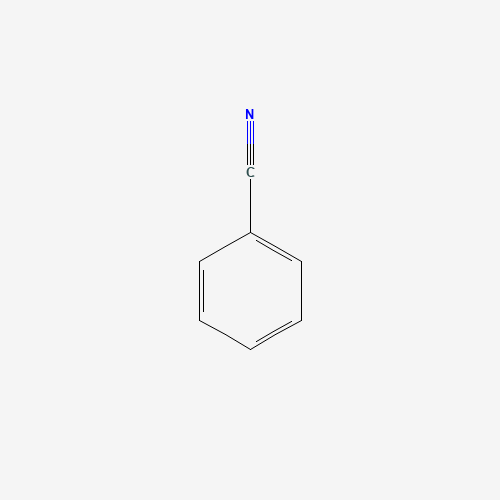
- DOT Label: Poison
- First Aid: ERG2024, Guide 152 (Benzonitrile): In Canada, an Emergency Response Assistance Plan (ERAP) may be required for this product. Please consult the shipping paper and/or the "ERAP" section.
- Treatment: Antidotes to cyanide poisoning include hydroxocobalamin and sodium nitrite, which release the cyanide from the cytochrome system, and rhodanase, which is an enzyme occurring naturally in mammals that combines serum cyanide with thiosulfate, producing comparatively harmless thiocyanate. Oxygen therapy can also be administered. (L97)
- AEGLs Notes: AEGLs Status: Final
- AEGLs Table: 8 hr: 3.7
- Body Burden: Benzonitrile was qualitatively detected in 3 of 12 samples of human milk collected from volunteers in Bayonne, NJ, Jersey City, NJ, Bridgeville, PA, and Baton Rouge, LA(1). Benzonitrile was detected in 24.6% of 387 of expired air samples collected from healthy, urban human adults; the mean concentration in expired air was 0.105 ng/L(2).
- Fire Hazards: Combustible. Gives off irritating or toxic fumes (or gases) in a fire. Above 75 °C explosive vapour/air mixtures may be formed.
- Interactions: The toxic mechanism of nitriles and the effect of metabolic modifiers in mice were studied in relation to their physicochemical properties. All the test nitriles liberated cyanide both in vivo and in vitro, with the exception of benzonitrile, although the extent of liberation and the effect of carbon tetrachloride pretreatment on the mortality of animals differed among nitriles. From these results, test compounds were tentatively divided into 3 groups. In group 1, acute toxicity was greatly reduced by carbon tetrachloride pretreatment, in group 2, toxicity was not significantly changed or was somewhat enhanced, and in group 3, benzonitrile only, toxicity was clearly enhanced. The amount of cyanide was higher at death in the brains of mice given group 1 compounds, the level being compara...
- Safe Storage: Separated from food and feedstuffs. Well closed. Keep in a well-ventilated room.
- Fire Fighting: Use powder, AFFF, foam, carbon dioxide. In case of fire: keep drums, etc., cool by spraying with water.
- Toxicity Data: LD50: 971 mg/kg (Oral, Rat) (T14) LD50: 740 mg/kg (Intraperitoneal, Rat) (T14) LD50: 180 mg/kg (Subcutaneous, Mouse) (T14) LD50: 1200 mg/kg (Dermal, Rat) (T88)
- Eye Prevention: Wear safety goggles or eye protection in combination with breathing protection.
- Fire Potential: ... Combustible but burns with difficulty.
- Health Effects: Exposure to high levels of cyanide for a short time harms the brain and heart and can even cause coma, seizures, apnea, cardiac arrest and death. Chronic inhalation of cyanide causes breathing difficulties, chest pain, vomiting, blood changes, headaches, and enlargement of the thyroid gland. Skin contact with cyanide salts can irritate and produce sores. (L96, L97)
- Health Hazards: ERG2024, Guide 152 (Benzonitrile): · Runoff from fire control or dilution water may be corrosive and/or toxic and cause environmental contamination.
- Reactive Group: Nitriles
- Adverse Effects: Other Poison - Uncoupler
- Cleanup Methods: Accidental Release Measures. Personal precautions, protective equipment and emergency procedures: Use personal protective equipment. Avoid breathing vapours, mist or gas. Ensure adequate ventilation. Remove all sources of ignition. Beware of vapours accumulating to form explosive concentrations. Vapours can accumulate in low areas. Environmental precautions: Prevent further leakage or spillage if safe to do so. Do not let product enter drains. Discharge into the environment must be avoided. Methods and materials for containment and cleaning up: Contain spillage, and then collect with an electrically protected vacuum cleaner or by wet-brushing and place in container for disposal according to local regulations. Keep in suitable, closed containers for disposal.
- Exposure Routes: Oral (L96); inhalation (L96); dermal (L96)
- Fire Prevention: NO open flames. Above 75 °C use a closed system and ventilation.
- Hazards Summary: Highly toxic; [Quick CPC] When burned, benzonitrile releases hydrogen cyanide and nitrogen oxides. Unlike the other nitriles, benzonitrile, an aromatic compound, does not release cyanide in the body after ingestion, inhalation, or skin absorption. Its acts as a uncoupler similar to the toxicity of pentachlorophenol. [HSDB; Goldfrank, p. 179] A skin, eye, and respiratory tract irritant; [ICSC] Causes contact urticaria; [Kanerva, p. 219] See Pentachlorophenol.
- Inhalation Risk: No indication can be given about the rate at which a harmful concentration of this substance in the air is reached on evaporation at 20 °C.
- Skin Prevention: Protective gloves. Protective clothing.
- Special Reports: OPDYKE DL J; FOOD COSMET TOXICOL 17(SUPPL): 723-5 (1979). REVIEW WITH 28 REF ON PHENYLCYANIDE INCLUDING TOXICITY, INHALATION, IRRITATION, SENSITIZATION, METAB, PHARMACOLOGY, & EFFECT ON ISOLATED TISSUE & PROTEINS.
- DOT ID and Guide: 2224 152
- Disposal Methods: SRP: Wastewater from contaminant suppression, cleaning of protective clothing/equipment, or contaminated sites should be contained and evaluated for subject chemical or decomposition product concentrations. Concentrations shall be lower than applicable environmental discharge or disposal criteria. Alternatively, pretreatment and/or discharge to a permitted wastewater treatment facility is acceptable only after review by the governing authority and assurance that "pass through" violations will not occur. Due consideration shall be given to remediation worker exposure (inhalation, dermal and ingestion) as well as fate during treatment, transfer and disposal. If it is not practicable to manage the chemical in this fashion, it must be evaluated in accordance with EPA 40 CFR Part 261, specif...
- Toxicity Summary: Organic nitriles decompose into cyanide ions both in vivo and in vitro. Consequently the primary mechanism of toxicity for organic nitriles is their production of toxic cyanide ions or hydrogen cyanide. Cyanide is an inhibitor of cytochrome c oxidase in the fourth complex of the electron transport chain (found in the membrane of the mitochondria of eukaryotic cells). It complexes with the ferric iron atom in this enzyme. The binding of cyanide to this cytochrome prevents transport of electrons from cytochrome c oxidase to oxygen. As a result, the electron transport chain is disrupted and the cell can no longer aerobically produce ATP for energy. Tissues that mainly depend on aerobic respiration, such as the central nervous system and the heart, are particularly affected. Cyanide is also...
- EC Classification: Symbol: Xn; R: 21/22; S: (2)-23
- Spillage Disposal: Personal protection: chemical protection suit including self-contained breathing apparatus. Do NOT let this chemical enter the environment. Collect leaking liquid in sealable containers. Absorb remaining liquid in sand or inert absorbent. Then store and dispose of according to local regulations.
- UN Classification: UN Hazard Class: 6.1; UN Pack Group: II
- Ecotoxicity Values: USDA APHIS Chemical Effects: collection=usda_chemeffect&query_type=synonym&query='^100-47-0$'
- Environmental Fate: ATMOSPHERIC FATE: According to a model of gas/particle partitioning of semivolatile organic compounds in the atmosphere(1), benzonitrile, which has a measured vapor pressure of 0.768 mm Hg at 25 °C(2), is expected to exist solely as a vapor in the ambient atmosphere(SRC). Vapor-phase benzonitrile is degraded in the atmosphere by reaction with photochemically-produced hydroxyl radicals(SRC); the half-life for this reaction in air is estimated to be 31 days(SRC), calculated from its rate constant of 3.30X10⁻¹³ cu cm/molecule-sec at 25 °C(3). Benzonitrile absorbs light at wavelengths >290 nm(4) and, therefore, may be susceptible to direct photolysis by sunlight(SRC).
- First Aid Measures: Ingestion First Aid: Rinse mouth. Rest. Refer for medical attention .
- Food Survey Values: Benzonitrile is found in milk products, roasted filberts and peanuts, and cooked trassi.
- Reactivity Profile: The cyano group can be readily hydrolyzed in the presence of mineral acids to produce stable, moderately toxic benzoic acid. When heated to decomposition, it emits highly toxic fumes of nitrogen oxides and hydrogen cyanide [Sax, 9th ed., 1996, p. 353].
- Signs and Symptoms: Cyanide poisoning is identified by rapid, deep breathing and shortness of breath, general weakness, giddiness, headaches, vertigo, confusion, convulsions/seizures and eventually loss of consciousness. (L96, L97)
- Storage Conditions: Conditions for safe storage, including any incompatibilities: Keep container tightly closed in a dry and well-ventilated place. Containers which are opened must be carefully resealed and kept upright to prevent leakage. Hygroscopic: Handle and store under inert gas.
- Exposure Prevention: PREVENT GENERATION OF MISTS!
- Milk Concentrations: Benzonitrile is found in milk products.
- Firefighting Hazards: Special hazards arising from the substance or mixture: Carbon oxides, nitrogen oxides (NOx)
- Ingestion Prevention: Do not eat, drink, or smoke during work.
- Atmospheric Standards: This action promulgates standards of performance for equipment leaks of Volatile Organic Compounds (VOC) in the Synthetic Organic Chemical Manufacturing Industry (SOCMI). The intended effect of these standards is to require all newly constructed, modified, and reconstructed SOCMI process units to use the best demonstrated system of continuous emission reduction for equipment leaks of VOC, considering costs, non air quality health and environmental impact and energy requirements. Benzonitrile is produced, as an intermediate or a final product, by process units covered under this subpart.
- Inhalation Prevention: Use ventilation, local exhaust or breathing protection.
- Nonfire Spill Response: ELIMINATE all ignition sources (no smoking, flares, sparks or flames) from immediate area. Do not touch damaged containers or spilled material unless wearing appropriate protective clothing. Stop leak if you can do it without risk. Prevent entry into waterways, sewers, basements or confined areas. Cover with plastic sheet to prevent spreading. Absorb or cover with dry earth, sand or other non-combustible material and transfer to containers. DO NOT GET WATER INSIDE CONTAINERS. (ERG, 2024)
- Air and Water Reactions: Slightly soluble in water.
- Effluent Concentrations: Benzonitrile was detected, not quantified, in water samples collected from an advanced waste treatment facility in Pomona, CA on June 25, 1975(1). Benzonitrile was detected in leachate samples at a concentration of 2.5 mg/L collected from a sanitary landfill near Waterloo, Ontario in 1982(2). Benzonitrile was also detected, not quantified, in leachate obtained from a simulated landfill lysimeter(3). Benzonitrile was detected at an estimated concentration of 0.7 mg/L in wastewater from the gasification of Indian Head lignite coal in North Dakota(4). Wastewater samples collected from two coal gasification and one shale oil processing facilities in Wyoming contained benzonitrile at concentrations ranging from 24-235 ppb(5). Benzonitrile was detected in condensate retort water from an oil s...
- Human Toxicity Excerpts: /SIGNS AND SYMPTOMS/ Following an occupational accident in which a worker's head and clothng were drenched with benzonitrile, the worker suffered severe respiratory distress and tonic convulsions between periods of unconsciousness which lasted for 75 min. Thereafter he gradually recovered, but several years later he experienced episodes of unconsciousness which might have been related to the benzonitrile exposure.
- ICSC Environmental Data: The substance is harmful to aquatic organisms.
- Packaging and Labelling: Do not transport with food and feedstuffs.
- Isolation and Evacuation: Evacuation: ERG2024, Guide 152 (Benzonitrile): · If tank, rail tank car or highway tank is involved in a fire, ISOLATE for 800 meters (1/2 mile) in all directions; also, consider initial evacuation for 800 meters (1/2 mile) in all directions.
- Other Safety Information: Chemical Assessment: IMAP assessments - Benzonitrile: Human health tier II assessment
- Soil Adsorption/Mobility: The Koc of benzonitrile is estimated as 150(SRC), using a log Kow of 1.56(1) and a regression-derived equation(2). According to a classification scheme(3), this estimated Koc value suggests that benzonitrile is expected to have moderate mobility in soil(SRC).
- Carcinogen Classification: No indication of carcinogenicity to humans (not listed by IARC).
- DOT Hazard Classification: Placard/Label(s)
- Toxic Combustion Products: Hydrogen cyanide & oxides of nitrogen may form in fire.
- Atmospheric Concentrations: SOURCE DOMINATED: Benzonitrile was detected, not quantified, in exhaust gas from engines burning hydrocarbon fuels(1). Benzonitrile was detected in the combustion of scrap tires in a horizontal laboratory scale reactor at 650, 750, 850, 950 degrees C at yields of 240, 580, 420, 120 mg/kg scrap tire; benzonitrile was not detected at 1050 degrees C(2). Benzonitrile was also detected in the emissions from a simulated automobile fire at 0.23 mg/kg(3).
- Accidental Release Measures: Spill or Leak: ERG2024, Guide 152 (Benzonitrile): · DO NOT GET WATER INSIDE CONTAINERS.
- Fish/Seafood Concentrations: Benzonitrile was detected, not quantified, in fish sauce from Southeast Asia(1).
- Lower Explosive Limit (LEL): 0.9 % (NTP, 1992)
- Upper Explosive Limit (UEL): 11.3 % (NTP, 1992)
- Artificial Pollution Sources: Benzonitrile's production and use in the synthesis of benzoquanamine; as an additive in nickel-plating baths; for separating naphthalene and alkylphthalates from non-aromatics by azetropic distillation; as jet-fuel additive; in cotton bleaching baths; as a drying additive for acrylic fibers; in the removal of titanium tetrachloride and vanadium oxytrichloride from silicon tetrachloride(1); as an intermediate of rubber chemicals; and as a solvent for nitrile rubber, speciality lacquers, and many resins, polymers and anhydrous metallic salts(2) may result in its release to the environment through various waste streams(SRC).
- Environmental Biodegradation: ANAEROBIC: Benzonitrile, present at a concentration of 3 mg-C/L, was biodegraded at 51% after 28 days under anaerobic conditions using a synthetic sewage inoculum at 37 °C(1).
- Hazard Classes and Categories: Acute Tox. 4 *
- Effects of Short Term Exposure: The substance is irritating to the eyes, skin and respiratory tract. The substance may cause effects on the cellular respiration. This may result in cyanosis. The effects may be delayed. Medical observation is indicated.
- Environmental Bioconcentration: An estimated BCF of 5 was calculated in fish for benzonitrile(SRC), using a measured log Kow of 1.56(1) and a regression-derived equation(2). According to a classification scheme(3), this BCF suggests the potential for bioconcentration in aquatic organisms is low(SRC).
- Explosive Limits and Potential: Explosive limits, vol% in air: 1.4-7.2
- Standard Transportation Number: 49 131 34; Benzonitrile
- Volatilization from Water/Soil: The Henry's Law constant for benzonitrile is estimated as 5.21X10⁻⁵ atm-cu m/mole(SRC) derived from its vapor pressure, 0.768 mm Hg(1), and water solubility of 2000 mg/L(2). This Henry's Law constant indicates that benzonitrile is expected to volatilize from water surfaces(3). Based on this Henry's Law constant, the volatilization half-life from a model river (1 m deep, flowing 1 m/sec, wind velocity of 3 m/sec)(3) is estimated as 20 hours(SRC). The volatilization half-life from a model lake (1 m deep, flowing 0.05 m/sec, wind velocity of 0.5 m/sec)(3) is estimated as 9 days(SRC). Benzonitrile's estimated Henry's Law constant indicates that volatilization from moist soil surfaces may occur(SRC). Benzonitrile is not expected to volatilize from dry soil surfaces(SRC) based upon its vapor...
- Protective Action Criteria (PAC): PAC-3: 19 [ppm]
- Shipment Methods and Regulations: The International Maritime Dangerous Goods Code lays down basic principles for transporting hazardous chemicals. Detailed recommendations for individual substances and a number of recommendations for good practice are included in the classes dealing with such substances. A general index of technical names has also been compiled. This index should always be consulted when attempting to locate the appropriate procedures to be used when shipping any substance or article.
- Critical Temperature and Pressure: Critical temperature: 691 K; critical pressure: 4.22 MPa; critical volume: 368 cu cm/mol
- Environmental Abiotic Degradation: The rate constant for the vapor-phase reaction of benzonitrile with photochemically-produced hydroxyl radicals has been reported as 3.30X10⁻¹³ cu cm/molecule-sec at 25 °C(1). This corresponds to an atmospheric half-life of about 31 days at an atmospheric concentration of 5X10+5 hydroxyl radicals per cu cm(1). Benzonitrile is expected to undergo hydrolysis in the environment due to the presence of functional groups that hydrolyze under environmental conditions(2). Benzonitrile is hydrolyzed to benzoic acid in water, anaerobic river and sediment, and sediment extract at elevated temperatures(3). The first order hydrolysis rate of benzonitrile in a phosphate buffer (pH 7.7) was 0.045 1/day with a half-life of 15.4 days at 85 degrees C(4). Benzonitrile absorbs at wavelengths >290 nm(5) and,...
- Probable Routes of Human Exposure: Occupational exposure to nitriles, such as benzonitrile, may occur through inhalation and dermal contact with this compound at workplaces where benzonitrile is produced or used(1). Monitoring data indicate that the general population may be exposed to benzonitrile via inhalation of ambient air, and ingestion of food containing benzonitrile(SRC).
- Environmental Water Concentrations: SURFACE WATER: Benzonitrile was detected at concentrations of 1300, 12, and 2.6 ug/L in surface water samples collected 0.67, 1.1, and 9 km downstream, respectively, from the site of the large tire fire in Winchester, VA in 1983(1).
- Environmental Fate/Exposure Summary: Benzonitrile's production and use in chemical synthesis, in industrial processes, as an additive, and as a solvent may result in its release to the environment through various waste streams. If released to air, a vapor pressure of 0.768 mm Hg at 25 °C indicates benzonitrile will exist solely as a vapor in the atmosphere. Vapor-phase benzonitrile will be degraded in the atmosphere by reaction with photochemically-produced hydroxyl radicals; the half-life for this reaction in air is estimated to be 31 days. Benzonitrile absorbs light at wavelengths >290 nm and, therefore, may be susceptible to direct photolysis by sunlight. If released to soil, benzonitrile is expected to have moderate mobility based upon an estimated Koc of 151. Volatilization from moist soil surfaces is expected to be a...
- Personal Protective Equipment (PPE): Personnel Protection: ... Wear positive pressure self-contained breathing apparatus. ... Wear appropriate chemical protective gloves, boots, and goggles.
- Shipping Name/ Number DOT/UN/NA/IMO: IMO 6.1; Benzonitrile
- Emergency Response Planning Guidelines: Emergency Response: ERG2024, Guide 152 (Benzonitrile): · For massive fire, use unmanned master stream devices or monitor nozzles; if this is impossible, withdraw from area and let fire burn.
- Skin, Eye, and Respiratory Irritations: Vapor is irritating to eyes, nose and throat. Liquid is irritating to skin and eyes.
- Exposure Control and Personal Protection: Protective Clothing: ERG2024, Guide 152 (Benzonitrile): · Structural firefighters' protective clothing provides thermal protection but only limited chemical protection.
- Hazardous Reactivities and Incompatibilities: Incompatible materials: Strong bases, strong oxidizing agents, strong reducing agents, acids, chlorates, nitrates, plastics.
- Immediately Dangerous to Life or Health (IDLH): 14.0 [ppm]
Warm reminder:
Because the manufacturer may temporarily adjust product specifications, prices, inventory, parameters and other information without notice, and there are differences in each user's consultation time and procurement needs, the platform reply content is only of reference value within a certain period. Sorry for the inconvenience caused to you, and thank you for your understanding and support! Please consult the online customer service for the latest details. Everything is subject to the real-time reply of the customer service.!
Please check the quantity, appearance and product information in time when you receive the goods. In case of damage, wrong delivery, abnormal quality and other problems, please feel free to contact us.
Service Hotline:400-6226-992 ,We will handle it for you as soon as possible, thank you for your support and trust.!
Research chemical 250mg
Research chemical 250mg; supplied for laboratory research, analysis, inspection, and scientific procurement use; specifications: 250mg.




