

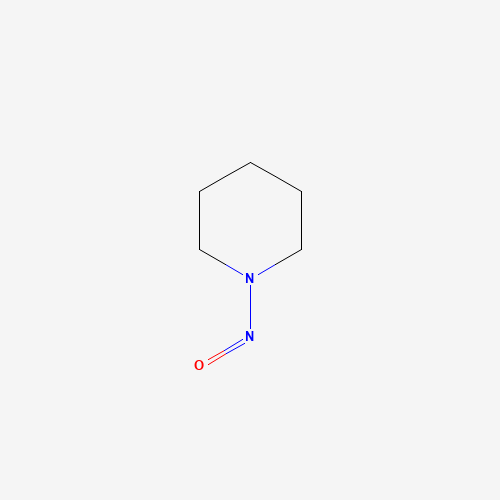
- DOT Label: Poison
- First Aid: OTHER: Since this chemical is a known or suspected carcinogen you should contact a physician for advice regarding the possible long term health effects and potential recommendation for medical monitoring. Recommendations from the physician will depend upon the specific compound, its chemical, physical and toxicity properties, the exposure level, length of exposure, and the route of exposure. (NTP, 1992)
- Body Burden: N-Nitrosopiperidine was detected at a concentration range of 0.20 to 4.39 ug/cu m in 28 of 28 personal air samples of salt bath line operators, salt bath line feeders and assistants, and molding/finishing operators at a rubber vehicle sealing plant; site visits were on February 16, 1994 and May 2-5, 1994(1).
- Fire Hazards: Flash point data are not available for this chemical, but it is probably combustible. (NTP, 1992)
- Fire Fighting: Fires involving this compound should be controlled with a dry chemical, carbon dioxide or Halon extinguisher. (NTP, 1992)
- Toxicity Data: LC (mice) > 500 mg/m3/10min
- Health Hazards: ACUTE/CHRONIC HAZARDS: When heated to decomposition this compound emits highly toxic fumes. (NTP, 1992)
- Reactive Group: Nitro, Nitroso, Nitrate, and Nitrite Compounds, Organic
- Adverse Effects: NTP Carcinogen - Reasonably anticipated to be a human carcinogen.
- Cleanup Methods: Decontamination of N-nitrosamines contaminated glassware /was described/. /N-nitrosamines/
- Hazards Summary: Danger of cutaneous absorption; MAC-2 (considered to be carcinogenic for man because sufficient data from long-term animal studies or limited evidence from animal studies substantiated by evidence from epidemiological studies indicate that it can make a significant contribution to cancer risk); [MAK] May cause irritation; Causes liver injury in high-dose animal studies; [MSDSonline]
- RCRA Requirements: U179; As stipulated in 40 CFR 261.33, when N-nitrosopiperidine, as a commercial chemical product or manufacturing chemical intermediate or an off-specification commercial chemical product or a manufacturing chemical intermediate, becomes a waste, it must be managed according to Federal and/or State hazardous waste regulations. Also defined as a hazardous waste is any residue, contaminated soil, water, or other debris resulting from the cleanup of a spill, into water or on dry land, of this waste. Generators of small quantities of this waste may qualify for partial exclusion from hazardous waste regulations (40 CFR 261.5).
- Environmental Fate: ATMOSPHERIC FATE: According to a model of gas/particle partitioning of semivolatile organic compounds in the atmosphere(1), N-nitrosopiperidine, which has a vapor pressure of 9.20X10⁻² mm Hg at 20 °C(2), is expected to exist solely as a vapor in the ambient atmosphere. Vapor-phase N-nitrosopiperidine is degraded in the atmosphere by reaction with photochemically-produced hydroxyl radicals(SRC); the half-life for this reaction in air is estimated to be 5 hours(SRC), calculated from its rate constant of 2.6X10⁻¹¹ cu cm/molecule-sec at 25 °C(SRC) that was derived using a structure estimation method(3). N-Nitrosopiperidine has a UV absorption maximum of 337 nm in water(4), and therefore may be susceptible to direct photolysis by sunlight(SRC).
- Food Survey Values: 75 samples of traditionally produced pork bacon and 37 samples of 4 bacon-like products which were manufactured from turkey, beef, pork and turkey, and beef and turkey were analyzed for volatile nitrosamines following preparation. All products were purchased in the US at retail stores in Oregon, California, Washington, Maryland, and Massachusetts between September 1993 and December 1994. N-Nitrosopiperidine was reported present only in those samples containing pepper, specifically traditional pork bacon with pepper, mean concentration 2.0, range 0.6-4.2 ug/kg(1).
- Reactivity Profile: N-NITROSOPIPERIDINE may react with strong oxidizing agents, especially peroxyacids. (NTP, 1992).
- Storage Conditions: PRECAUTIONS FOR "CARCINOGENS": Storage site should be as close as practicable to lab in which carcinogens are to be used, so that only small quantities required for ... expt need to be carried. Carcinogens should be kept in only one section of cupboard, an explosion-proof refrigerator or freezer (depending on chemicophysical properties ...) that bears appropriate label. An inventory ... should be kept, showing quantity of carcinogen & date it was acquired. ... Facilities for dispensing ... should be contiguous to storage area. /Chemical Carcinogens/
- Medical Surveillance: PRECAUTIONS FOR "CARCINOGENS": ... In relation specifically to cancer hazards, there are at present no health monitoring methods that may ensure the early detection of preneoplastic lesions or lesions which may prelude them. Whenever medical surveillance is indicated, in particular when exposure to a carcinogen has occurred, ad hoc decisions should be taken concerning additional tests that might become useful or mandatory. /Chemical Carcinogens/
- RAIS Toxicity Values: Oral Slope Factor Reference: CALEPA
- Nonfire Spill Response: STORAGE PRECAUTIONS: You should protect this material from exposure to light, and store it in a refrigerator. (NTP, 1992)
- Air and Water Reactions: Water soluble.
- Effluent Concentrations: Trace levels (<0.6 ppb) of N-nitrosopiperidine were detected in municipal sludge from Boston, MA and Galveston, TX(1). Levels of 0.03 ug/L N-nitrosopiperidine were reported to be found in waste water from 1 of 19 chemical factories(2). N-Nitrosopiperidine is a disinfection byproduct of water treatment and in reaction of disinfectant nitrosamines with natural organic matter in surface water(3,4).
- Human Toxicity Excerpts: /ALTERNATIVE and IN VITRO TESTS/ In the present study, the human promyelocytic leukemia cell line HL-60, was used to characterize the apoptotic effects of N-nitrosamines, and to examine the production of reactive oxygen species (ROS). Apoptotic cells were identified by (i) chromatin condensation (ii) flow cytometry analysis and (iii) poly(ADP-ribose) polymerase (PARP) cleavage. N-Nitrosopiperidine and N-nitrosodibutylamine induced morphological changes consistent with apoptotic events in HL-60 cells. Flow cytometry analysis showed that both N-nitrosamines induced apoptotic cell death in a concentration and time dependent-manner. It was observed that N-nitrosodibutylamine was stronger than N-nitrosopiperidine, since it induced a significant apoptotic cell death after 18 hr starting from...
- Isolation and Evacuation: FIRE: If tank, rail tank car or highway tank is involved in a fire, ISOLATE for 800 meters (1/2 mile) in all directions; also, consider initial evacuation for 800 meters (1/2 mile) in all directions. (ERG, 2024)
- Soil Adsorption/Mobility: The Koc of N-nitrosopiperidine is estimated as 170(SRC), using a log Kow of 0.36(1) and a regression-derived equation(2). According to a classification scheme(3), this estimated Koc value suggests that N-nitrosopiperidine is expected to have high mobility in soil.
- Carcinogen Classification: IARC Monographs: Volume Sup 7: Overall Evaluations of Carcinogenicity: An Updating of IARC Monographs Volumes 1 to 42, 1987; 440 pages; ISBN 92-832-1411-0 (out of print)
- Natural Pollution Sources: No evidence was found that N-nitrosopiperidine has been detected as a natural product(SRC). The formation of nitrosamines in natural ecosystems in the presence of high concentrations of secondary amines and nitrite has been demonstrated(1). Nitrite concentrations may be high in localized areas in soil and food to effect nitrosation of piperidine(1).
- Atmospheric Concentrations: SOURCE DOMINATED: N-Nitrosopiperidine was detected at a range of 3.9 to 7.6 ug/cu m in air samples from a rubber vehicle sealing plant on February 16, 1994. Concentrations ranging from 1.35 to 10.17 ug/cu m were measured during a followup May 2-5, 1994 site visit(1). The compound was detected in 28% of 177 samples from 24 rubber manufacturing plants in France sampled from December 1992 to November 1995; the median concentration was 0.24 ug/cu m, maximum, 2.1 ug/cu m(2).
- EPA Hazardous Waste Number: U179; A toxic waste when a discarded commercial chemical product or manufacturing chemical intermediate or an off-specification commercial chemical product or a manufacturing chemical intermediate.
- Artificial Pollution Sources: N-Nitrosamines are formed by the interaction between amines and NOx or nitrites(1) which are used as additives(2). N-Nitrosopiperidine's inadvertent production as a disinfection byproduct of water treatment and in reaction of disinfectant nitrosamines with natural organic matter in surface water(3) may result in its direct release to the environment(SRC).
- Environmental Biodegradation: AEROBIC: In unamended soils, 33% of N-nitrosopiperidine was degraded by soil microorganisms after 30 days(1).
- Evidence for Carcinogenicity: N-Nitrosopiperidine: reasonably anticipated to be a human carcinogen.
- Hazard Classes and Categories: Carcinogens, Flammable agents - 2nd degree, Reactive agents - 1st degree
- Environmental Bioconcentration: An estimated BCF of 3 was calculated in fish for N-nitrosopiperidine(SRC), using a log Kow of 0.36(1) and a regression-derived equation(2). According to a classification scheme(3), this BCF suggests the potential for bioconcentration in aquatic organisms is low(SRC).
- Volatilization from Water/Soil: The Henry's Law constant for N-nitrosopiperidine is 8.44X10⁻⁷ atm-cu m/mole(1). This Henry's Law constant indicates that N-nitrosopiperidine is expected to be essentially nonvolatile from water surfaces(2). N-Nitrosopiperidine's Henry's Law constant indicates that volatilization from moist soil surfaces may not occur(SRC). N-Nitrosopiperidine is not expected to volatilize from dry soil surfaces(SRC) based upon a vapor pressure of 9.20X10⁻² mm Hg(3).
- Antidote and Emergency Treatment: Advanced treatment: Consider orotracheal or nasotracheal intubation for airway control in the patient who is unconscious or is in severe respiratory distress. Monitor cardiac rhythm and treat arrhythmias if necessary. Start IV administration of D5W /SRP: "To keep open", minimal flow rate/. Use 0.9% saline (NS) or lactated Ringer's (LR) if signs of hypovolemia are present. For hypotension with signs of hypovolemia, administer fluid cautiously. If unresponsive to these measures, vasopressors may be helpful. Watch for signs of fluid overload ... . Treat seizures with diazepam or lorazepam ... . Administer 1% solution methylene blue if patient is symptomatic with severe hypoxia, cyanosis, and cardiac compromise not responding to oxygen. ... . Use proparacaine hydrochloride to assist eye irr...
- Shipment Methods and Regulations: PRECAUTIONS FOR "CARCINOGENS": When no regulations exist, the following procedure must be adopted. The carcinogen should be enclosed in a securely sealed, watertight container (primary container), which should be enclosed in a second, unbreakable, leakproof container that will withstand chem attack from the carcinogen (secondary container). The space between primary & secondary container should be filled with absorbent material, which would withstand chem attack from the carcinogen & is sufficient to absorb the entire contents of the primary container in the event of breakage or leakage. Each secondary container should then be enclosed in a strong outer box. The space between the secondary container & the outer box should be filled with an appropriate quantity of shock-absorbent materia...
- Environmental Abiotic Degradation: Nitrosamines are rapidly decomposed by photolysis and do not persist for a significant time in water illuminated in sunlight. Thus, it is unlikely that they will be present in high (greater than 1 mg/L) concentrations in surface waters. However, in the absence of light they can be expected to persist. /Nitrosamines/
- Probable Routes of Human Exposure: Occupational exposure to N-nitrosopiperidine may occur through inhalation and dermal contact with this compound at workplaces where N-nitrosopiperidine is inadvertently produced(SRC). Workers can be exposed to nitrosamines via the air in the rubber and tire industry(1). Monitoring data indicate that the general population may be exposed to N-nitrosopiperidine via ingestion of food and drinking water(SRC). Limited data indicate that infants may be exposed to N-nitrosopiperidine via the use of rubber baby bottle nipples and pacifiers(SRC).
- Environmental Water Concentrations: SURFACE WATER: Concentrations of N-nitrosopiperidine in surface water samples at a water treatment plant and in three samples downstream (in order of decreasing distance from the plant) were 33.1, 59,8, 59,8, and 117.8 ng/L; location not specified(1).
- Other Environmental Concentrations: N-Nitrosopiperidine concentrations in various combustion smokes were as follows (ng/g): black pepper 45030; soy sauce 299; dried squid 516; pork vienna not detected; chicken 155, beef 147. It was not detected in semi-dried squid. Concentrations in combustion smokes of other non-food products were as follows (ng/g): mosquito repellent 405; hair 540; wood chips 21; rubber not detected; plastic not detected(1).
- Environmental Fate/Exposure Summary: N-Nitrosopiperidine is a disinfection byproduct of water treatment and also a byproduct in reaction of disinfectant nitrosamines with natural organic matter in surface water; these disinfectant processes may result in its direct release to the environment. N-Nitrosamines are formed by the interaction between amines and NOx or nitrites, which are used as additives. If released to air, a vapor pressure of 9.20X10⁻² mm Hg at 20 °C indicates N-nitrosopiperidine will exist solely as a vapor in the atmosphere. Vapor-phase N-nitrosopiperidine will be degraded in the atmosphere by reaction with photochemically-produced hydroxyl radicals; the half-life for this reaction in air is estimated to be 5 hours. N-Nitrosopiperidine has a UV absorption maximum of 337 nm in water; therefore this compound...
- Personal Protective Equipment (PPE): Wear nitrile rubber gloves, protective laboratory coat, self-contained breathing apparatus, eye protection and protective shoes. /Nitrosamines/
- Hazard Quotient Level 3 or Cancer Risk Level 1E-04: Fraction of Contaminant Absorbed Dermally from Soil: 0.1
- Hazard Quotient Level 0.1 or Cancer Risk Level 1E-06: Fraction of Contaminant Absorbed Dermally from Soil: 0.1
Warm reminder:
Because the manufacturer may temporarily adjust product specifications, prices, inventory, parameters and other information without notice, and there are differences in each user's consultation time and procurement needs, the platform reply content is only of reference value within a certain period. Sorry for the inconvenience caused to you, and thank you for your understanding and support! Please consult the online customer service for the latest details. Everything is subject to the real-time reply of the customer service.!
Please check the quantity, appearance and product information in time when you receive the goods. In case of damage, wrong delivery, abnormal quality and other problems, please feel free to contact us.
Service Hotline:400-6226-992 ,We will handle it for you as soon as possible, thank you for your support and trust.!
Research chemical 1. 2mL
Research chemical 1. 2mL; supplied for laboratory research, analysis, inspection, and scientific procurement use; specifications: 1. 2mL.




