

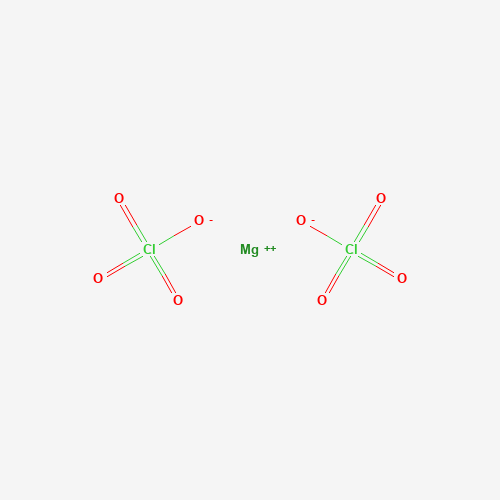
- DOT Label: Oxidizer
- First Aid: ERG2024, Guide 140 (Magnesium perchlorate): In Canada, an Emergency Response Assistance Plan (ERAP) may be required for this product. Please consult the shipping paper and/or the "ERAP" section.
- Treatment: In case of oral exposure, immediately dilute with 4 to 8 ounces (120 to 240 mol) of water or milk. Consider after ingestion of a potentially life-threatening amount of poison if it can be performed soon after ingestion (generally within 1 hour). Protect airway by placement in Trendelenburg and left lateral decubitus position or by endotracheal intubation. Control any seizures first. Maintain ventilation and oxygenation and evaluate with frequent arterial blood gas or pulse oximetry monitoring. Early use of PEEP and mechanical ventilation may be needed. Following inhalation, Move patient to fresh air. Monitor for respiratory distress. If cough or difficulty breathing develops, evaluate for respiratory tract irritation, bronchitis, or pneumonitis. Administer oxygen and assist ventilation...
- Fire Hazards: ERG2024, Guide 140 (Magnesium perchlorate): · Runoff may create fire or explosion hazard.
- Fire Fighting: FIRE INVOLVING TANKS, RAIL TANK CARS OR HIGHWAY TANKS: For ammonium nitrate products: Do not fight cargo fire. Withdraw, evacuate and isolate area for at least 1600 meters (1 mile). Treat as an explosive (ERG Guide 112). Do not enter area for 24 hours or until expert advice has been provided. Fight fire from maximum distance or use unmanned master stream devices or monitor nozzles. Cool containers with flooding quantities of water until well after fire is out. ALWAYS stay away from tanks in direct contact with flames. For massive fire, use unmanned master stream devices or monitor nozzles; if this is impossible, withdraw from area and let fire burn. (ERG, 2024)
- Fire Potential: It is noncombustible but it will accelerate the burning of combustible materials.
- Health Effects: Adverse effects on a wide variety of organ systems can result from disruption in the availability of T3 to target tissues. Organ systems affected by disturbances in T3 levels include the skin, cardiovascular system, pulmonary system, kidneys, gastrointestinal tract, liver, blood, neuromuscular system, central nervous system, skeleton, male and female reproductive systems, and numerous endocrine organs, including the pituitary and adrenal glands. Such an array of secondary potential targets underscores the need to maintain an adequate level of circulating thyroid hormones. Perchlorate, an environmental contaminant, is known to disturb the hypothalamus-pituitary-thyroid (HPT) axis by blocking iodide accumulation in the thyroid. Iodide deficiency can lead to hypothyroidism and goiter (L894...
- Health Hazards: ERG2024, Guide 140 (Magnesium perchlorate): · Runoff from fire control or dilution water may cause environmental contamination.
- Reactive Group: Oxidizing Agents, Strong
- Adverse Effects: Methemoglobinemia - The presence of increased methemoglobin in the blood; the compound is classified as secondary toxic effect
- Cleanup Methods: IMMEDIATELY REMOVE & CAREFULLY DISPOSE OF ANY SPILLED PERCHLORATE.
- Exposure Routes: Inhalation (L894); oral (L894); dermal (L894); eye contact (L894).
- Hazards Summary: Skin and mucous membrane irritant; Information is limited, but concentrated solutions are probably not irritating; May induce methemoglobinemia after ingestion; [CHEMINFO] Very toxic by ingestion; [CAMEO] A skin, eye, and mucous membrane irritant; [CHRIS] An oxidizing agent that may cause fire on contact with combustible materials; A skin and strong eye irritant; [Alfa Aesar MSDS] See PERCHLORATES.
- DOT ID and Guide: 1475 140
- Disposal Methods: SRP: At the time of review, criteria for land treatment or burial (sanitary landfill) disposal practices are subject to significant revision. Prior to implementing land disposal of waste residue (including waste sludge), consult with environmental regulatory agencies for guidance on acceptable disposal practices.
- Toxicity Summary: The primary and most sensitive target of the perchlorate anion (perchlorate) is the thyroid gland. Perchlorate inhibits the transport of iodide (I-) from the blood into the thyroid follicle cells. The inhibition is thought to be accomplished by perchlorate competitively blocking iodide binding to a carrier, or sodium/iodide symporter (NIS), which catalyzes the simultaneous transfer of Na+ and I-across the basolateral membrane of thyroid follicle cells. Perchlorate inhibition of the NIS can limit the availability of iodide needed for the production of the thyroid hormones thyroxine (T4) and triiodothyronine (T3), which in turn, may affect the circulating levels of T4 and T3. All known effects of perchlorate on the thyroid hormone system derive directly or secondarily from the inhibition...
- Reactivity Alerts: Strong Oxidizing Agent
- Minimum Risk Level: Chronic Oral: 0.0007 mg/kg/day (L900)
- Reactivity Profile: MAGNESIUM PERCHLORATE is a strong oxidizing agent. Decomposes at 185-190 °C [Hawley]. Noncombustible but accelerates the burning of combustible materials. If large quantities are involved in the fire or the combustible material is finely divided an explosion may result. Avoid contact with mineral acids because of the danger of explosion. In the preparation of anhydrous dimethyl sulfoxide by vacuum distillation from anhydrous magnesium perchlorate, an explosion occurred [MCA Case History 1187, 1966]. Drying ethylene oxide with magnesium perchlorate resulted in an explosion [NSC Newsletter. Chem. Soc. 1959]. Magnesium perchlorate used in drying hydrocarbons exploded when heated to 220 °C [Ind. & Eng. News 17:70. 1939]. As soon as trimethyl phosphite contacted a small amount of magnesium p...
- Signs and Symptoms: Irritating to skin, eyes, and respiratory system, depending on the route of exposure. Esophageal or gastrointestinal tract irritation could occur following exposures (L894).
- Storage Conditions: Keep tightly closed.
- Preventive Measures: SRP: The scientific literature for the use of contact lenses in industry is conflicting. The benefit or detrimental effects of wearing contact lenses depend not only upon the substance, but also on factors including the form of the substance, characteristics and duration of the exposure, the uses of other eye protection equipment, and the hygiene of the lenses. However, there may be individual substances whose irritating or corrosive properties are such that the wearing of contact lenses would be harmful to the eye. In those specific cases, contact lenses should not be worn. In any event, the usual eye protection equipment should be worn even when contact lenses are in place.
- Nonfire Spill Response: LARGE SPILL: Dike far ahead of liquid spill for later disposal. (ERG, 2024)
- Regulatory Information: New Zealand EPA Inventory of Chemical Status: Perchloric acid, magnesium salt: HSNO Approval: HSR001331 Approved with controls
- Air and Water Reactions: Deliquescent. Water soluble
- Fire Fighting Procedures: Evacuation: If fire becomes uncontrollable - consider evacuation of one-half (1/2) mile radius.
- Isolation and Evacuation: Evacuation: ERG2024, Guide 140 (Magnesium perchlorate): · If ammonium nitrate products are in a tank, rail car or truck and involved in a fire, ISOLATE for 1600 meters (1 mile) in all directions; also, initiate evacuation including emergency responders for 1600 meters (1 mile) in all directions.
- Other Safety Information: Chemical Assessment: IMAP assessments - Perchlorates: Human health tier II assessment
- Carcinogen Classification: No indication of carcinogenicity to humans (not listed by IARC).
- DOT Hazard Classification: Placard/Label(s)
- Non-Human Toxicity Values: LD50 Mouse intraperitoneal 1500 mg/kg
- NFPA Hazard Classification: NFPA Instability Rating: 0 - Materials that in themselves are normally stable, even under fire conditions.
- Accidental Release Measures: Spill or Leak: ERG2024, Guide 140 (Magnesium perchlorate): · Dike far ahead of liquid spill for later disposal.
- Hazard Classes and Categories: Oxidizing solids - Category 2
- Explosive Limits and Potential: If large quantities of the material are involved in the fire or the combustible material is finely divided an explosion may result.
- Standard Transportation Number: 49 187 29; Magnesium perchlorate
- Antidote and Emergency Treatment: Advanced treatment: Consider orotracheal or nasotracheal intubation for airway control in the patient who is unconscious. Start an IV with D5W /SRP: "To keep open", minimal flow rate/. Use lactated Ringer's if signs of hypovolemia are present. Watch for signs of fluid overload. Treat seizures with diazepam ... . Use proparacaine hydrochloride to assist eye irrigation ... . /Chlorates and Related Compounds/
- Protective Action Criteria (PAC): PAC-3: 320 [mg/m3]
- Personal Protective Equipment (PPE): Personnel protection: Wear appropriate chemical protective gloves, boots and goggles. ...
- Shipping Name/ Number DOT/UN/NA/IMO: IMO 5.1; Magnesium perchlorate
- Emergency Response Planning Guidelines: Emergency Response: ERG2024, Guide 140 (Magnesium perchlorate): · For massive fire, use unmanned master stream devices or monitor nozzles; if this is impossible, withdraw from area and let fire burn.
- Skin, Eye, and Respiratory Irritations: Can cause irritation of skin, and mucous membranes.
- Exposure Control and Personal Protection: Protective Clothing: ERG2024, Guide 140 (Magnesium perchlorate): · Structural firefighters' protective clothing provides thermal protection but only limited chemical protection.
Warm reminder:
Because the manufacturer may temporarily adjust product specifications, prices, inventory, parameters and other information without notice, and there are differences in each user's consultation time and procurement needs, the platform reply content is only of reference value within a certain period. Sorry for the inconvenience caused to you, and thank you for your understanding and support! Please consult the online customer service for the latest details. Everything is subject to the real-time reply of the customer service.!
Please check the quantity, appearance and product information in time when you receive the goods. In case of damage, wrong delivery, abnormal quality and other problems, please feel free to contact us.
Service Hotline:400-6226-992 ,We will handle it for you as soon as possible, thank you for your support and trust.!




