

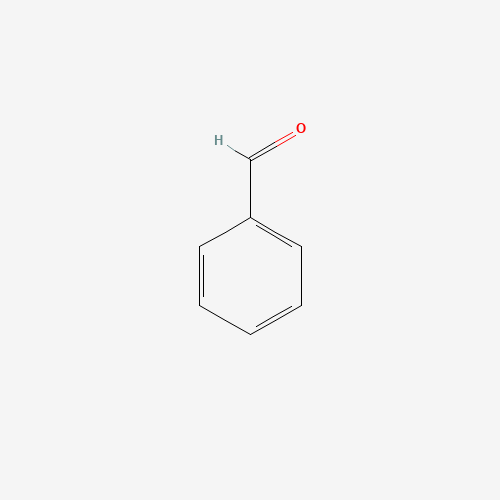
- DOT Label: Class 9
- First Aid: ERG2024, Guide 171 (Benzaldehyde): · Note: Basic Life Support (BLS) and Advanced Life Support (ALS) should be done by trained professionals.
- Body Burden: Benzaldehyde was qualitatively detected in 8 of 12 samples of human milk collected from volunteers in Bayonne, NJ, Jersey City, NJ, Bridgeville, PA, and Baton Rouge, LA(1). Benzaldehyde was identified in the purge of a sample of human breast milk(2).
- Fire Hazards: Combustible. Gives off irritating or toxic fumes (or gases) in a fire. Above 63 °C explosive vapour/air mixtures may be formed.
- Interactions: In vitro toxicological studies together with atomistic molecular dynamics simulations show that occupational co-exposure with C60 fullerene may strengthen the health effects of organic industrial chemicals. The chemicals studied are acetophenone, benzaldehyde, benzyl alcohol, m-cresol, and toluene which can be used with fullerene as reagents or solvents in industrial processes. Potential co-exposure scenarios include a fullerene dust and organic chemical vapor, or a fullerene solution aerosolized in workplace air. Unfiltered and filtered mixtures of C60 and organic chemicals represent different co-exposure scenarios in in vitro studies where acute cytotoxicity and immunotoxicity of C60 and organic chemicals are tested together and alone by using human THP-1-derived macrophages. Statisti...
- Safe Storage: Separated from incompatible materials. See Chemical Dangers. Well closed. Ventilation along the floor. Cool. Store in an area without drain or sewer access. Keep in the dark.
- Fire Fighting: Use water spray, foam, powder, carbon dioxide.
- Target Organs: Urinary
- Toxicity Data: LC (rat) = >500 mg/m3
- Eye Prevention: Wear safety spectacles or face shield.
- Fire Potential: Combustible liquid.
- Health Hazards: ERG2024, Guide 171 (Benzaldehyde): · Runoff from fire control or dilution water may cause environmental contamination.
- Reactive Group: Aldehydes
- Adverse Effects: Skin Sensitizer - An agent that can induce an allergic reaction in the skin.
- Exposure Routes: The substance can be absorbed into the body by inhalation of its vapour, through the skin and by ingestion.
- Fire Prevention: NO open flames. Above 63 °C use a closed system and ventilation.
- Hazards Summary: An eye irritant; [ICSC] At a concentration of 2 ppm, there is a strong penetrating odor without marked irritation; [AIHA] Included in list of established contact allergens in humans; [EC: Scientific Committee on Consumer Safety: Fragrance allergens in cosmetic products (2011)] Benzaldehyde can cause contact urticaria. [Kanerva, p. 221]
- Inhalation Risk: No indication can be given about the rate at which a harmful concentration of this substance in the air is reached on evaporation at 20 °C.
- Skin Prevention: Protective gloves. Protective clothing.
- Special Reports: DHHS/NTP; Toxicology and Carcinogenesis Studies of Benzaldehyde in F344/N Rats and B6C3F1 Mice (Gavage Studies) (1990) Technical Rpt Series No. 378 NIH Pub No. 90-2833[Available from: http://ntp.niehs.nih.gov/]
- DOT ID and Guide: 1990 171
- Disposal Methods: Incineration; add combustible solvent and spray into incinerator with afterburner.
- FDA Requirements: Synthetic flavoring substances and adjuvants /for animal drugs, feeds, and related products/ that are generally recognized as safe for their intended use, within the meaning of section 409 of the Act. Benzaldehyde is included on this list.
- Flammable Limits: Lower: 1.4% by vol
- Toxicity Summary: IDENTIFICATION AND USE: Benzaldehyde is a strongly refractive liquid, becoming yellowish on keeping. It is used in cosmetics as a denaturant, a flavoring agent, and as a fragrance. Currently used in only seven cosmetic products, its highest reported concentration of use was 0.5% in perfumes. Substantial amounts are used in the production of derivatives that are also employed in the perfume and flavor industries. In the pharmaceutical industry benzaldehyde is used as an intermediate in the manufacture of chloramphenicol, ephedrine, ampicillin, diphenylhydantoin, and other products. HUMAN EXPOSURE AND TOXICITY: It may cause contact dermatitis. It was positive in sister chromatid exchange assay with human lymphocytes from healthy non-smoking donors. Benzaldehyde was found to induce formati...
- EC Classification: Symbol: Xn; R: 22; S: (2)-24
- Spillage Disposal: Personal protection: filter respirator for organic gases and vapours adapted to the airborne concentration of the substance. Do NOT let this chemical enter the environment. Collect leaking and spilled liquid in sealable containers as far as possible. Absorb remaining liquid in sand or inert absorbent. Then store and dispose of according to local regulations.
- UN Classification: UN Hazard Class: 9; UN Pack Group: III
- Environmental Fate: ATMOSPHERIC FATE: According to a model of gas/particle partitioning of semivolatile organic compounds in the atmosphere(1), benzaldehyde, which has a vapor pressure of 1.27 mm Hg at 25 °C(2), is expected to exist solely as a vapor in the ambient atmosphere. Vapor-phase benzaldehyde is degraded in the atmosphere by reaction with photochemically-produced hydroxyl radicals(SRC); the half-life for this reaction in air is estimated to be 30 hours(SRC), calculated from its rate constant of 1.29X10⁻¹¹ cu cm/molecule-sec at 25 °C(3). Vapor-phase benzaldehyde is also degraded in the atmosphere by reaction with nitrate radicals(SRC); the half-life for this reaction in air is estimated to be 7.5 days(SRC), calculated from its rate constant of 4.30X10⁻¹⁵ cu cm/molecule-sec at 25 °C(4). The atmosphe...
- First Aid Measures: Ingestion First Aid: Rinse mouth. Rest.
- Food Survey Values: Benzaldehyde was found in the volatiles of sweet corn products; concentrations ranged from 4 ppb for fresh kernels to 16 ppb for canned creamed corn(1). Benzaldehyde was identified in the flavor and aroma volatiles isolated from microwave oven-produced popcorn at a concentrations of 0.020 mg/kg popcorn(2). Benzaldehyde was identified in the volatile compounds in two commercial rice cakes at concentrations of 0.13 and 0.2 mg/kg of rice cake(3). Benzaldehyde was detected in the volatile components of three fermented soybean curds at concentrations ranged from 0.3064-0.451 mg/kg(4). Benzaldehyde was identified in paprika oleoresin (Spanish type) at a concentration of 1.3 mg/kg(5). Benzaldehyde was detected in the volatile components of strawberry jam at a concentration of 32.6 mg/kg of jam...
- Reactivity Profile: A nontoxic, combustible liquid, reacts with oxidizing reagents. BENZALDEHYDE must be blanketed with an inert gas at all times since it is oxidized readily by air to benzoic acid [Kirk-Othmer, 3rd ed., Vol. 3, 1978, p. 736]. In contact with strong acids or bases it will undergo an exothermic condensation reaction [Sax, 9th ed., 1996, p. 327]. A violent reaction was observed on contact with peroxyacids (peroxyformic acid) [D'Ans, J. et al., Ber., 1915, 48, p. 1136]. An explosion occurred when pyrrolidine, benzaldehyde, and propionic acid were heated to form porphyrins.
- Signs and Symptoms: Ingestion Exposure: Sore throat.
- Storage Conditions: Keep tightly closed and protected form light.
- Milk Concentrations: Benzaldehyde was qualitatively detected in 8 of 12 samples of human milk collected from volunteers in Bayonne, NJ, Jersey City, NJ, Bridgeville, PA, and Baton Rouge, LA(1). Benzaldehyde was identified in the purge of a sample of human breast milk(2).
- Average Daily Intake: Individual: 0.3403 mg/kg/day(1).
- EPA IRIS Information: Reference Dose (RfD), chronic: 1 x 10 ^-1 mg/kg-day
- Firefighting Hazards: Vapors are heavier than air and will collect in low areas. Vapors may travel long distances to ignition sources and flashback. Vapors in confined areas may explode when exposed to fire. Storage containers and parts of containers may rocket great distances, in many directions.
- Ingestion Prevention: Do not eat, drink, or smoke during work.
- RAIS Toxicity Values: Oral Slope Factor Reference: PPRTV Current
- Atmospheric Standards: This action promulgates standards of performance for equipment leaks of Volatile Organic Compounds (VOC) in the Synthetic Organic Chemical Manufacturing Industry (SOCMI). The intended effect of these standards is to require all newly constructed, modified, and reconstructed SOCMI process units to use the best demonstrated system of continuous emission reduction for equipment leaks of VOC, considering costs, non air quality health and environmental impact and energy requirements. Benzaldehyde is produced, as an intermediate or a final product, by process units covered under this subpart.
- Inhalation Prevention: Use ventilation, local exhaust or breathing protection.
- Nonfire Spill Response: LARGE SPILL: Dike far ahead of liquid spill for later disposal. Cover powder spill with plastic sheet or tarp to minimize spreading. Prevent entry into waterways, sewers, basements or confined areas. (ERG, 2024)
- Air and Water Reactions: Oxidizes in air to form benzoic acid, which is moderately toxic by ingestion. Insoluble in water.
- Effluent Concentrations: Detected in gasoline exhaust <0.1-13.5 ppm, in diesel exhaust 0.3 ppm
- ICSC Environmental Data: The substance is harmful to aquatic organisms.
- Isolation and Evacuation: Evacuation: ERG2024, Guide 171 (Benzaldehyde): · If tank, rail tank car or highway tank is involved in a fire, ISOLATE for 800 meters (1/2 mile) in all directions; also, consider initial evacuation for 800 meters (1/2 mile) in all directions.
- Other Safety Information: Chemical Assessment: Evaluation - Benzaldehyde
- Soil Adsorption/Mobility: Using a structure estimation method based on molecular connectivity indices(1), the Koc of benzaldehyde can be estimated to be 11(SRC). According to a classification scheme(2), this estimated Koc value suggests that benzaldehyde is expected to have very high mobility in soil.
- Carcinogen Classification: Summary: Under the conditions of these 2-year gavage studies, there was no evidence of carcinogenic activity of benzaldehyde for male or female F344/N rats receiving 200 or 400 mg/kg per day. There was some evidence of carcinogenic activity of benzaldehyde for male or female B6C3F1 mice, as indicated by increased incidences of squamous cell papillomas and hyperplasia of the forestomach. Female rats and male and female mice might have been able to tolerate higher doses.
- DOT Hazard Classification: Notes: Symbol +: Fixes the proper shipping name, hazard class and packing group for that entry
- Natural Pollution Sources: /Present/ hickory smoke
- Peroxide Forming Chemical: Reference(s): Management of time-sensitive chemicals (JCHAS)
- Toxic Combustion Products: Combustion may produce irritants and toxic gases.
- Atmospheric Concentrations: SOURCE DOMINATED: A field monitoring study along a highway in Raleigh, NC in May 1983 detected benzaldehyde levels of 8.91- 15.26 ppb (approximately 2.05-3.51 ug/cu m)(1); the primary source of the benzaldehyde was considered to be exhaust from cars and trucks(1). Benzaldehyde was detected in 10 of 12 ambient air samples collected near an American Cyanamide production facility in Linden, NJ between 1976 and 1978 at levels of 0.036-0.557 ug/cu m(2). Volatile organic compounds were studied in the ambient air at a landfill site that received both municipal and industrial wastes; benzaldehyde concentrations ranged from <0.1 to 68.8 ug/cu m in air sampled at 6 locations over 18 months(3). A mean benzaldehyde concentration of 1.09 ppb was detected at a roadway tunnel exit in Zurich Switerland...
- NFPA Hazard Classification: NFPA Instability Rating: 0 - Materials that in themselves are normally stable, even under fire conditions.
- Accidental Release Measures: Spill or Leak: ERG2024, Guide 171 (Benzaldehyde): · Prevent entry into waterways, sewers, basements or confined areas.
- Fish/Seafood Concentrations: Benzaldehyde concentrations ranged from 0.222 to 17.8 mg/kg of paste in the volatile components of four Korean salt-fermented fish and shrimp pastes(1). Benzaldehyde was detected in the volatile components of the meat of commonly consumed crabs (Charybdis feriatus) in Asia at the following concentrations (mg/kg dry weight): 0.064 (leg), 0.0313 (body), and 0.703 (carapace)(2).
- Lower Explosive Limit (LEL): 14000 [ppm]
- Artificial Pollution Sources: Benzaldehyde's production and use as a food additive, as a fragrance in cosmetics, perfumes, and detergents, as an intermediate in the synthesis of a variety of pharmaceuticals and industrial chemicals, and as a solvent for resins, oils, and cellulose acetates and nitrates(1) may result in its release to the environment through various waste streams(SRC). Benzaldehyde has been detected in atmospheric emissions from fireplaces and wood burning(2-4). Benzaldehyde has been identified in volatile emissions from sanitary landfills(5). Exhaust emissions from gasoline and hydrocarbon engines have been found to contain benzaldehyde(6-10). Benzaldehyde has been detected in flue gas emissions from waste incineration(11,12). Aqueous effluents from coal conversion facilities can contain benzaldehyd...
- Environmental Biodegradation: ANAEROBIC: Under anaerobic conditions 95% biodegradation was observed for benzaldehyde (30 mg C/L) after 14 days, in a test using seeding bacteria cultured by synthetic sewage in a continuous bioreactor at 37 °C(1). Benzaldehyde was degraded in methanogenic granular sludge in both batch and upflow anaerobic sludge blanket reactors; benzoic acid was the principal intermediate(2).
- Sediment/Soil Concentrations: Benzaldehyde was qualitatively detected in sediments taken from Tobin Lake in Saskatchewan, Canada(1) and in sediments collected near hazardous waste sites along the Niagara River, New York(2). Soil samples collected along the Buffalo River in Buffalo, NY contained a benzaldehyde concentration of 4 ppm, but river sediments had no detectable levels(3).
- Hazard Classes and Categories: Acute Tox. 4 *
- Effects of Short Term Exposure: The substance is irritating to the eyes.
- Environmental Bioconcentration: An estimated BCF of 4.4 was calculated in fish for benzaldehyde(SRC), using a log Kow of 1.48(1) and a regression-derived equation(2). According to a classification scheme(3), this BCF suggests the potential for bioconcentration in aquatic organisms is low.
- Explosive Limits and Potential: Explosive limits, vol% in air: 1.4
- Standard Transportation Number: 49 131 11; Benzaldehyde
- Volatilization from Water/Soil: The Henry's Law constant for benzaldehyde is 2.67X10⁻⁵ atm-cu m/mole(1). This Henry's Law constant indicates that benzaldehyde is expected to volatilize from water surfaces(2). Based on this Henry's Law constant, the volatilization half-life from a model river (1 m deep, flowing 1 m/sec, wind velocity of 3 m/sec)(2) is estimated as 1.5 days (SRC). The volatilization half-life from a model lake (1 m deep, flowing 0.05 m/sec, wind velocity of 0.5 m/sec)(2) is estimated as 14 days(SRC). Benzaldehyde's Henry's Law constant indicates that volatilization from moist soil surfaces may occur(SRC). Benzaldehyde is expected to volatilize from dry soil surfaces(SRC) based upon a vapor pressure of 1.27 mm Hg at 25 °C(3).
- State Drinking Water Guidelines: (FL) FLORIDA 700 ug/L
- Antidote and Emergency Treatment: If this chemical gets into the eyes, remove any contact lenses at once and irrigate immediately for at least 15 min, occasionally lifting upper and lower lids. Seek medical attention immediately. If this chemical contacts the skin, remove contaminated clothing and wash immediately with soap and water. Seek medical attention immediately. If this chemical has been inhaled, remove from exposure, begin rescue breathing (using universal precautions, including resuscitation mask) if breathing has stopped and CPR if heart action has stopped. Transfer promptly to a medical facility. When this chemical has been swallowed, get medical attention.
- Protective Action Criteria (PAC): PAC-3: 260 [ppm]
- Shipment Methods and Regulations: The International Maritime Dangerous Goods Code lays down basic principles for transporting hazardous chemicals. Detailed recommendations for individual substances and a number of recommendations for good practice are included in the classes dealing with such substances. A general index of technical names has also been compiled. This index should always be consulted when attempting to locate the appropriate procedures to be used when shipping any substance or article. Benzaldehyde is included on the dangerous goods list.
- Critical Temperature and Pressure: Critical temperature: 695 K; critical pressure 4.65 MPa
- Environmental Abiotic Degradation: The rate constant for the vapor-phase reaction of benzaldehyde with photochemically-produced hydroxyl radicals has been reported to be 1.29X10⁻¹¹ cu cm/molecule-sec at 25 °C(1). This corresponds to an atmospheric half-life of about 30 hours at an atmospheric concentration of 5X10+5 hydroxyl radicals per cu cm(2). The rate constant for the vapor-phase reaction of benzaldehyde with atmospheric nitrate radicals has been measured as 4.3X10⁻¹⁵ cu cm/molecule-sec at 22 °C(3); this corresponds to an atmospheric half-life of about 7.5 days(SRC) at an atmospheric concentration of 2.5X10+8 nitrate radicals per cu cm(4). The atmospheric reaction between benzaldehyde and ozone is too slow to be important environmentally(5). The rate constant for the reaction of hydroxyl radicals in aqueous solution...
- Probable Routes of Human Exposure: NIOSH (NOES Survey 1981-1983) has statistically estimated that 67,721 workers (27,021 of these are female) are potentially exposed to benzaldehyde in the US(1). Occupational exposure to benzaldehyde may occur through inhalation and dermal contact with this compound at workplaces where benzaldehyde is produced or used(SRC). Monitoring data indicate that the general population may be exposed to benzaldehyde via inhalation of ambient air, ingestion of food and drinking water, and dermal contact with consumer products containing benzaldehyde(SRC). Benzaldehyde was one of the 20 most common chemicals found in 31 fragrance products(2). Benzaldehyde's use as a flavoring agent and its natural occurrence in many foods will expose the general population through oral consumption(3,4).
- Environmental Water Concentrations: RAIN/SNOW: Benzaldehyde levels of 0-0.57 ug/L (mean concentration 0.05 ug/L) have been detected in cloud water collected from Henninger Flats, CA(1); levels of 0.08-0.19 ug/L have been detected in ice fog water collected from Fairbanks, Alaska(1); rain water collected in Carson, CA contained a benzaldehyde concentration of 0.09 ug/L(1). Benzaldehyde was found in precipitation (mainly rain) collected in Hannover, Germany in 1989 and 1990 ranging from 0.08-0.48 ug/L with a mean concentration of 0.25 ug/L(2). Benzaldehyde concentrations ranged from 0.14 to 0.59 ug/kg in snow samples collected in early March from six locations in Russia and four locations in Finland(3).
- Other Environmental Concentrations: Benzaldehyde has been identified in tobacco smoke(1).
- Environmental Fate/Exposure Summary: Benzaldehyde's production and use as a food additive, as a fragrance in cosmetics, perfumes, and detergents, as a chemical intermediate and as a solvent may result in its release to the environment through various waste streams. Benzaldehyde is also released to the environment in emissions from combustion processes such as gasoline and diesel engines, incinerators and wood burning. It is formed in the atmosphere through photochemical oxidation of toluene and other aromatic hydrocarbons. It occurs naturally in many plant species and has been identified in volcanic emissions. If released to air, a vapor pressure of 1.27 mm Hg at 25 °C indicates benzaldehyde will exist solely as a vapor in the atmosphere. Vapor-phase benzaldehyde will be degraded in the atmosphere by reaction with photoche...
- Shipping Name/ Number DOT/UN/NA/IMO: IMO 9; Benzaldehyde
- Emergency Response Planning Guidelines: Emergency Response: ERG2024, Guide 171 (Benzaldehyde): · ALWAYS stay away from tanks in direct contact with flames.
- Skin, Eye, and Respiratory Irritations: A skin irritant.
- Exposure Control and Personal Protection: Protective Clothing: ERG2024, Guide 171 (Benzaldehyde): · Structural firefighters' protective clothing provides thermal protection but only limited chemical protection.
- Other Standards Regulations and Guidelines: Workplace Environmental Exposure Level (WEEL): 8-hr Time-weighted Average (TWA) 2 ppm; Short-term Exposure Limit (STEL) 4 ppm, 15 min, DSEN. Last Revised: 1998.
- Hazardous Reactivities and Incompatibilities: An explosion occurred when benzaldehyde, pyrrolidine ..., and propionic acid were heated to form porphins.
- EPA Provisional Peer-Reviewed Toxicity Values: Weight-Of-Evidence (WOE): Suggestive evidence of carcinogenic potential
- Hazard Quotient Level 3 or Cancer Risk Level 1E-04: Soil Saturation Concentration (mg/kg): 1.16e+03
- Hazard Quotient Level 0.1 or Cancer Risk Level 1E-06: Soil Saturation Concentration (mg/kg): 1.16e+03
Warm reminder:
Because the manufacturer may temporarily adjust product specifications, prices, inventory, parameters and other information without notice, and there are differences in each user's consultation time and procurement needs, the platform reply content is only of reference value within a certain period. Sorry for the inconvenience caused to you, and thank you for your understanding and support! Please consult the online customer service for the latest details. Everything is subject to the real-time reply of the customer service.!
Please check the quantity, appearance and product information in time when you receive the goods. In case of damage, wrong delivery, abnormal quality and other problems, please feel free to contact us.
Service Hotline:400-6226-992 ,We will handle it for you as soon as possible, thank you for your support and trust.!
Research chemical CAS 100-52-7 HPLC ≥98% 0. 5ml
Yuanye Research chemical CAS 100-52-7 HPLC ≥98% 0. 5ml, complete specifications; suitable for production, research, laboratory testing and inspection; digital one-stop procurement platform for scientific materials.




