

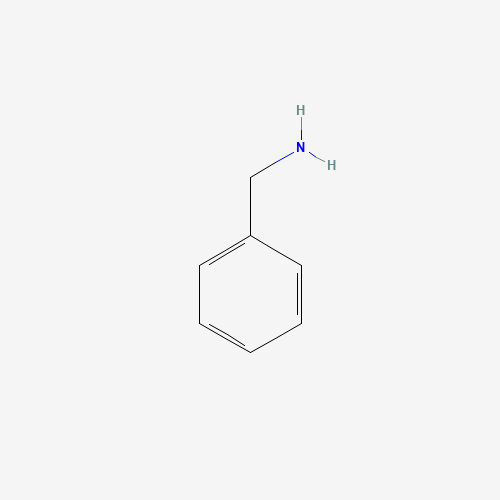
- DOT Label: Corrosive
- First Aid: EYES or SKIN: wash with copious amounts of water for 15 min. (USCG, 1999)
- Body Burden: A total of 224 expired air samples were collected from 28 healthy, non-smoking volunteers in Chicago(1); approximately 18% of the samples contained benzylamine at a geometric mean concentration of about 0.1 ng/L(1). In another study, a total of 387 expired air samples were collected from 54 healthy volunteers in Chicago(1); approximately 12% of the samples contained benzylamine at a geometric mean concentration of about 0.007 ng/L(2).
- Fire Hazards: Flammable. Gives off irritating or toxic fumes (or gases) in a fire. Above 60 °C explosive vapour/air mixtures may be formed.
- Safe Storage: Fireproof. Separated from strong oxidants, strong acids and food and feedstuffs.
- Fire Fighting: Use water spray, powder, alcohol-resistant foam, carbon dioxide. In case of fire: keep drums, etc., cool by spraying with water.
- Eye Prevention: Wear face shield.
- Fire Potential: Flammable
- Health Hazards: Inhalation of vapor causes irritation of the mucous membranes of the nose and throat, and lung irritation with respiratory distress and cough. Headache, nausea, faintness, and anxiety can occur. Exposure to vapor produces eye irritation with lachrymation, conjunctivitis, and corneal edema resulting in halos around lights. Direct local contact with liquid is known to produce severe and sometimes permanent eye damage and skin burns. Vapors may also produce primary skin irritation and dermatitis. (USCG, 1999)
- Reactive Group: Amines, Phosphines, and Pyridines
- Adverse Effects: Toxic Pneumonitis - Inflammation of the lungs induced by inhalation of metal fumes or toxic gases and vapors.
- Cleanup Methods: Collect leaking liquid in sealable containers. Cautiously neutralize remainder. Then wash away with plenty of water. Extra personal protection: complete protective clothing including self-contained breathing apparatus.
- Exposure Routes: The substance can be absorbed into the body by inhalation of its vapour and by ingestion.
- Fire Prevention: NO open flames, NO sparks and NO smoking. Above 60 °C use a closed system, ventilation and explosion-proof electrical equipment.
- Hazards Summary: Corrosive to skin; [Quick CPC] Inhalation of vapor can cause respiratory distress and cough; Effects on the eye include lacrimation and corneal edema associated with a perception of halos around lights; [CAMEO] A corrosive substance that can cause pulmonary edema; [ICSC]
- Inhalation Risk: No indication can be given about the rate at which a harmful concentration of this substance in the air is reached on evaporation at 20 °C.
- Skin Prevention: Protective gloves. Protective clothing.
- Disposal Methods: This combustible material may be burned in a chemical incinerator equipped with an afterburner and scrubber. Observe all federal, state, and local environmental regulations. Contact a licensed professional waste disposal service to dispose of this material.
- EC Classification: Symbol: C; R: 21/22-34; S: (1/2)-26-36/37/39-45
- RCRA Requirements: D002; A solid waste containing benzylamine may become characterized as a hazardous waste when subjected to testing for corrosivity as stipulated in 40 CFR 261.21, and if so characterized, must be managed as a hazardous waste.
- Spillage Disposal: Personal protection: complete protective clothing including self-contained breathing apparatus. Collect leaking and spilled liquid in sealable containers as far as possible. Cautiously neutralize remainder. Then wash away with plenty of water.
- UN Classification: UN Hazard Class: 8
- Ecotoxicity Values: LC50; Species: Pimephales promelas (fathead minnow, age 30 days, 0.087 g, 18.2 mm); Conditions: freshwater, flow through, 23.9 °C, pH 7.9, hardness 44.7 mg/L CaCO3, alkalinity 44.0 mg/L CaCO3, dissolved oxygen 6.9 mg/L; Concentration: 102000 ug/L (97900-106000 ug/L) for 96 hr /99% pure/
- Environmental Fate: ATMOSPHERIC FATE: According to a model of gas/particle partitioning of semivolatile organic compounds in the atmosphere(1), benzylamine, which has a vapor pressure of 0.662 mm Hg at 25 °C(2), is expected to exist solely as a vapor in the ambient atmosphere. Vapor-phase benzylamine is degraded in the atmosphere by reaction with photochemically-produced hydroxyl radicals(SRC); the half-life for this reaction in air is estimated to be 11 hours(SRC), calculated from its rate constant of 3.3X10⁻¹¹ cu cm/molecule-sec at 25 °C(3). Benzylamine does not contain chromophores that absorb at wavelengths >290 nm(4) and therefore is not expected to be susceptible to direct photolysis by sunlight(SRC).
- First Aid Measures: Ingestion First Aid: Rinse mouth. Do NOT induce vomiting. Refer for medical attention .
- Food Survey Values: The following concentrations of benzylamine (in mg/kg) were detected in samples of fresh vegetables: spinach, 6.1; red cabbage, 3.3; cabbage, 2.8; cauliflower, 1.4; kale, 3.8; white beet, 5.3; carrots, 2.8; red beet, 0.1; large radish, 1.8; red radish, 4.8; celery, 3.4. Benzylamine concentrations (in mg/kg) were detected in the following foods: maize, grains, 3.4; green salad, 11.5; rhubard, 2.9; apple flesh, 0.3; apple peel, 0.6(1).
- Reactivity Profile: In presence of moisture, BENZYLAMINE may weakly corrode some metals. Liquid will attack some plastics (USCG, 1999). Neutralize acids to form salts plus water in exothermic reactions. May be incompatible with isocyanates, halogenated organics, peroxides, phenols (acidic), epoxides, anhydrides, and acid halides. Flammable gaseous hydrogen is generated in combination with strong reducing agents, such as hydrides.
- Signs and Symptoms: Ingestion Exposure: Burning sensation. Abdominal pain. Shock or collapse.
- Storage Conditions: Fireproof. Separated from strong oxidants, strong acids, food and feedstuffs.
- Exposure Prevention: AVOID ALL CONTACT! IN ALL CASES CONSULT A DOCTOR!
- Preventive Measures: Ventilation, local exhaust, or breathing protection.
- Ingestion Prevention: Do not eat, drink, or smoke during work.
- Atmospheric Standards: This action promulgates standards of performance for equipment leaks of Volatile Organic Compounds (VOC) in the Synthetic Organic Chemical Manufacturing Industry (SOCMI). The intended effect of these standards is to require all newly constructed, modified, and reconstructed SOCMI process units to use the best demonstrated system of continuous emission reduction for equipment leaks of VOC, considering costs, non air quality health and environmental impact and energy requirements. Benzylamine is produced, as an intermediate or a final product, by process units covered under this subpart.
- Inhalation Prevention: Use ventilation, local exhaust or breathing protection.
- Nonfire Spill Response: Neutralizing Agents for Acids and Caustics: Flush with water. (USCG, 1999)
- Regulatory Information: New Zealand EPA Inventory of Chemical Status: Benzylamine: Does not have an individual approval but may be used under an appropriate group standard
- Air and Water Reactions: Water soluble.
- Human Toxicity Excerpts: /CASE REPORTS/ The case of a 48 year old chemist who developed a work related dermatitis after handling epichlorohydrin, benzylamine, and benzyl-1-amino-3-chloro-2-hydroxypropane was described. The patient presented with a dermatitis of the hands and face which subsided after a few days away from work. He used the compounds as chemical intermediates in the potential synthesis of agricultural chemicals, and his dermatitis developed shortly after he had contact with the materials. The clinical history included hay fever, and positive inhalation responses to house dust, grass pollen, and animal dander were obtained. A weak reaction to formaldehyde was found in patch tests with the ICDRG standard series. Patch tests to epichlorohydrin were negative. Patch tests to benzylamine and benzyl-1-a...
- Packaging and Labelling: Do not transport with food and feedstuffs.
- Fire Fighting Procedures: Wear self contained breathing apparatus for fire fighting if necessary.
- Isolation and Evacuation: FIRE: If tank, rail tank car or highway tank is involved in a fire, ISOLATE for 800 meters (1/2 mile) in all directions; also, consider initial evacuation for 800 meters (1/2 mile) in all directions. (ERG, 2024)
- Soil Adsorption/Mobility: The Koc of benzylamine is estimated as 270(SRC), using a log Kow of 1.09(1) and a regression-derived equation(2). According to a classification scheme(3), this estimated Koc value suggests that benzylamine is expected to have moderate mobility in soil. The pKa of benzylamine is 9.33(4), indicating that this compound will almost entirely exist in the cation form in the environment and cations generally adsorb more strongly to soils containing organic carbon and clay than their neutral counterparts(5).
- Natural Pollution Sources: Benzylamine has been detected in a wide variety of fresh vegetables and fruits such as spinach, cabbage, cauliflower, kale, beets, carrots, radishes, celery, maize, apples and rhubarb(1).
- Non-Human Toxicity Values: LD50 Mouse ip 600 mg/kg
- Toxic Combustion Products: Gives off irritating or toxic fumes (or gases) in a fire.
- EPA Hazardous Waste Number: D002; A waste containing benzylamine may (or may not) be characterized a hazardous waste following testing for corrosivity characteristics as prescribed by the Resource Conservation and Recovery Act (RCRA) regulations.
- NFPA Hazard Classification: NFPA Instability Rating: 0 - Materials that in themselves are normally stable, even under fire conditions.
- Artificial Pollution Sources: Benzylamine's production and use in organic synthesis(1), chemical intermediates for dyes, pharmaceuticals, and polymers(2), as a raw material for the production biotin (Vitamin H) and certain photographic materials(3), in synthetic textiles, in paints, as a corrosion inhibitor, and an intermediate in the production of compounds for plant and material protection(4) may result in its release to the environment through various waste streams(SRC).
- Environmental Biodegradation: AEROBIC: Biomineralization of benzylamine was measured (via 14-CO2 evolution) in lake water at concentrations ranging from 0.1 ng/mL to 1.0 ug/mL(1); over a 6-day incubation period, 96.1-98.9% of initial benzylamine mineralized(1). Addition of clay to lake water has been observed to retard the biodegradation rate of benzylamine due to sorption to clay surfaces which decreases the bioavailablity to microbes; however, the benzylamine still biodegraded readily(2,3).
- Hazard Classes and Categories: Skin Corr. 1B
- Effects of Short Term Exposure: The substance is corrosive to the eyes, skin and respiratory tract. Inhalation of the vapour may cause lung oedema. The effects may be delayed. Medical observation is indicated.
- Environmental Bioconcentration: An estimated BCF of 2.4 was calculated for benzylamine(SRC), using a log Kow of 1.09(1) and a regression-derived equation(2). According to a classification scheme(3), this BCF suggests the potential for bioconcentration in aquatic organisms is low(SRC).
- Explosive Limits and Potential: Above 60 °C explosive vapor/air mixtures may be formed.
- Volatilization from Water/Soil: A pKa of 9.33(1) indicates benzylamine will exist almost entirely in the cation form at pH values of 5 to 9 and therefore volatilization from water surfaces and moist soil surfaces is not expected to be an important fate process(2). Benzylamine is not expected to volatilize from dry soil surfaces(SRC) based upon a vapor pressure of 0.662 mm Hg(3).
- Antidote and Emergency Treatment: /SRP:/ Advanced treatment: Consider orotracheal or nasotracheal intubation for airway control in the patient who is unconscious, has severe pulmonary edema, or is in severe respiratory distress. Positive-pressure ventilation techniques with a bag-valve-mask device may be beneficial. Consider drug therapy for pulmonary edema ... . Monitor cardiac rhythm and treat arrhythmias as necessary ... . Start IV administration of D5W /SRP: "To keep open", minimal flow rate/. Use 0.9% saline (NS) or lactated Ringer's (LR) if signs of hypovolemia are present. For hypotension with signs of hypovolemia, administer fluid cautiously. If patient is unresponsive to these measures, vasopressors may be helpful. Watch for signs of fluid overload ... . Administer 1% solution methylene blue if patient is sympt...
- Protective Action Criteria (PAC): PAC-3: 130 [mg/m3]
- Environmental Abiotic Degradation: The rate constant for the vapor-phase reaction of benzylamine with photochemically-produced hydroxyl radicals has been estimated as 3.4X10⁻¹¹ cu cm/molecule-sec at 25 °C(1) using a structure estimation method(2). This corresponds to an atmospheric half-life of about 11 hours at an atmospheric concentration of 5X10+5 hydroxyl radicals per cu cm(2). Benzylamine is not expected to undergo hydrolysis in the environment due to the lack of functional groups that hydrolyze under environmental conditions(3). Benzylamine does not contain chromophores that absorb at wavelengths >290 nm(3) and therefore is not expected to be susceptible to direct photolysis by sunlight(SRC).
- Probable Routes of Human Exposure: NIOSH (NOES Survey 1981-1983) has statistically estimated that 5,721 workers (300 of these were female) were potentially exposed to benzylamine in the US(1). Occupational exposure to benzylamine may occur through inhalation and dermal contact with this compound at workplaces where benzylamine is produced or used. Monitoring data indicate that the general population may be exposed to benzylamine via ingestion of food and dermal contact with this compound or other products containing benzylamine(SRC).
- Environmental Water Concentrations: SURFACE WATER: A benzylamine concn of 1 ug/kg was detected in the River Alster in Germany (sampling date not reported)(1). A benzylamine concn of 0.3 ug/kg was detected in the River Au near Hetlingen in Germany (sampling date not reported)(1).
- Environmental Fate/Exposure Summary: Benzylamine's production and use in organic synthesis, chemical intermediates for dyes, pharmaceuticals, and polymers, as a raw material for the production biotin (Vitamin H) and certain photographic materials, in synthetic textiles, in paints, as a corrosion inhibitor, and an intermediate in the production of compounds for plant and material protection may result in its release to the environment through various waste streams. Benzylamine has been detected in a wide variety of fresh vegetables and fruits. If released to air, a vapor pressure of 0.662 mm Hg at 25 °C indicates benzylamine will exist solely as a vapor in the atmosphere. Vapor-phase benzylamine will be degraded in the atmosphere by reaction with photochemically-produced hydroxyl radicals; the half-life for this reaction in...
- Personal Protective Equipment (PPE): Protective gloves. Protective clothing. Face shield.
- Shipping Name/ Number DOT/UN/NA/IMO: UN-2735; Amines, liquid, corrosive, n.o.s. (Benzylamine)[Sigma-Aldrich Corp; Safety Data Sheet for Benzylamine (Product Number: B16305) Version 3.0 (August 21, 2009). Available from, as of June 15, 2010: http://www.sigmaaldrich.com]
- Skin, Eye, and Respiratory Irritations: An irritant to skin, eyes, and mucous membranes.
- Hazardous Reactivities and Incompatibilities: Violent or explosive reaction with N-chlorosuccinimide
Warm reminder:
Because the manufacturer may temporarily adjust product specifications, prices, inventory, parameters and other information without notice, and there are differences in each user's consultation time and procurement needs, the platform reply content is only of reference value within a certain period. Sorry for the inconvenience caused to you, and thank you for your understanding and support! Please consult the online customer service for the latest details. Everything is subject to the real-time reply of the customer service.!
Please check the quantity, appearance and product information in time when you receive the goods. In case of damage, wrong delivery, abnormal quality and other problems, please feel free to contact us.
Service Hotline:400-6226-992 ,We will handle it for you as soon as possible, thank you for your support and trust.!
benzylamine Reagent Grade, 99. 00% 250/ml
benzylamine Reagent Grade, 99. 00% 250/ml 100-46-9, , .




