
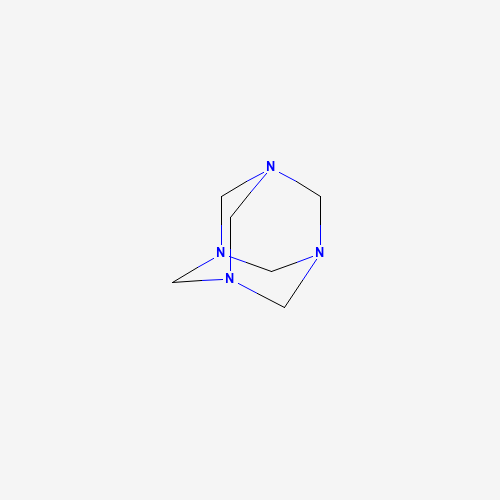
- DOT Label: Flammable Solid
- First Aid: ERG2024, Guide 133 (Hexamethylenetetramine): In Canada, an Emergency Response Assistance Plan (ERAP) may be required for this product. Please consult the shipping paper and/or the "ERAP" section.
- Fire Hazards: Combustible. Gives off irritating or toxic fumes (or gases) in a fire. Finely dispersed particles form explosive mixtures in air.
- Interactions: Formaldehyde and some sulfonamides (e.g., sulfamethizole, sulfathiazole (not commercially available in the US)) form an insoluble precipitate in acid urine; therefore, methenamine salts should not be administered concomitantly with sulfonamides.
- Safe Storage: Separated from strong acids and strong oxidants. Dry.
- Fire Fighting: Use water spray, foam, powder.
- Eye Prevention: Wear face shield or eye protection in combination with breathing protection.
- Fire Potential: Combustible.
- Health Hazards: ERG2024, Guide 133 (Hexamethylenetetramine): · Runoff from fire control or dilution water may cause environmental contamination.
- Hepatotoxicity: Likelihood score: E (unlikely cause of clinically apparent liver injury).
- Reactive Group: Amines, Phosphines, and Pyridines
- Adverse Effects: ACGIH Carcinogen - Not Classifiable.
- Cleanup Methods: Toxic compd can be removed by reverse osmosis. Hexamethyleneamine treated with oxygen in presence of pyrolusite ores to form HCO2H & NaNO3 which can be removed by biol treatment.
- Exposure Routes: The substance can be absorbed into the body by inhalation of its aerosol and by ingestion.
- Fire Prevention: NO open flames. Closed system, dust explosion-proof electrical equipment and lighting. Prevent deposition of dust.
- Hazards Summary: A skin and eye irritant; A skin sensitizer; May cause asthma; [ICSC] Danger of skin sensitization; [MAK] TLV Basis is dermal sensitization. No evidence of increased risk of occupational asthma at concentrations of 0.2-2.6 mg/m3.
- Inhalation Risk: Evaporation at 20 °C is negligible; a harmful concentration of airborne particles can, however, be reached quickly when dispersed.
- Skin Prevention: Protective gloves. Protective clothing.
- Special Reports: Lo TS et al; Expert Rev Anti Infect Ther 12 (5): 549-54 (2014)
- DOT ID and Guide: 1328 133
- Disposal Methods: Product: Burn in a chemical incinerator equipped with an afterburner and scrubber but exert extra care in igniting as this material is highly flammable. Offer surplus and non-recyclable solutions to a licensed disposal company. Contact a licensed professional waste disposal service to dispose of this material; Contaminated packaging: Dispose of as unused product.
- FDA Requirements: Drug products containing certain active ingredients offered over-the-counter (OTC) for certain uses. A number of active ingredients have been present in OTC drug products for various uses, as described below. However, based on evidence currently available, there are inadequate data to establish general recognition of the safety and effectiveness of these ingredients for the specified uses: Methenamine is included in orally administered menstrual drug products.
- Physical Dangers: Dust explosion possible if in powder or granular form, mixed with air.
- Toxicity Summary: IDENTIFICATION AND USE: Methenamine is a white or colorless crystalline solid. It is an anti-infective agent. Methenamine hippurate tablets, USP are indicated for prophylactic or suppressive treatment of frequently recurring urinary tract infections when long-term therapy is considered necessary. Non-medical uses include the following: in adhesives, coatings, and sealing compounds; as cross-linking agent for hardening phenol-formaldehyde resin and vulcanizing rubber; as corrosion inhibitor for steel; as fuel tablets for camping stoves; as stabilizer for lubricating and insulating oils; in the chemical detection of metals; in the preservation of hides; as dye fixative; for the manufacture of explosive compounds; antimicrobial food additive. HUMAN EXPOSURE AND TOXICITY: GI distress freque...
- EC Classification: Symbol: F, Xn; R: 11-42/43; S: (2)-16-22-24-37
- Reactivity Alerts: Highly Flammable
- Spillage Disposal: Personal protection: filter respirator for organic gases and particulates adapted to the airborne concentration of the substance. Sweep spilled substance into covered containers. If appropriate, moisten first to prevent dusting. Wash away remainder with plenty of water.
- UN Classification: UN Hazard Class: 4.1; UN Pack Group: III
- Ecotoxicity Values: USDA APHIS Chemical Effects: collection=usda_chemeffect&query_type=synonym&query='^100-97-0$'
- Environmental Fate: ATMOSPHERIC FATE: According to a model of gas/particle partitioning of semivolatile organic compounds in the atmosphere(1), methenamine, which has a vapor pressure of 6.1X10⁻⁴ mm Hg at 25 °C(2), will exist in both the vapor and particulate phases in the ambient atmosphere. Vapor-phase methenamine is degraded in the atmosphere by reaction with photochemically-produced hydroxyl radicals(SRC); the half-life for this reaction in air is estimated to be 45 minutes(SRC), calculated from its rate constant of 5.1X10⁻¹⁰ cu cm/molecule-sec at 25 °C(SRC) that was derived using a structure estimation method(3). Particulate-phase methenamine may be removed from the air by wet and dry deposition(SRC).
- FIFRA Requirements: Residues of hexamethylenetetramine are exempted from the requirement of a tolerance when used in accordance with good agricultural practice as inert (or occasionally active) ingredients in pesticide formulations applied to growing crops only. Use: Stabilizer for carriers in solid pesticide formulations. Limit: None.
- First Aid Measures: Ingestion First Aid: Rinse mouth. Give a slurry of activated charcoal in water to drink. Refer for medical attention .
- Food Survey Values: Methenamine was not detected in Korean retail provolone cheese, glass noodle and tofu snack (detection limit 0.3-1.0 mg/kg)(1).
- Reactivity Profile: HEXAMETHYLENETETRAMINE is hygroscopic. It is sensitive to exposure to heat. This chemical is incompatible with oxidizing agents. It is also incompatible with acids. It reacts violently with sodium peroxide. It reacts explosively with 1-bromopentaborane(9) at temperatures above 194 °F. The complex with iodine deflagrates at 280 °F. The 1:1 addition complex with iodoform has exploded at 352 °F. It is corrosive to some metals, such as aluminum and zinc (NTP, 1992). Special Hazards of Combustion Products: Formaldehyde gas and ammonia may be given off when hot (USCG, 1999).
- Signs and Symptoms: Ingestion Exposure: Abdominal pain. Nausea. Vomiting.
- Storage Conditions: Keep container tightly closed in a dry and well-ventilated place. Hygroscopic. Storage class (TRGS 510): Flammable solid hazardous materials
- Exposure Prevention: PREVENT DISPERSION OF DUST!
- Milk Concentrations: Methenamine is excreted into breast milk.
- Allowable Tolerances: Residues of hexamethylenetetramine are exempted from the requirement of a tolerance when used in accordance with good agricultural practice as inert (or occasionally active) ingredients in pesticide formulations applied to growing crops only. Use: Stabilizer for carriers in solid pesticide formulations. Limit: None.
- Ingestion Prevention: Do not eat, drink, or smoke during work.
- Atmospheric Standards: This action promulgates standards of performance for equipment leaks of Volatile Organic Compounds (VOC) in the Synthetic Organic Chemical Manufacturing Industry (SOCMI). The intended effect of these standards is to require all newly constructed, modified, and reconstructed SOCMI process units to use the best demonstrated system of continuous emission reduction for equipment leaks of VOC, considering costs, non air quality health and environmental impact and energy requirements. Hexamethylenetetramine is produced, as an intermediate or a final product, by process units covered under this subpart.
- Inhalation Prevention: Use local exhaust or breathing protection.
- Nonfire Spill Response: STORAGE PRECAUTIONS: You should store this chemical under refrigerated temperatures, and keep it away from oxidizing materials. Protect from exposure to moisture. (NTP, 1992)
- Air and Water Reactions: Highly flammable. Burns readily on contact with a flame with a smokeless flame. Finely powdered dust is significant dust explosion hazard. Water soluble.
- Effluent Concentrations: Methenamine was identified as a volatile organic compound emitted from various types of furniture coatings(1).
- Fire Fighting Procedures: Solid streams of water may spread fire. Use water in flooding quantities as fog. Use dry chemical, graphite, or dry earth.
- Isolation and Evacuation: Evacuation: ERG2024, Guide 133 (Hexamethylenetetramine): · If tank, rail tank car or highway tank is involved in a fire, ISOLATE for 800 meters (1/2 mile) in all directions; also, consider initial evacuation for 800 meters (1/2 mile) in all directions.
- Other Safety Information: Chemical Assessment: IMAP assessments - 1,3,5,7-Tetraazatricyclo[3.3.1.13,7]decane: Human health tier II assessment
- Soil Adsorption/Mobility: Using a structure estimation method based on molecular connectivity indices(1), the Koc for methenamine can be estimated to be about 10(SRC). According to a classification scheme(2), this estimated Koc value suggests that methenamine is expected to have very high mobility in soil(SRC). The pKa of methenamine is 4.89(3), indicating that this compound will exist partially in cation form in the environment and cations generally adsorb more strongly to soils containing organic carbon and clay than their neutral counterparts(4).
- Carcinogen Classification: No indication of carcinogenicity to humans (not listed by IARC).
- DOT Hazard Classification: Placard/Label(s)
- Non-Human Toxicity Values: LD50 Mouse subcutaneous 215 mg/kg
- Toxic Combustion Products: Special hazards arising from the substance or mixture: Carbon oxides, Nitrogen oxides (NOx), Hydrogen cyanide (hydrocyanic acid)
- Accidental Release Measures: Spill or Leak: ERG2024, Guide 133 (Hexamethylenetetramine): · Prevent entry into waterways, sewers, basements or confined areas.
- Fish/Seafood Concentrations: Methenamine was tentatively identified in Korean salt-fermented anchovy (Engraulis japonica) paste, hair tail (Trichiurus japonica) viscera paste and shrimp (Acetes chimensis) paste at concentrations of 1,540, 3,820, and 3,990 ng/g, respectively(1).
- Non-Human Toxicity Excerpts: /VETERINARY CASE REPORTS/ Dogs have received single IV dosages of up to 600 mg/kg of methenamine hippurate without overt toxic effects.
- Populations at Special Risk: Methenamine hippurate and methenamine mandelate are contraindicated in patients with renal insufficiency; methenamine hippurate also is contraindicated in patients with severe hepatic insufficiency or severe dehydration.
- Artificial Pollution Sources: Methenamine's production and use as an ammonia or formaldehyde donor in the production of resins, vulcanization agents and in fuel tablets for camping stoves(1,2) as well as its administration as a medication(4) may result in its release to the environment through various waste streams(SRC). Methenamine was identified as a volatile organic compound emitted from various types of furniture coatings that might contribute to indoor air pollution(3).
- Environmental Biodegradation: AEROBIC: In a closed bottle test using a secondary activated sludge inoculum, methenamine was found to be readily biodegradable with 70% biodegraded after 28 days(1). Methenamine was categorized as a synthetic organic chemical unlikely to be removed during biological sewage treatment, even after prolonged exposure of the biota(2). In a 5-day BOD test using a sewage seed, methenamine reached 2.02% of its theoretical BOD(3). Using an activated sludge inoculum, up to 87% removal of methenamine was observed after a 28 day incubation period(4). Methenamine was not degraded in the SCAS test, but it was degraded during 28-day die-away tests(5); no rates were given(SRC). Methenamine, present at 30 mg/L, reached 22% of its theoretical BOD in 2 weeks using an activated sludge inoculum at 100 mg/L...
- Threshold Limit Values (TLV): (inhalable fraction and vapour): 1 mg/m
- Effects of Long Term Exposure: Repeated or prolonged contact may cause skin sensitization. Repeated or prolonged inhalation may cause asthma.
- Hazard Classes and Categories: Skin Sens. 1
- Effects of Short Term Exposure: The substance is mildly irritating to the eyes and skin.
- Environmental Bioconcentration: An estimated BCF of 3 was calculated in fish for methenamine(SRC), using a log Kow of -2.18(1) and a regression-derived equation(2). According to a classification scheme(2), this BCF suggests the potential for bioconcentration in aquatic organisms is low(SRC).
- Explosive Limits and Potential: Dust explosion possible if in powder or granular form, mixed with air.
- Volatilization from Water/Soil: The Henry's Law constant for methenamine is estimated as 3.7X10⁻¹⁰ atm-cu m/mole(SRC) derived from its vapor pressure, 6.1X10⁻⁴ mm Hg(1), and water solubility, 3.02X10+5 mg/L(2). This Henry's Law constant indicates that methenamine is expected to be essentially nonvolatile from water surfaces(3). Methenamine's estimated Henry's Law constant indicates that volatilization from moist soil surfaces is not expected to occur(SRC). Methenamine is not expected to volatilize from dry soil surfaces(SRC) based on its vapor pressure.
- Antidote and Emergency Treatment: VET: Large oral overdosages should be handled using established gut emptying protocols, maintaining hydration status and supporting as required.
- Protective Action Criteria (PAC): PAC-3: 1800 [ppm]
- Shipment Methods and Regulations: The International Maritime Dangerous Goods Code lays down basic principles for transporting hazardous chemicals. Detailed recommendations for individual substances and a number of recommendations for good practice are included in the classes dealing with such substances. A general index of technical names has also been compiled. This index should always be consulted when attempting to locate the appropriate procedures to be used when shipping any substance or article. Hexamethylenetetramine is included on the dangerous goods list.
- Critical Temperature and Pressure: Critical temp: 837 K (estimated); Critical press: 3.68 MPa (estimated)
- Environmental Abiotic Degradation: The rate constant for the vapor-phase reaction of methenamine with photochemically-produced hydroxyl radicals has been estimated as 5.1X10⁻¹⁰ cu cm/molecule-sec at 25 °C(SRC) using a structure estimation method(1). This corresponds to an atmospheric half-life of about 45 minutes at an atmospheric concentration of 5X10+5 hydroxyl radicals per cu cm(1). Methenamine hydrolyzes in aqueous solution to yield ammonia and formaldehyde(2). The kinetics of hydrolysis of methenamine were studied in citrate-phosphate buffers between pH 2.0 and 7.4 at 37.5 degrees(3); the conversion of methenamine to formaldehyde was found to be pH dependent in the buffers of constant ionic strength, with the reaction half-life decreasing from 13.8 hr at pH 5.8 to 1.6 hr at pH 2.0(3). Using these hydrolysis data, th...
- Probable Routes of Human Exposure: The main route of potential consumer exposure to methenamine is assumed to be via dermal contact(1). Exposure of consumers to methenamine results from the use of cosmetics containing the substance as a preservative (maximum allowed concentration 0.15%) and in addition, from the use of solid fuel tablets(1). Oral exposure may result from the intake of foods containing methenamine food additives(1,2). Oral exposure will result from intake of urinary antibacterial agents containing methenamine(1). Estimated exposure of the Finnish population to methenamine (as a food additive) was reported as 65 ug/day(2). Geometric mean methenamine air concentrations of 0.3 and 0.6 mg/cu m were detected in personal air sampling of shift-leaders and baggers, respectively, at a methenamine producing chemica...
- Occupational Exposure Limits (OEL): MAK (Maximale Arbeitsplatz Konzentration): sensitization of skin (SH)
- Other Environmental Concentrations: Mean emission factors for methenamine from smoldering duff, self-sustained smoldering duff, and smoldering humus were 0.28, 0.02, and 0.059 g/kg(1).
- Environmental Fate/Exposure Summary: Methenamine's production and use as an ammonia or formaldehyde donor in the production of resins, vulcanization agents and in fuel tablets for camping stoves, as well as its administration as a medication may result in its release to the environment through various waste streams. If released to air, a vapor pressure of 6.1X10⁻⁴ mm Hg at 25 °C indicates methenamine will exist in both the vapor and particulate phases in the atmosphere. Vapor-phase methenamine will be degraded in the atmosphere by reaction with photochemically-produced hydroxyl radicals; the half-life for this reaction in air is estimated to be 45 minutes. Particulate-phase methenamine will be removed from the atmosphere by wet and dry deposition. If released to soil, methenamine is expected to have very high mobility base...
- Shipping Name/ Number DOT/UN/NA/IMO: IMO 4.1; Hexamethylenetetramine
- Effects During Pregnancy and Lactation: Relevant published information was not found as of the revision date.
- Emergency Response Planning Guidelines: Emergency Response: ERG2024, Guide 133 (Hexamethylenetetramine): · ALWAYS stay away from tanks in direct contact with flames.
- Skin, Eye, and Respiratory Irritations: An irritant to skin, eyes, and mucous membranes.
- Exposure Control and Personal Protection: Protective Clothing: ERG2024, Guide 133 (Hexamethylenetetramine): · Structural firefighters' protective clothing provides thermal protection but only limited chemical protection.
- Hazardous Reactivities and Incompatibilities: Can react with oxidizing materials. Explosive reaction with acetic acid + acetic anhydride + ammonium nitrate + nitric acid; 1-bromopenta borane(9) (above 90 °C); iodoform (at 178 °C); iodine (at 138 °C). Reaction with nitric acid + acetic anhydride forms the military explosives RDX and HMX. Reacts violently with Na2O2.
- USGS Health-Based Screening Levels for Evaluating Water-Quality: Reference: Smith, C.D. and Nowell, L.H., 2024. Health-Based Screening Levels for evaluating water-quality data (3rd ed.). DOI:10.5066/F71C1TWP
Warm reminder:
Because the manufacturer may temporarily adjust product specifications, prices, inventory, parameters and other information without notice, and there are differences in each user's consultation time and procurement needs, the platform reply content is only of reference value within a certain period. Sorry for the inconvenience caused to you, and thank you for your understanding and support! Please consult the online customer service for the latest details. Everything is subject to the real-time reply of the customer service.!
Please check the quantity, appearance and product information in time when you receive the goods. In case of damage, wrong delivery, abnormal quality and other problems, please feel free to contact us.
Service Hotline:400-6226-992 ,We will handle it for you as soon as possible, thank you for your support and trust.!
Research chemical 100mL
Research chemical 100mL; supplied for laboratory research, analysis, inspection, and scientific procurement use; specifications: 100mL.