

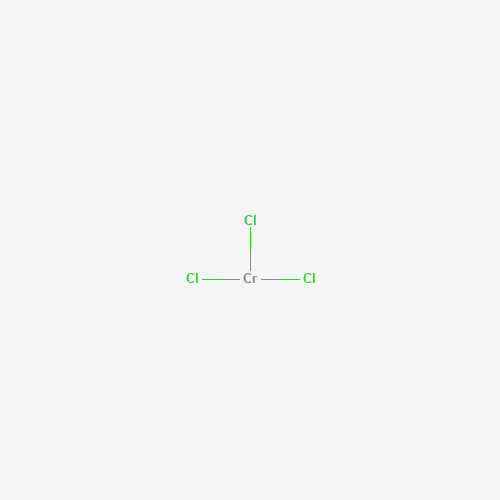
- DOT Label: Corrosive
- First Aid: 6. RUSH to a health care facility. (EPA, 1998)
- Treatment: There is no know antidote for chromium poisoning. Exposure is usually handled with symptomatic treatment. (L16)
- Fire Hazards: Not combustible.
- Fire Fighting: In case of fire in the surroundings, use appropriate extinguishing media.
- Toxicity Data: LC50 (mice) = 31.5 mg/m3/2h
- Eye Prevention: Wear safety goggles.
- Health Effects: Chromium in its trivalent state is not very toxic. It may be oxidized to hexavalent chromium, a known carcinogen. Hexavalent chromium has also been shown to affect reproduction and development. (A12)
- Health Hazards: It displays high dermal toxicity, and moderate oral toxicity. (EPA, 1998)
- OSHA Standards: Permissible Exposure Limit: Table Z-1 8-hr Time Weighted Avg: 0.5 mg/cu m. /Chromium(III) compounds, as Cr/
- Reactive Group: Non-Redox-Active Inorganic Compounds
- Adverse Effects: ACGIH Carcinogen - Not Classifiable.
- Cleanup Methods: If chromium metal or insoluble chromium salts are spilled, the following steps should be taken: 1. Remove all ignition sources where metallic chromium has been spilled. 2. Ventilate area of spill. 3) Collect spilled material in the most convenient and safe manner and deposit in sealed containers for reclamation or for disposal in a secured sanitary landfill. Liquid containing chromium metal or insoluble chromium salts should be absorbed in vermiculite, dry sand, earth, or a similar material. /Chromium metal and insoluble chromium salts/
- Exposure Routes: Oral (L16); inhalation (L16); dermal (L16)
- Hazards Summary: CrIII compounds do not cause chrome ulcerations but may cause allergic dermatitis in workers with prior sensitization to CrVI compounds. [ILO Encyclo] CrIII is an essential trace mineral in the human diet. [ATSDR Case Studies] An eye and respiratory tract irritant; [ICSC] Toxic by ingestion or skin absorption; [CAMEO] See Chromium.
- Inhalation Risk: A harmful concentration of airborne particles can be reached quickly when dispersed.
- Skin Prevention: Protective gloves.
- Toxicity Summary: Trivalent chromium may also form complexes with peptides, proteins, and DNA, resulting in DNA-protein crosslinks, DNA strand breaks, DNA-DNA interstrand crosslinks, chromium-DNA adducts, chromosomal aberrations and alterations in cellular signaling pathways. It has been shown to induce carcinogenesis by overstimulating cellular regulatory pathways and increasing peroxide levels by activating certain mitogen-activated protein kinases. It can also cause transcriptional repression by cross-linking histone deacetylase 1-DNA methyltransferase 1 complexes to CYP1A1 promoter chromatin, inhibiting histone modification. Chromium may increase its own toxicity by modifying metal regulatory transcription factor 1, causing the inhibition of zinc-induced metallothionein transcription. (A12, L16, A34,...
- RCRA Requirements: D007; A solid waste containing chromium may or may not become characterized as a hazardous waste when subjected to the Toxicity Characteristic Leaching Procedure listed in 40 CFR 261.24, and if so characterized, must be managed as a hazardous waste. /Chromium/
- Spillage Disposal: Personal protection: particulate filter respirator adapted to the airborne concentration of the substance. Sweep spilled substance into covered containers. If appropriate, moisten first to prevent dusting.
- First Aid Measures: Ingestion First Aid: Rinse mouth.
- Reactivity Profile: When heated to decomposition, CHROMIC CHLORIDE emits toxic fumes of chlorine containing compounds. Violent reaction with lithium, nitrogen. Incompatible with strong oxidizers. [EPA, 1998].
- Signs and Symptoms: Chromium in its trivalent state is not very toxic, but it may be oxidized to hexavalent chromium. Breathing hexavalent chromium can cause irritation to the lining of the nose, nose ulcers, runny nose, and breathing problems, such as asthma, cough, shortness of breath, or wheezing. Ingestion of hexavalent chromium causes irritation and ulcers in the stomach and small intestine, as well as anemia. Skin contact can cause skin ulcers. (L16)
- Storage Conditions: Keep tightly closed.
- Ecotoxicity Excerpts: /AQUATIC SPECIES/ The influence of humic acid (HA) on the toxicity and bioavailability of two forms of trivalent chromium (chromic chloride and chrome lignosulfonate) was evaluated using a common freshwater invertebrate, Daphnia pulex. With both compounds, the 50 mg/liter HA significantly decreased toxicity at all time points examined. The remaining two HA concentrations, 0.5 and 5 mg/liter, either had no influence or decreased the toxicity of the compounds. Humic acid appeared to have no influence on the bioavailability of chrome lignosulfonate. However, for chromic chloride, 5 and 50 mg/liter HA decreased the percentage free chromium at all time points examined.
- Firefighting Hazards: Hydrogen chloride gas, Chromium oxides
- Ingestion Prevention: Do not eat, drink, or smoke during work.
- Inhalation Prevention: Use local exhaust or breathing protection.
- NIOSH Recommendations: Recommended Exposure Limit: 10-hour Time-Weighted Average: 0.5 mg/cu m. /Chromium(III) compounds (as Cr)/
- Nonfire Spill Response: ELIMINATE all ignition sources (no smoking, flares, sparks or flames) from immediate area. Do not touch damaged containers or spilled material unless wearing appropriate protective clothing. Stop leak if you can do it without risk. Prevent entry into waterways, sewers, basements or confined areas. Absorb or cover with dry earth, sand or other non-combustible material and transfer to containers. DO NOT GET WATER INSIDE CONTAINERS. (ERG, 2024)
- Regulatory Information: New Zealand EPA Inventory of Chemical Status: Chromium chloride: HSNO Approval: HSR004020 Approved with controls
- Air and Water Reactions: The rate of solution for water is extremely slow, pH of 0.2 M. aqueous solution is 2.4.
- Fire Fighting Procedures: Respiratory protection from chromium metal and insoluble chromium salts while fighting fires: self-contained breathing apparatus with a full facepiece operated in pressure-demand or other positive pressure mode. /Chromium metal and insoluble chromium salts/
- Isolation and Evacuation: FIRE: If tank, rail tank car or highway tank is involved in a fire, ISOLATE for 800 meters (1/2 mile) in all directions; also, consider initial evacuation for 800 meters (1/2 mile) in all directions. (ERG, 2024)
- Soil Adsorption/Mobility: In batch soil extractability experiments using chromium (III) chloride at up to 500 ppm over a 16 week period in three soils (Rubikon sand, Morley clay loam and limed Morley clay loam), chromium (III) hydroxide was formed in the soils at pH >4.7. In soils precipitated chromium (III) hydroxide is aged with time resulting in more crystalline forms with lowered solubility. There is strong evidence that organic bound chromium(III) is very low. The exchangeable portion of Cr(III) is also negligible. The water soluble fraction is nearly zero after 2 weeks(1).
- Carcinogen Classification: 3, not classifiable as to its carcinogenicity to humans. (L135)
- Non-Human Toxicity Values: LD50 Rat oral 1870 mg/kg
- EPA Hazardous Waste Number: D007; A waste containing chromium may or may not be characterized as a hazardous waste following testing by the Toxicity Characteristic Leaching Procedure as prescribed by the Resource Conservation and Recovery Act (RCRA) regulations. /Chromium/
- Evidence for Carcinogenicity: Evaluation: There is inadequate evidence in humans for the carcinogenicity of metallic chromium and of chromium(III) compounds. There is inadequate evidence in experimental animals for the carcinogenicity of metallic chromium, barium chromate and chromium(III) compounds. Overall evaluation: Metallic chromium and chromium(III) compounds are not classifiable as to their carcinogenicity to humans (Group 3). /Metallic chromium and chromium(III) compounds/
- Threshold Limit Values (TLV): (as Cr(III), inhalable fraction): 0.003 mg/m
- Hazard Classes and Categories: Hazardous to the aquatic environment (Long-term) - Category 1
- Effects of Short Term Exposure: May cause mechanical irritation to the eyes and respiratory tract.
- Environmental Bioconcentration: Using chromium (III) chloride as the Cr3+ source and mollusc (Mytilus edulis L.) as the aquatic organism in a saltwater, flow-through study over 24 weeks, the BCF for chromium (III) resulting from exposure to 1 mg Cr/L seawater was found to be be 86 (dimensionless) based on wet weight(1).
- State Drinking Water Guidelines: (MN) MINNESOTA 20000 ug/L /Chromium III ion/
- Federal Drinking Water Standards: Maximum contaminant level for inorganic contaminants: Contaminant: Chromium; MCL 0.1 mg/L. /Chromium/
- Permissible Exposure Limit (PEL): 0.5 [mg/m3]
- Protective Action Criteria (PAC): PAC-3: 1.1 [mg/m3]
- Federal Drinking Water Guidelines: Maximum contaminant level goal for inorganic contaminants: Contaminant: Chromium; MCLG 0.1 mg/L. /Chromium/
- Probable Routes of Human Exposure: NIOSH (NOES Survey 1981-1983) has statistically estimated that 3,273 workers (1,706 of these are female) were potentially exposed to chromium (III) chloride in the US(1).
- Occupational Exposure Limits (OEL): MAK (Maximale Arbeitsplatz Konzentration): sensitization of skin (SH)
- Skin, Eye, and Respiratory Irritations: Eczematous dermatitis due to trivalent chromium compounds has been reported. /Trivalent chromium compounds/
- Hazardous Reactivities and Incompatibilities: Avoid moisture.
- Immediately Dangerous to Life or Health (IDLH): 25 mg/cu m (as Cr(III)). /Chromium(III) compounds (as Cr)/
Warm reminder:
Because the manufacturer may temporarily adjust product specifications, prices, inventory, parameters and other information without notice, and there are differences in each user's consultation time and procurement needs, the platform reply content is only of reference value within a certain period. Sorry for the inconvenience caused to you, and thank you for your understanding and support! Please consult the online customer service for the latest details. Everything is subject to the real-time reply of the customer service.!
Please check the quantity, appearance and product information in time when you receive the goods. In case of damage, wrong delivery, abnormal quality and other problems, please feel free to contact us.
Service Hotline:400-6226-992 ,We will handle it for you as soon as possible, thank you for your support and trust.!
Research chemical 25g; ≥99. 99%; metals basis
Research chemical 25g; ≥99. 99%; metals basis; supplied for laboratory research, analysis, inspection, and scientific procurement use; specifications: 25g; ≥99. 99%; metals basis.
25g




