
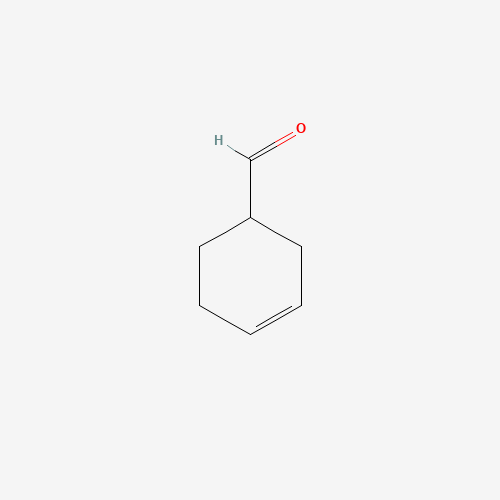
- DOT Label: Flammable Liquid
- First Aid: ERG2024, Guide 129 (1,2,3,6-Tetrahydrobenzaldehyde): In Canada, an Emergency Response Assistance Plan (ERAP) may be required for this product. Please consult the shipping paper and/or the "ERAP" section.
- Fire Hazards: ERG2024, Guide 129 (1,2,3,6-Tetrahydrobenzaldehyde): · Many liquids will float on water.
- Fire Fighting: FIRE INVOLVING TANKS, RAIL TANK CARS OR HIGHWAY TANKS: Fight fire from maximum distance or use unmanned master stream devices or monitor nozzles. Cool containers with flooding quantities of water until well after fire is out. Withdraw immediately in case of rising sound from venting safety devices or discoloration of tank. ALWAYS stay away from tanks in direct contact with flames. For massive fire, use unmanned master stream devices or monitor nozzles; if this is impossible, withdraw from area and let fire burn. (ERG, 2024)
- Toxicity Data: LC50 (rat) = 2,000 ppm/4h
- Health Hazards: ERG2024, Guide 129 (1,2,3,6-Tetrahydrobenzaldehyde): · Runoff from fire control or dilution water may cause environmental contamination.
- Reactive Group: Hydrocarbons, Aliphatic Unsaturated
- Adverse Effects: Dermatotoxin - Skin burns.
- Hazards Summary: A strong tissue irritant; May cause burns to skin and eyes; [CAMEO] An irritant; May cause burns to eyes; [MSDSonline]
- DOT ID and Guide: 2498 129
- Disposal Methods: SRP: At the time of review, criteria for land treatment or burial (sanitary landfill) disposal practices are subject to significant revision. Prior to implementing land disposal of waste residue (including waste sludge), consult with environmental regulatory agencies for guidance on acceptable disposal practices.
- Reactivity Profile: 1,2,3,6-TETRAHYDROBENZALDEHYDE is an aldehyde. Aldehydes are frequently involved in self-condensation or polymerization reactions. These reactions are exothermic; they are often catalyzed by acid. Aldehydes are readily oxidized to give carboxylic acids. Flammable and/or toxic gases are generated by the combination of aldehydes with azo, diazo compounds, dithiocarbamates, nitrides, and strong reducing agents. Aldehydes can react with air to give first peroxo acids, and ultimately carboxylic acids. These autoxidation reactions are activated by light, catalyzed by salts of transition metals, and are autocatalytic (catalyzed by the products of the reaction). The addition of stabilizers (antioxidants) to shipments of aldehydes retards autoxidation.
- Preventive Measures: Personnel protection: Avoid breathing vapors. Keep upwind. Avoid bodily contact with the material. ... Do not handle broken packages unless wearing appropriate personal protective equipment. Wash away any material which may have contacted the body with copious amounts of water or soap and water. If contact with the material anticipated, wear appropriate chemical protective clothing.
- Nonfire Spill Response: LARGE SPILL: Dike far ahead of liquid spill for later disposal. Water spray may reduce vapor, but may not prevent ignition in closed spaces. (ERG, 2024)
- Air and Water Reactions: Flammable. Slightly soluble in water.
- Human Toxicity Excerpts: The mucus membranes of the nasal and oral passages and the upper respiratory tract are affected, producing a burning sensation ... bronchial constriction, choking, and coughing. The eyes tear, and a burning sensation is noted on the skin of the face. /Aldehydes/
- Fire Fighting Procedures: If material on fire or involved in fire: Do not extinguish fire unless flow can be stopped or safely confined. Use water in flooding quantities as fog. Cool all affected containers with flooding quantities of water. Apply water from as far a distance as possible. Solid streams of water may be ineffective. Use "alcohol" foam, dry chemical or carbon dioxide.
- Isolation and Evacuation: Evacuation: ERG2024, Guide 129 (1,2,3,6-Tetrahydrobenzaldehyde): · If tank, rail tank car or highway tank is involved in a fire, ISOLATE for 800 meters (1/2 mile) in all directions; also, consider initial evacuation for 800 meters (1/2 mile) in all directions.
- DOT Hazard Classification: Placard/Label(s)
- NFPA Hazard Classification: NFPA Instability Rating: 0 - Materials that in themselves are normally stable, even under fire conditions.
- Accidental Release Measures: Spill or Leak: ERG2024, Guide 129 (1,2,3,6-Tetrahydrobenzaldehyde): · Water spray may reduce vapor, but may not prevent ignition in closed spaces.
- Non-Human Toxicity Excerpts: Study was conducted to determine if HCHO pretreatment would cause sensory irritation cross tolerance to other inhaled aldehydes. Male F-344 rats, weighing 190 to 210 g, were pretreated with 15 ppm HCHO, 6 hr/day for 9 days, and challenged on the 10th day with a saturated (acetaldehyde, propionaldehyde, and butyraldehyde), unsaturated (acrolein and crotonaldehyde), or cyclic (cyclohexanecarboxaldehyde, 3-cyclohexene-1-carboxaldehyde, and benzaldehyde) aldehyde. The sensory irritation response in these animals was quantified by measuring respiratory rate depression in a head-only inhalation chamber in naive (nonpretreated) animals, the concentration eliciting a 50% decrease in respiratory rate (RD50) was 23 ppm or less for unsaturated aliphatic aldehydes. For cyclic and saturated aliphati...
- Hazard Classes and Categories: Flammable agents - 2nd degree
- Personal Protective Equipment (PPE): Personnel protection: ... Wear appropriate chemical protective gloves, boots, and goggles.
- Shipping Name/ Number DOT/UN/NA/IMO: IMO 3.3; 1,2,3,6-TETRAHYDROBENZALDEHYDE
- Emergency Response Planning Guidelines: Emergency Response: ERG2024, Guide 129 (1,2,3,6-Tetrahydrobenzaldehyde): · For massive fire, use unmanned master stream devices or monitor nozzles; if this is impossible, withdraw from area and let fire burn.
- Skin, Eye, and Respiratory Irritations: The low molecular weight aldehydes, the halogenated aliphatic aldehydes, and the unsaturated aldehydes are particularly irritating. /Aldehydes/
- Exposure Control and Personal Protection: Protective Clothing: ERG2024, Guide 129 (1,2,3,6-Tetrahydrobenzaldehyde): · Structural firefighters' protective clothing provides thermal protection but only limited chemical protection.
Warm reminder:
Because the manufacturer may temporarily adjust product specifications, prices, inventory, parameters and other information without notice, and there are differences in each user's consultation time and procurement needs, the platform reply content is only of reference value within a certain period. Sorry for the inconvenience caused to you, and thank you for your understanding and support! Please consult the online customer service for the latest details. Everything is subject to the real-time reply of the customer service.!
Please check the quantity, appearance and product information in time when you receive the goods. In case of damage, wrong delivery, abnormal quality and other problems, please feel free to contact us.
Service Hotline:400-6226-992 ,We will handle it for you as soon as possible, thank you for your support and trust.!
3-cyclohexylenemethylaldehyde 98% 25/ml
3-cyclohexylenemethylaldehyde 98% 25/ml Macklin 100-50-5, available in complete specifications for production, research, laboratory testing and inspection; digital one-stop procurement platform for scientific materials